What Does an AI Receptionist for a Law Firm Actually Do?
An AI receptionist for a law firm answers the intake calls the firm would otherwise miss. It tells the caller which matters the firm handles and books a consultation. It gives the address and hours, and states fees exactly as the firm lists them.
It does not give legal advice, predict outcomes or negotiate fees; those calls go to a lawyer.
The gap it fills is large. In Clio's 2024 secret-shopper study, only 40% of law firms answered the phone, down from 56% in 2019, and 48% were "essentially unreachable by phone". Each unanswered call is a prospective client who moves to the next listing.
Aibrify Desk is one such AI receptionist, built for firms in the US that take calls in English, Mandarin and Spanish. The firm keeps its number, forwards calls to Desk, and gets each call's summary in Chinese or English.
Forwarding can cover all calls or only the ones nobody picks up. The law firm setup is described on desk.aibrify.com/for/law-firms.
Why Do Law Firms Miss So Many Intake Calls?
Law firms miss calls because the people who could answer are in court, in depositions or on another line. A solo practice has no second person. Clio measured the result twice, five years apart, and the numbers got worse.
| Measure (Clio secret-shopper studies) | 2019 | 2024 |
|---|---|---|
| Firms that answered the phone | 56% | 40% |
| Firms that responded to an email inquiry | 40% | 33% |
| Firms unreachable by phone | not reported | 48% |
| Firms that offered rate information on the phone | not reported | 41% |
| Shoppers unlikely to recommend the firms they contacted | not reported | 73% |
The 2024 study emailed 500 firms; the 2019 study contacted 1,000 firms by email and phone. In the 2019 consumer survey that went with it, 79% of legal consumers expected a response within 24 hours, and 82% said timeliness was important.
Callers reward a live answer. In the same 2024 study, 39% of shoppers said they would recommend firms they spoke with directly. That compares with 73% of all shoppers who were unlikely to recommend the firms they contacted.
Clio also found that firms using online intake tools had 50% more incoming potential clients on average.
Solo and small firms are already looking at this category. Clio's May 2025 report found that only 8% of solo practitioners and 4% of small law firms have adopted AI widely. Many, it notes, are "strategically experimenting with document automation and virtual receptionist services".
What Should the AI Answer, and What Must It Pass to a Lawyer?
The AI receptionist answers questions whose answer is already written down by the firm, and passes everything that requires judgment about a specific person's situation. The dividing line is simple: facts about the firm are fine, opinions about the caller's case are not.
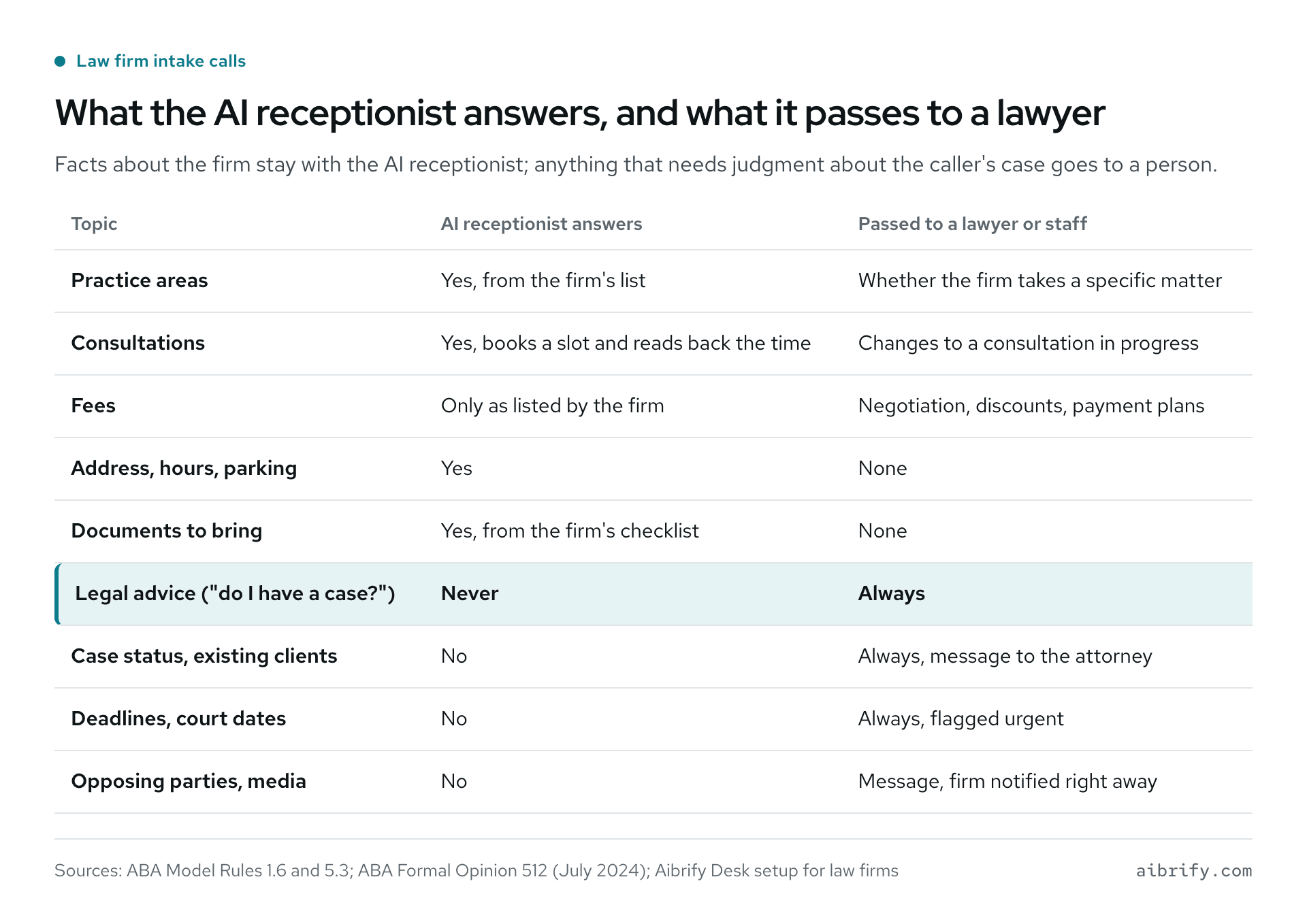
The chart and the table below show the same split.
| Topic | AI receptionist answers | Passed to a lawyer or staff |
|---|---|---|
| Practice areas | Yes, from the firm's list ("the firm handles family law and estate planning") | Whether a specific matter is one the firm will take |
| Consultations | Yes, books a slot in the booking calendar and reads back the time | Changes to a consultation already in progress |
| Fees | Yes, only as listed ("the consultation fee is $150 for 30 minutes") | Any negotiation, discount request or payment plan |
| Address, hours, parking | Yes | None |
| Documents to bring | Yes, from the firm's checklist | None |
| Legal advice ("do I have a case?") | No, never | Always |
| Case status for existing clients | No | Always, by message to the handling attorney |
| Deadlines, court dates, statutes of limitation | No | Always, flagged as urgent |
| Opposing parties, media, process servers | No | Takes a message, notifies the firm right away |
| Anything the caller marks as confidential | Takes minimal details | Always |
Two rules make this work in practice. First, the owner writes the list of "topics Desk won't answer": fees beyond the listed figures, complaints, refunds, case outcomes, legal advice.
Desk transfers those calls to the firm's phone, or takes the details and notifies the firm immediately. Second, when the AI receptionist is unsure, it does the same rather than guessing.
What counts as legal advice on a phone call?
Any sentence that applies law to the caller's facts is legal advice. Examples: "that sounds like negligence", "you probably have two years to file", "the landlord can't do that". The AI receptionist is set to say instead that the attorney will review the facts in a consultation.
It can still collect the facts needed for that consultation: names, dates, the county, and whether another lawyer is already involved.
Conflict checks and intake forms
A receptionist, human or AI, can collect the names of the parties so the firm can run a conflict check before the consultation. It should not confirm or deny a conflict on the call.
Smith.ai, a live receptionist service, prices this step separately at $0.50 per call for conflict checks. That shows how standard the step is in legal intake.
What Does a Sample Intake Call Sound Like?
A good intake call takes three to four minutes. The AI receptionist discloses what it is, learns the type of matter, books the consultation and reads everything back. The script below is a sample for a personal injury firm, not a recording of a real call.
AI receptionist: Thank you for calling the firm. I'm an AI assistant, and this call is transcribed so the attorney can review it. How can I help you today?
Caller: I was rear-ended last Tuesday on the 405. The other driver's insurance keeps calling me. Do I have a case?
AI receptionist: I'm sorry that happened. I can't say whether you have a case; the attorney reviews that in a consultation. The firm does handle car accident injury matters. May I book you a consultation?
Caller: Is it free?
AI receptionist: The firm lists the initial consultation as free, thirty minutes, by phone or in the office. Would Thursday at 10 a.m. or Friday at 2 p.m. work better?
Caller: Thursday. Should I talk to the insurance adjuster before then?
AI receptionist: That's a question for the attorney, and I'll note it so it's the first thing covered Thursday. May I have your full name, a callback number, and the date of the accident?
Caller: Maria Delgado, the 29th. Can we do this in Spanish?
AI receptionist (in Spanish): Of course. Your consultation is Thursday at 10 a.m. with the attorney. The firm asks that you bring the police report and any letters from the insurer. You'll get a text confirmation once texting is set up for the firm, and the attorney will have the notes from this call.
After the call, the firm receives a summary. It lists the matter type, accident date, the booked slot, the caller's preferred language, and the adjuster question flagged for the attorney. The caller's "do I have a case" question was heard, acknowledged and passed, not answered.
Note what the AI receptionist did not do. It did not estimate the claim's value, did not comment on the adjuster, and quoted no fee beyond the one the firm lists. Those are the lines that keep the call on the right side of the rules in the next section.
How Do Confidentiality and Disclosure Work?
The AI receptionist is a nonlawyer assistant under the firm's supervision, so the same rules apply as to a human answering service. The lawyer is responsible for how it behaves. Three documents set the frame.
Rule 1.6. A lawyer "shall not reveal information relating to the representation of a client unless the client gives informed consent" (ABA Rule 1.6). Paragraph (c) adds a duty to "make reasonable efforts to prevent the inadvertent or unauthorized disclosure of, or unauthorized access to" that information.
Rule 5.3. It covers a nonlawyer "employed or retained by or associated with a lawyer" (ABA Rule 5.3). The supervising lawyer "shall make reasonable efforts to ensure that the person's conduct is compatible with the professional obligations of the lawyer". A phone service that books consultations is the kind of retained help the rule covers.
Opinion 512. The ABA's first guidance on generative AI, issued July 29, 2024, points lawyers to Rules 1.1, 1.4, 1.5 and 1.6 (ABA news). On confidentiality, it says the lawyer "must be cognizant of the duty to keep confidential all information relating to the representation of a client". That duty holds "regardless of its source, unless the client gives informed consent".
What this means for the phone
Three practical consequences follow for a firm choosing an AI receptionist:
- Say what it is, every call. Desk opens each call by saying it is an AI assistant and that the call is transcribed. The caller knows before saying anything substantive.
- Keep the record small. Desk keeps a transcript and sends the summary; it does not keep audio. The firm decides who receives the summary (email or Slack) and in which language.
- Limit what is collected. A prospective client's intake call needs the matter type, names for a conflict check, contact details and a time. Detailed facts belong in the consultation with the lawyer, not in a phone transcript.
Most states have adopted some version of these ABA rules, and several state bars have issued their own AI opinions since 2023. Check the current guidance from the bar where the firm is admitted; a receptionist vendor cannot do that for you.
Custom setup for careful practices
Firms with higher stakes, such as criminal defense, immigration or family law, can go custom: more material for the AI receptionist to work from and stricter limits on what it will say, priced to fit.
A typical stricter setup blocks any discussion of facts and takes only a name, number and matter type. Every existing-client call transfers straight to the firm. The same custom route exists for clinics and other fields where the default limits are too loose.
Can It Take Calls From Spanish- and Mandarin-Speaking Clients?
Yes. Desk answers in English, Mandarin and Spanish, detects the caller's language, and sends the firm its summary in Chinese or English. Cantonese is not supported.
In the Census Bureau's 2018 to 2022 American Community Survey, 78.3% of people age 5 and older spoke only English at home. Among the rest, Spanish was 61.1% and Chinese (all dialects) 5.1%. Among those speakers, only 61.0% of Spanish speakers and 48.2% of Chinese speakers spoke English "very well".
For a firm in Los Angeles, Houston, the San Gabriel Valley or Flushing, that is a large share of callers. Many would rather explain an accident or an immigration question in their first language. A firm with one bilingual paralegal cannot cover that line from 9 to 5, let alone evenings.
For the language side in more depth, see the guide to Chinese bilingual AI receptionists and the Spanish page on desk.aibrify.com.
Two cautions apply to any language. The AI receptionist should still not translate legal advice; the limits are the same in Spanish and Mandarin as in English. And the summary the lawyer reads is in Chinese or English, so a firm whose attorneys read neither language should ask for the English summary.
How Much Does an AI Receptionist for a Law Firm Cost?
Aibrify Desk costs $179 a month with 400 minutes included, $0.30 for each extra minute, setup included, month to month with no contract. Live receptionist services built for lawyers charge by the call or by the minute. Their published plans run from $250 to over $2,000 a month.
| Option (as of October 2026) | Monthly price | What's included | Source |
|---|---|---|---|
| Aibrify Desk, AI receptionist | $179 | 400 minutes; $0.30 per extra minute; English, Mandarin, Spanish; setup included; no contract | desk.aibrify.com |
| Smith.ai live receptionists, Starter | $300 | 30 calls; $11.50 per call over 30; conflict checks $0.50 per call | Smith.ai pricing |
| Smith.ai, Basic | $810 | 90 calls; $10.50 per call over 90 | Smith.ai pricing |
| Smith.ai, Pro | $2,100 | 300 calls; $8.50 per call over 300 | Smith.ai pricing |
| Ruby virtual receptionists, 50 minutes | $250 | 50 receptionist minutes | Ruby pricing |
| Ruby, 100 minutes | $395 | 100 receptionist minutes | Ruby pricing |
| Ruby, 200 minutes | $720 | 200 receptionist minutes | Ruby pricing |
| Ruby, 500 minutes | $1,725 | 500 receptionist minutes | Ruby pricing |
| In-house receptionist, wages only | $3,168 | Median $38,010 a year, May 2025, divided by 12; before benefits and payroll tax | BLS |
Ruby's pricing page does not list a per-minute overage rate, so treat its plans as "price on request" above the included minutes. Smith.ai's page notes no setup fees and a 30-day money-back guarantee.
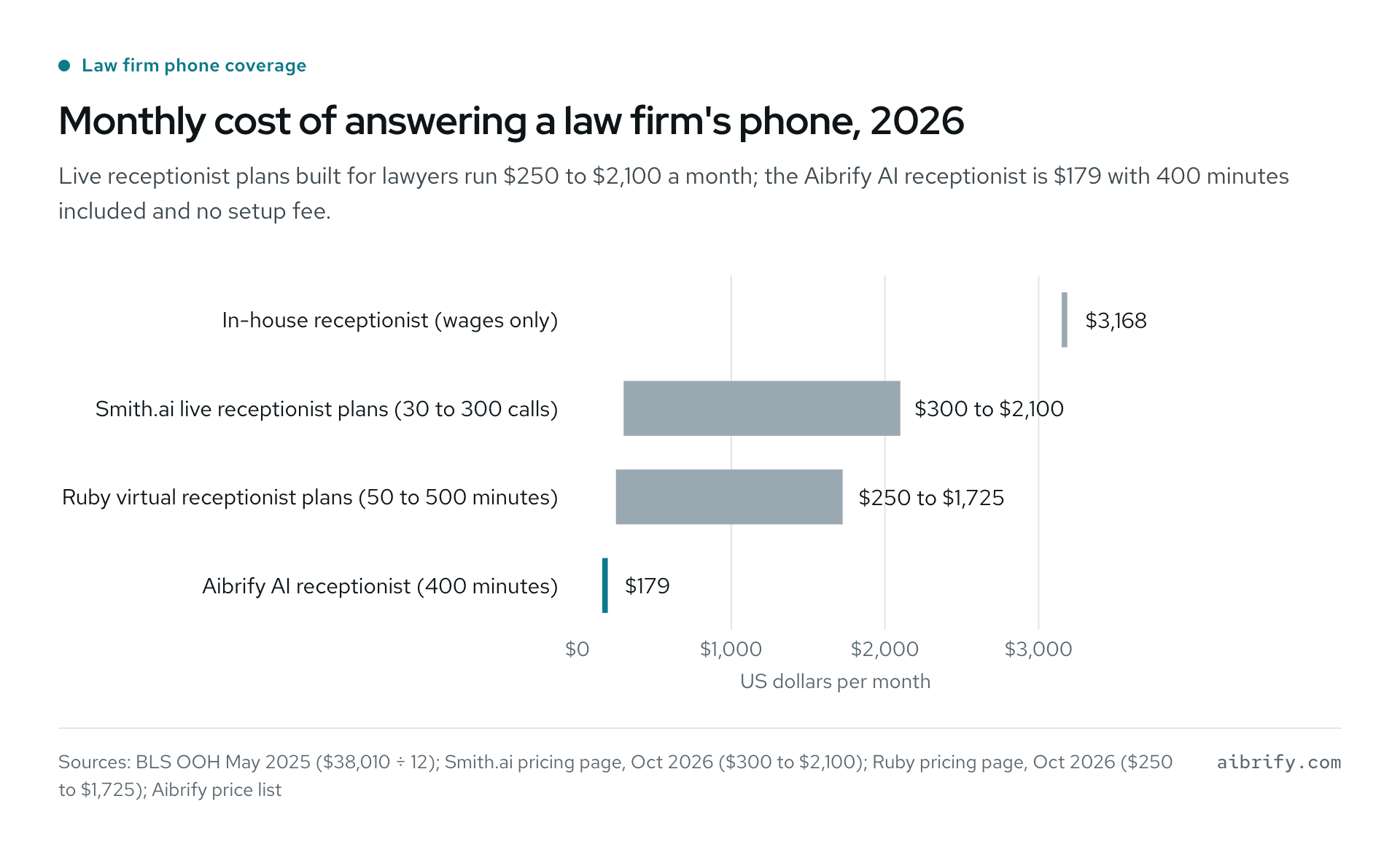
Same figures as the table above, side by side.
| Option | Low (per month) | High (per month) |
|---|---|---|
| In-house receptionist, wages only | $3,168 | $3,168 |
| Smith.ai live receptionist plans | $300 | $2,100 |
| Ruby virtual receptionist plans | $250 | $1,725 |
| Aibrify Desk AI receptionist | $179 | $179 |
How the minutes compare
Four hundred minutes is 100 four-minute intake calls, or 133 three-minute ones. Ruby's 500-minute plan, the only one with more minutes than Desk's included 400, is $1,725. Smith.ai's 90-call plan at $810 covers a similar call count to Desk at about four and a half times the price.
The live services do things an AI receptionist does not, and a firm with complex intake may want a human on the line. The trade-off between the two is covered in AI receptionist vs human receptionist. The full price breakdown of the category is in what an AI receptionist costs.
What one caught consultation is worth
Clio's 2025 solo and small firm report found that solo firms using digital intake tools reported 53% higher revenue and 48% more client leads than those without. A firm does not need that much lift to cover $179 a month: one booked consultation that turns into a retained matter usually does it.
How Do You Set Up an AI Receptionist at a Law Firm?
Setup is a short list of decisions the firm makes once, then a forwarding change on the phone line. Here are the steps for Desk.
- Step 1. Write down what the AI receptionist may say. Practice areas, consultation length and the fee as listed, address, hours, parking, and documents to bring. Also what happens after a consultation is booked.
- Step 2. Write the "won't answer" list. Legal advice, case outcomes, fee negotiation, case status for existing clients, deadlines, and anything from opposing parties or the press. Desk passes each of these to a person.
- Step 3. Pick the transfer rule. Transfer to the attorney's cell during office hours and take a message after hours, or take a message always. Decide who gets the summary (email or Slack) and in which language, Chinese or English.
- Step 4. Set the booking calendar. Consultation slots, length, and buffer time. Desk books into its own booking calendar; the firm checks it like any other calendar.
- Step 5. Call the demo line. Hear the opening disclosure and test the limits with the questions your callers actually ask; the demo line is on desk.aibrify.com.
- Step 6. Forward the number. You keep your number. Set forwarding on the existing line, either for all calls or only when nobody answers, and Desk takes the forwarded calls.
- Step 7. Review the first week of summaries. Tighten the "won't answer" list where the AI receptionist said too much. Add material where it had to pass a question that was really about hours or the address.
For criminal defense, immigration and family practices, ask for the custom setup with stricter limits when you start. Details and the law firm examples are on desk.aibrify.com/for/law-firms.
Frequently Asked Questions
Can an AI receptionist give legal advice?
No, an AI receptionist for a law firm answers facts about the firm, such as practice areas, listed fees, address and hours, and books consultations. Any question that applies law to a caller's situation, including "do I have a case", goes to a lawyer. The firm writes the list of topics the receptionist must not answer, and it transfers or takes a message for each one.
Does using an AI receptionist violate attorney-client confidentiality?
Not by itself, but the firm stays responsible: ABA Model Rule 5.3 requires lawyers to supervise nonlawyer assistance. ABA Formal Opinion 512 (July 2024) says lawyers using generative AI keep the full Rule 1.6 duty of confidentiality. A phone service that discloses it is an AI, keeps a transcript but no audio, and collects only intake basics fits inside those rules.
Does the caller know they are talking to an AI?
Yes, Aibrify Desk opens every call by saying it is an AI assistant and that the call is transcribed. The caller hears this before giving any details, and no audio recording is kept. The firm receives a written summary by email or Slack in Chinese or English, plus a weekly summary and a monthly report.
Can the AI receptionist quote my fees?
Only the fees the firm lists, word for word: for example, a free 30-minute consultation or a $150 flat consultation fee. The AI receptionist does not estimate the cost of a matter, offer discounts or discuss payment plans. Fee negotiation is on the "won't answer" list and goes to a lawyer or staff member.
What happens when a current client calls about their case?
The AI receptionist does not discuss case status; it takes the client's name, callback number and a short message, then notifies the firm right away. If the firm chose transfer instead, the call goes to the attorney's phone. Deadlines and court-date questions are flagged as urgent in the summary.
How much does an AI receptionist for a law firm cost compared with a live service?
Aibrify Desk is $179 a month with 400 minutes included and $0.30 per extra minute, no contract. As of October 2026, Smith.ai's live receptionist plans run from $300 a month for 30 calls to $2,100 for 300 calls. Ruby's plans run from $250 for 50 minutes to $1,725 for 500 minutes, and a median in-house receptionist earns $38,010 a year before benefits.
Can it answer in Spanish or Mandarin?
Yes, Aibrify Desk answers in English, Mandarin and Spanish and detects the caller's language on the call; Cantonese is not supported. The limits on legal advice and fees are the same in every language. The lawyer receives the written summary in Chinese or English, whichever the firm chooses.
Does the firm have to change its phone number?
No, the firm keeps its number and sets up call forwarding on the existing line, for all calls or only for calls nobody answers. Aibrify Desk answers the forwarded calls, books consultations into its own booking calendar, and sends the summary after each call. Setup is included in the $179 monthly price.