What Does an AI Receptionist for Veterinary Clinics Actually Do?
An AI receptionist for a veterinary clinic answers the phone when the front desk cannot. It books wellness and routine visits, answers questions about hours, address, species seen and payment types, and takes messages. It gives no medical advice: symptoms, dosing, emergencies, prices and test results go to a person at the clinic.
The gap it fills is real. In early 2025, researchers phoned more than 5,000 randomly selected veterinary practices in six states. They secured an appointment only 67% of the time (Ohio State University, October 2025).
When a call failed, the usual reason was that nobody could be reached. The other common reason: the caller sat on hold for more than five minutes.
Aibrify Desk answers forwarded calls in English, Mandarin and Spanish, books into its own calendar and sends the clinic a summary after every call. Each call opens with a disclosure: the voice is an AI assistant, the call is transcribed, and no audio is kept.
Veterinary clinics are a careful field. So Desk is configured the way the medical offices page describes. That means a custom setup: more material to work from, and stricter limits on what the phone may say.
Why Are Veterinary Front Desks So Overloaded?
More pets, more routine visits and a support team that is hard to keep. Each of those trends has a number behind it.
The AVMA's 2024 pet demographic report counted 89.7 million dogs and 73.8 million cats in the US (Global Pet Industry, October 2024). Dogs live in 45.5% of US households and cats in 32.1%. In the same report, 74.2% of dog owners and 57.3% of cat owners said they visited a clinic that year.
Routine checkups made up nearly 80% of those visits. Routine visits are phone-heavy visits. A wellness exam starts with a call to book, often a call to confirm, and sometimes a call to move it.
Those are exactly the calls that stack up at 10 a.m. on a Monday.
The staffing side
The people who answer those calls are in short supply. The Bureau of Labor Statistics counts 131,400 veterinary technologist and technician jobs in 2025 (BLS Occupational Outlook Handbook). It projects 9% growth from 2025 to 2035, with about 13,400 openings a year.
Veterinarians themselves are projected to grow at the same 9% rate (BLS). Demand for people is rising faster than the people arrive.
Growth is not the only problem; retention is. In NAVTA's 2024 demographic survey, only 8% of veterinary technicians were "extremely satisfied" with their jobs, down from 25% in 2022 (NAVTA, April 2025). In the same survey, 39% named low pay as their most significant challenge and 88% had experienced compassion fatigue.
When a technician leaves, the front desk often absorbs the overflow. Phones ring longer, and callers hang up.
What happens to the calls
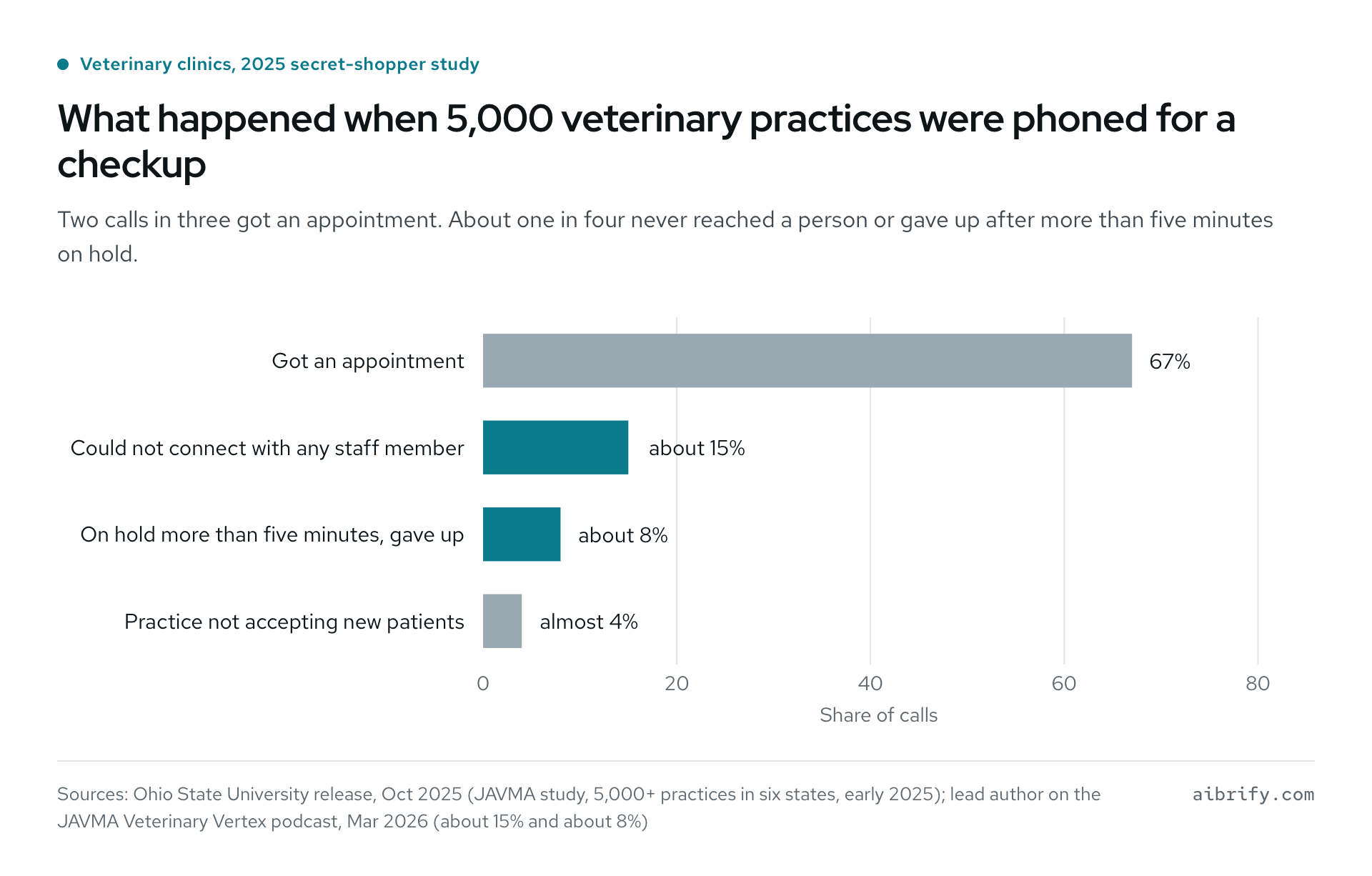
The chart shows what happened when the Ohio State team phoned more than 5,000 practices as new dog owners asking for a first available checkup.
| Outcome of the call | Share of calls |
|---|---|
| Got an appointment | 67% |
| Could not connect with any staff member | about 15% |
| On hold for more than five minutes, then gave up | about 8% |
| Practice not accepting new patients | almost 4% |
The 67% and 4% figures come from the Ohio State release. The 15% and 8% figures were given by the lead author on the JAVMA Veterinary Vertex podcast in March 2026 (episode page). Rural practices did worse: under 62% success and an average wait of 8.6 days.
One more data point, with a caveat. A November 2025 column in Today's Veterinary Business cited vendor data on "small and medium veterinary clinics" (Today's Veterinary Business). In that data, 25% to 30% of calls go unanswered, and 85% of those callers never call back.
The column does not publish a sample size. Treat those two numbers as a vendor estimate rather than a study.
What Does the AI Receptionist Answer, and What Does It Pass to Your Team?
The split is simple: logistics are answered, medicine is passed. Everything on the right-hand side of the table reaches a person at the clinic by transfer or by immediate message.
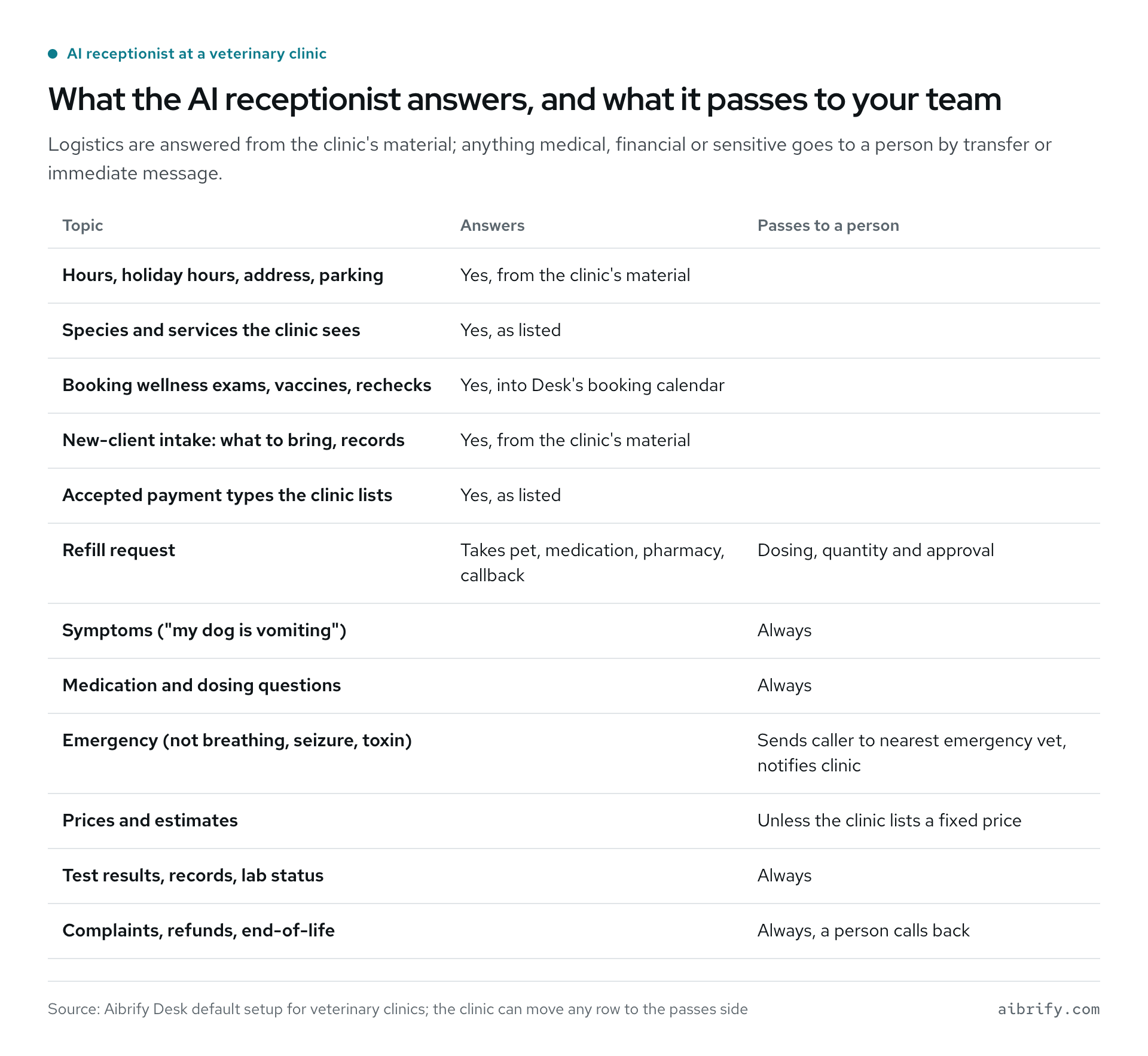
Default split; the clinic can move any row.
| Topic | AI receptionist answers | AI receptionist passes to a person |
|---|---|---|
| Hours, holiday hours, address, parking | Yes, from the clinic's material | |
| Species and services the clinic sees | Yes, as listed (dogs, cats, exotics, boarding, grooming) | |
| Booking wellness exams, vaccines, routine rechecks | Yes, into Desk's booking calendar | |
| New-client intake: what to bring, records to send | Yes, from the clinic's material | |
| Accepted payment types, financing options the clinic lists | Yes, as listed | |
| Refill request: pet name, medication, pharmacy, callback number | Takes the details only | Dosing, quantity and approval go to the team |
| "My dog is vomiting, what should I do?" | Yes: symptoms are never answered | |
| Medication and dosing questions | Yes, always | |
| Emergency: not breathing, seizure, hit by car, toxin | Yes: directs the caller to the nearest emergency vet and notifies the clinic | |
| Prices and estimates | Yes, unless the clinic lists a fixed price | |
| Test results, records, lab status | Yes, always | |
| Complaints, refunds, billing disputes | Yes, always | |
| End-of-life and euthanasia conversations | Yes: a person calls back |
Refill requests deserve a word. The AI receptionist takes the pet's name, the medication name as the owner says it, the pharmacy and a callback number. It never confirms a dose, never says a refill is approved, and never reads anything from a chart.
A technician or veterinarian sees the request in the summary and decides. When the AI receptionist is unsure about anything else, it transfers the call to the clinic's phone. Or it takes the details and sends the clinic a message right away.
What Does a Veterinary Clinic Call Sound Like?
A typical booking call lasts two to three minutes and ends with a confirmed slot or a clean handoff. The exchange below is a composed example, not a recording.
Desk: Thank you for calling Westside Animal Hospital. I'm an AI assistant and this call is transcribed. How can I help?
Caller: Hi, I need to book a yearly checkup for my dog, Milo. He's due for his rabies shot too.
Desk: I can book that. Is Milo an existing patient at Westside?
Caller: Yes.
Desk: Thanks. That visit takes 30 minutes. I have Thursday at 10:30 a.m. or Friday at 2:15 p.m. Which works better?
Caller: Friday.
Desk: Done: Milo's wellness exam and rabies vaccine, Friday afternoon at 2:15. May I have your name and the best number to confirm?
Caller: Dana Reyes. Also, he's been scratching his ear a lot. Should I put something on it?
Desk: I can't advise on symptoms, but I'll note the ear scratching so the team sees it before Friday. If it gets worse before then, please call the clinic directly and a person will help. Anything else?
Caller: No, that's it.
Desk: You're all set. The team will get a summary of this call now. Have a good day.
Notice what the AI receptionist did not do. It did not suggest an ear cleaner, did not say whether scratching is normal, and did not promise the vet would call. It booked the slot, recorded the symptom in the summary and told the caller how to reach a person.
The clinic sees that summary by email or Slack within moments of the hangup. On Monday a weekly summary arrives; at month end, a report. Text alerts start once carrier texting registration is approved.
How Should an AI Receptionist Handle Veterinary Emergencies?
With a script the clinic wrote, no triage, and an immediate notification. The AI receptionist is not a nurse line. Its job in an emergency is to get the caller to the right place fast and to tell the clinic.
The rules Desk follows at a veterinary clinic:
- The clinic defines the trigger words. Examples: not breathing, seizure, hit by a car, bloated abdomen, collapsed, ate something toxic, heavy bleeding. The list is the clinic's, and the clinic can add to it.
- No triage, ever. The AI receptionist does not ask "how long has this been going on" to decide severity. Any trigger word moves the call to the emergency path.
- During open hours, transfer first. The call is transferred to the clinic's line. If no one picks up, the AI receptionist reads the emergency script.
- After hours: script, then notify. The script says this may be an emergency and sends the caller to the nearest emergency veterinary hospital now. Desk then reads out the clinic's chosen emergency hospital and its address, and notifies the clinic right away.
- Poisoning follows the same path. The caller is sent to emergency care. The AI receptionist does not suggest inducing vomiting or any home step.
- Nothing is prescribed and no dose is quoted, even if the owner says the medication is already in the house.
- Every emergency call is flagged in the summary so the clinic can call the owner back and review the handling.
Those rules are why veterinary clinics go on the custom setup described on the medical offices page. The clinic supplies more material: the emergency hospital it refers to, the species it treats, its refill policy, its new-client policy. Desk gets tighter limits in return: no symptom talk, no dosing, no prices unless listed.
After-hours volume is where the rules matter most. The pattern for clinics generally is covered in why clinics miss calls after hours; a veterinary clinic adds the emergency path on top.
What Does an AI Receptionist Cost Compared With a Veterinary Answering Service?
Aibrify Desk is $179 a month with 400 minutes included, $0.30 for each extra minute, setup included, month to month. Human answering services sell minutes in smaller bundles at a higher rate. Veterinary-specific services with credentialed technicians do not publish prices.
Prices below were read from each vendor's own pricing page on 2026-10-07, so "as of October 2026" applies to every row.
| Option | Monthly price | What the price includes | Extra minutes |
|---|---|---|---|
| In-house receptionist | about $3,168 in wages alone | One person, one shift; the median receptionist wage is $38,010 a year (BLS, May 2025) | Overtime |
| PATLive live answering | $99 to $759 | 50 to 500 minutes, 24/7 agents, no contract | $2.29 down to $1.79 a minute |
| Specialty Answering Service | $159 to $649 | 100 to 500 minutes, no setup fee | $1.44 down to $1.34 a minute |
| Ruby virtual receptionist | $250 to $1,725 | 50 to 500 minutes, Spanish included | Not listed on the pricing page |
| GuardianVets | Price on request | 24/7 credentialed veterinary technicians, after-hours triage | Price on request |
| PupPilot | Price on request | AI front office "sized to your clinic", unlimited calling | Price on request |
| Aibrify Desk | $179 | 400 minutes, English, Mandarin and Spanish, booking, summaries, setup included | $0.30 a minute |
A note on the human services: minute bundles run out fast at a veterinary clinic. A 500-minute plan at $1.79 a minute overage means a busy month can double the bill.
Per-minute pricing across the whole category is broken down in what an AI receptionist costs. The human-versus-AI trade-offs are in AI receptionist vs answering service.
The veterinary-specific services are a different product. GuardianVets puts a credentialed technician on the line to triage after hours, which an AI receptionist does not do.
If after-hours triage is the need, that is the right category. If the need is answering and booking without medical talk, the AI receptionist is the cheaper option.
What 400 minutes covers
At three minutes a call, 400 minutes is about 130 answered calls a month. That is roughly six a day over a 22-day month, which fits a clinic that forwards only unanswered and after-hours calls. A clinic forwarding every call will use more minutes and pay $0.30 for each.
How Do You Set Up an AI Receptionist at a Veterinary Clinic?
The setup is a list of documents and decisions, not a software project. Your clinic keeps its number: you forward calls to Desk (no-answer or all calls) and Desk answers them. The summary then arrives in Chinese or English.
- Gather the material. Hours, holiday closures, address and parking, species seen, services offered, and the new-client policy. Add what to bring, accepted payment types and any financing option the clinic lists.
- Write the "won't answer" list. Symptoms, dosing, prices, test results, complaints, refunds, end-of-life. Desk passes each of these to a person instead of answering.
- Name the emergency hospital. The nearest emergency veterinary hospital the clinic refers to, with its address, and the trigger words that send a call there.
- Set the refill policy. What details to collect and which pharmacies the clinic works with. Also the message to read, such as "the team will review and call you back".
- Define the appointment types. Wellness exam, vaccine visit, recheck, nail trim, new-client exam, with the length of each and the days they are offered.
- Choose the forwarding rule. No-answer forwarding after a set number of rings, after-hours forwarding, or all calls.
- Pick the languages. English, Mandarin and Spanish are available; the clinic picks which to offer and in which order the greeting runs.
- Test with staff calls. Have two team members call as a new client, a refill request and an emergency, then read the summaries. You can hear the format first by calling the demo line on desk.aibrify.com.
- Go live and review on Mondays. The weekly summary shows which calls were transferred and why. Tighten the material where callers asked something it did not cover.
Clinics that run a practice management system keep using it. Desk books into its own calendar, and the front desk copies confirmed visits into the clinic's system from the summary. There is no integration to install.
Do Spanish-Speaking and Mandarin-Speaking Pet Owners Change the Setup?
Yes, in the greeting and in who gets the summary; the limits stay the same in every language. An estimated 36% to 38% of US Latino individuals own a pet (dvm360, October 2024). Within that group, about 6 million are Spanish speakers who speak English less than very well.
The same article cites practice surveys in which only 8% of practices had personnel fluent in spoken Spanish. In those surveys, 12% of pet owners said they would seek another clinic when no Spanish speaker was available. That is a caller a clinic loses before the first visit.
With Desk, the AI receptionist answers in the language the caller uses, in English, Mandarin or Spanish. Cantonese is not supported. The clinic owner reads the summary in Chinese or English, whichever they chose at setup.
The Spanish setup is described on the Spanish page; the Mandarin side is covered in the bilingual receptionist guide. The medical limits do not relax by language. A Spanish-speaking caller describing vomiting is passed to a person the same way an English-speaking caller is.
Is It Right for Your Clinic?
It fits a clinic whose front desk misses booking calls at peak hours and after closing. It also requires a team that is clear the phone gives no medical advice. It does not fit a clinic that wants after-hours triage by a technician; that is a different service at a different price.
The two things to decide before signing up are the emergency script and the "won't answer" list. With those written, the rest is material. If your clinic's rules need to be stricter than the defaults, start from the medical offices setup and ask for the custom version.
Related guides in this series cover AI receptionist vs human receptionist and the cost question in detail.
Frequently Asked Questions
Can an AI receptionist give medical advice about my pet?
No. An AI receptionist at a veterinary clinic answers logistics only: hours, address, services, booking and payment types. Questions about symptoms, medication, dosing or how serious a condition is go to a technician or veterinarian, with the details in the call summary.
What happens when a caller describes an emergency after hours?
The AI receptionist reads the clinic's emergency script and tells the caller to head to the closest emergency veterinary hospital now. It names the hospital the clinic chose and gives its address, and the clinic gets an immediate notification. No triage questions are asked and no home treatment is suggested at any point.
Can an AI receptionist handle prescription refill requests?
It takes the request, not the decision: the pet's name, the medication as the owner says it, the pharmacy and a callback number. The caller is told the team will review it. Dosing, quantity and approval stay with the veterinary team, who see the request in the summary after the call.
Does it integrate with veterinary practice management software?
No integration is claimed or required. Aibrify Desk books appointments into its own booking calendar and sends a summary after each call by email or Slack. The front desk enters confirmed visits into the clinic's own system from that summary, so clinics keep whatever practice software they already use.
How much does an AI receptionist for a veterinary clinic cost?
Aibrify Desk costs $179 a month; 400 minutes are included, extra minutes are $0.30 each, setup is included and there is no contract. Human answering services read on 2026-10-07 ranged from $99 for 50 minutes to $1,725 for 500 minutes a month. Veterinary-specific triage services such as GuardianVets quote prices on request.
Does the AI receptionist speak Spanish and Mandarin?
Yes, Aibrify Desk answers in English, Mandarin and Spanish, in the language the caller uses; Cantonese is not supported. The medical limits are identical in every language, so symptoms, dosing and emergencies are passed to a person. The clinic owner receives each call summary in Chinese or English, whichever was chosen at setup.
Do I have to change my clinic's phone number?
No. The clinic keeps its number and sets up call forwarding: unanswered calls after a set number of rings, after-hours calls, or all calls. Desk answers the forwarded calls, and removing the forwarding rule returns the line to the front desk with nothing else to undo.
How is a veterinary clinic set up differently from a retail business?
A veterinary clinic gets the medical-office custom setup: more material for the AI receptionist and stricter rules on what it may say. The clinic supplies its emergency hospital, species, refill policy and new-client policy. In return, symptoms, dosing and prices are always passed to a person rather than answered.