


What Does an AI Receptionist Do for a Restaurant?
An AI receptionist for restaurants, sometimes called a virtual receptionist, answers the phone when the staff cannot. It takes orders, books tables, answers menu and hours questions, and transfers the rest to a person. Quick-service restaurants miss 40 percent of their calls, according to the State of Restaurant Calls 2026 report, which analyzed 12,091 recorded calls.
The report comes from Revmo, which sells an automated answering product. HungerRush estimates that about 60 percent of unanswered calls were orders. The receptionist's job is to catch the calls the staff cannot.
Aibrify builds and runs an AI receptionist for restaurants that answers in English and Mandarin, day and night. The plan is $149 a month with 400 minutes included and no setup fee.
It transfers to a person when it is unsure and texts the owner a summary of every call. The owner also gets a monthly report of the calls it answered.
How Many Calls Do Restaurants Actually Miss?
Restaurants miss between 9 and 40 percent of calls depending on the segment, and the misses cluster at the exact moments the kitchen is busiest.
The 2026 report from Revmo put the quick-service miss rate at 40.1 percent, fast casual at 24.8 percent, and full-service restaurants at 9.0 percent. Pizza operators answered 93.1 percent of calls, the best of any segment, because phone orders are their core channel.
HungerRush, which sells restaurant ordering software, describes the mechanics. A quick-service restaurant receives 50 to 75 calls a day, with 8 to 10 arriving at the same time during a rush.
The staff can hold one phone. The rest ring out or go to voicemail.
The same guide reports that 91 percent of customers expect to wait on hold for three minutes or less. A caller who hears a fourth ring during Friday dinner service is already deciding where else to order.
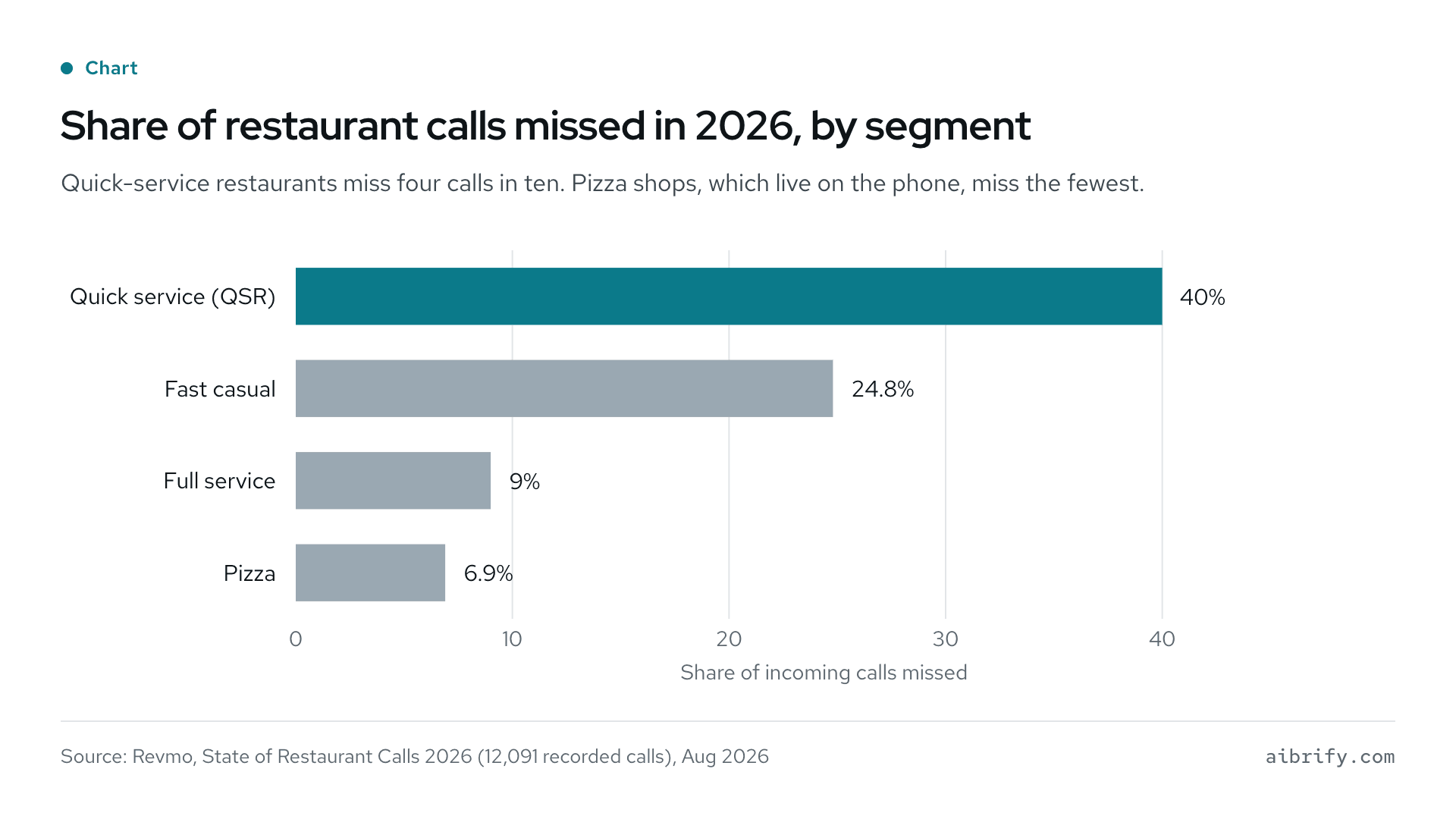
The chart shows the miss rate by segment from the 12,091-call sample. The table lists the published figures.
| Segment | Calls missed | Calls answered |
|---|---|---|
| Quick service (QSR) | 40.1% | 59.9% |
| Fast casual | 24.8% | 75.2% |
| Full service | 9.0% | 91.0% |
| Pizza | 6.9% | 93.1% |
What Does a Missed Call Cost a Restaurant?
A missed call costs a restaurant the order that was about to be placed. Published estimates put the annual total at $27,000 to $73,000 per location.
HungerRush's model starts from roughly 150 unanswered calls a month. It estimates that about 60 percent of those, 90 to 100 calls, were orders. At a $25 average order, that is $2,250 a month, or more than $27,000 a year, from one location.
Revmo's 2026 sample produced a larger number for quick service: a $73,000 annual revenue leak per location. A 50-location chain loses $3.65 million a year on the same basis. The gap between the two estimates comes from call volume and order size, not from disagreement about the mechanism.
Both estimates come from vendors that sell answering or ordering products, so read the totals as a vendor's model rather than an audit.
The report also found that only 28.6 percent of pizza calls included an upsell attempt.
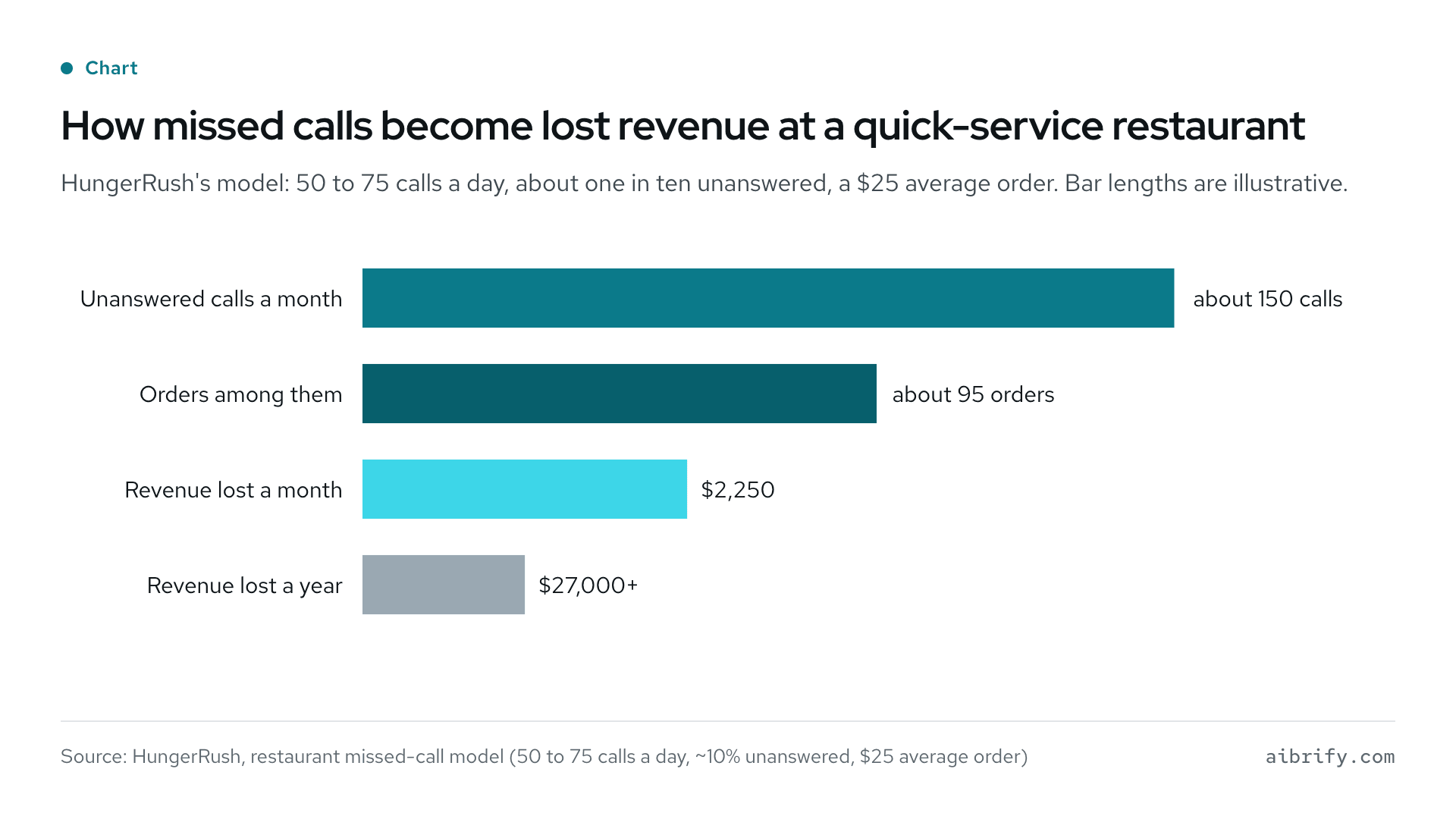
The funnel follows HungerRush's monthly model from unanswered calls to lost revenue. The table lists each step.
| Step | Figure | Basis |
|---|---|---|
| Unanswered calls per month | ~150 | HungerRush estimate |
| Orders among them | 90–100 | 60% of 150, per HungerRush |
| Average order value | $25 | HungerRush estimate |
| Revenue lost per month | $2,250 | 90 orders × $25 |
| Revenue lost per year | $27,000+ | 12 × $2,250 |
What Are the Options for Answering Restaurant Calls?
A restaurant has four ways to answer more calls. It can hire a person, subscribe to a live answering service, use an AI receptionist, or accept the misses. Each has a monthly price and a ceiling on what it can do.
Hire a receptionist. The median receptionist earns $38,010 a year, or $18.27 an hour, per the U.S. Bureau of Labor Statistics, before payroll taxes and benefits. One person covers one shift.
Subscribe to a live answering service. Human answering services charge $175 to $325 a month at entry level, according to OnceHub's 2026 pricing survey. At 200 to 500 calls the price rises to $700 to $1,700 a month. Operators read from a script and take messages; the AI receptionist vs answering service guide compares what each option does after hello.
Use an AI receptionist. AI receptionists run $25 to $300 a month in the same survey, with most full-featured plans at $50 to $200. The checklist below tests whether one takes orders and reservations, hands off to a person, and knows the menu.
Accept the misses. At $27,000 to $73,000 a year per location, on those two vendors' estimates, this is the most expensive option on the list.
| Option | Monthly cost | Takes orders | After hours | Source |
|---|---|---|---|---|
| In-house receptionist | ~$3,168 in wages alone | Yes | Only on shift | BLS, May 2025 |
| Live answering service | $175–$1,700 | Depends on the service | Yes | OnceHub, Sep 2026 |
| AI receptionist | $25–$300 | Depends on the product | Yes | OnceHub, Sep 2026 |
| Aibrify AI receptionist | $149 (400 minutes included), setup included | Yes | Yes | Aibrify price list |
| Do nothing | $0, minus $27,000–$73,000 a year in lost orders | No | No | HungerRush; Revmo |
How Does the Aibrify AI Receptionist Work?
The restaurant keeps its own number, and calls forward to the AI receptionist when the line is busy or after hours. The receptionist works from the restaurant's own menu and hours. A fixed set of rules says what it may and may not do.
- Brief. The owner texts or emails Aibrify the menu, hours, delivery zone, and the number that should receive transfers. Reply within one business hour.
- Setup, included. Aibrify builds the call flow around the restaurant: greeting, order taking, reservations, common questions, and the transfer rule.
- Review on a phone. The owner calls the line and tries to break it. Wrong answers are fixed before launch, usually within a week.
- Live, $149 a month. Every call is answered in English or Mandarin, whichever the caller uses. Orders, bookings and a summary of each call are texted to the owner in Chinese or English. Anything the receptionist is unsure about is transferred to a person, with a text summary to the owner.
- Monthly report. Once a month, a report of the calls it answered. The report is what tells an owner whether the line is paying for itself.
Two rules apply to every call. The call opens with a short notice that it is recorded and answered by an automated assistant. And when the receptionist is unsure, it transfers the call, including any question outside the menu, hours, or booking rules.
The plan includes 400 minutes a month, and extra minutes cost $0.30 each. A restaurant that averages four minutes a call covers 100 calls inside the allowance; the price list has the current terms. A busier line pays overage, and the FAQ below works the arithmetic for a quick-service restaurant at 50 calls a day.
Which Restaurants Get the Most From an AI Receptionist?
Restaurants with a strong phone channel, thin front-of-house staffing, or bilingual customers see the largest change. Three scenarios show where the value lands.
The owner-operator of a Chinese restaurant in the San Gabriel Valley. Calls come in Mandarin and English, and the same two people cook and answer. A bilingual AI receptionist takes takeout orders in either language, and the order is sent to the restaurant by text. The bilingual AI receptionist guide goes deeper on Mandarin and English answering.
A pizza shop with three lines. Pizza already answers 93 percent of calls, so the gain is the after-hours orders. A receptionist that takes orders after the counter closes would test whether those orders are worth catching without hiring.
A full-service restaurant that lives on reservations. Full-service misses only 9 percent. A missed reservation call on a Saturday, though, is a table that stays empty. The receptionist books the table, sends the booking to the restaurant by text, and transfers the caller who wants to discuss a private event.
The restaurant examples on the homepage list this and three fixed-price projects, from a QR menu at $100 to a catering order form at $1,000.
What Should a Restaurant Check Before Signing Up?
Before signing up for any receptionist, a restaurant owner should test five things on a real call. The failures that matter show up in the first minute.
- Hand-off. Ask something outside the menu. A good receptionist transfers to a person or takes a message; a bad one invents an answer.
- Menu accuracy. Ask for a dish that was taken off the menu last month. The answer should come from the current menu, not a stale copy.
- Languages and accents. Order in the languages the customers use. If the second language is a promise rather than a feature, the transfer rate will show it.
- Recording notice. California requires consent from all parties to record a confidential call under Penal Code section 632. The Aibrify AI receptionist opens every call by saying it is automated and recorded, and that notice covers the recording consent. Restaurants outside California should check their own state's rule.
- Reporting. Ask what the monthly report contains. If the only metric is minutes used, the owner will never learn whether the line caught orders.
The state's bot law, Business and Professions Code sections 17940–17941, is narrower than it sounds. It covers automated accounts on public-facing websites and apps, and only bans using one to mislead a person about being automated; disclosure is the defense. It does not name phone calls, so the receptionist's disclosure is Aibrify's policy rather than a statutory requirement.
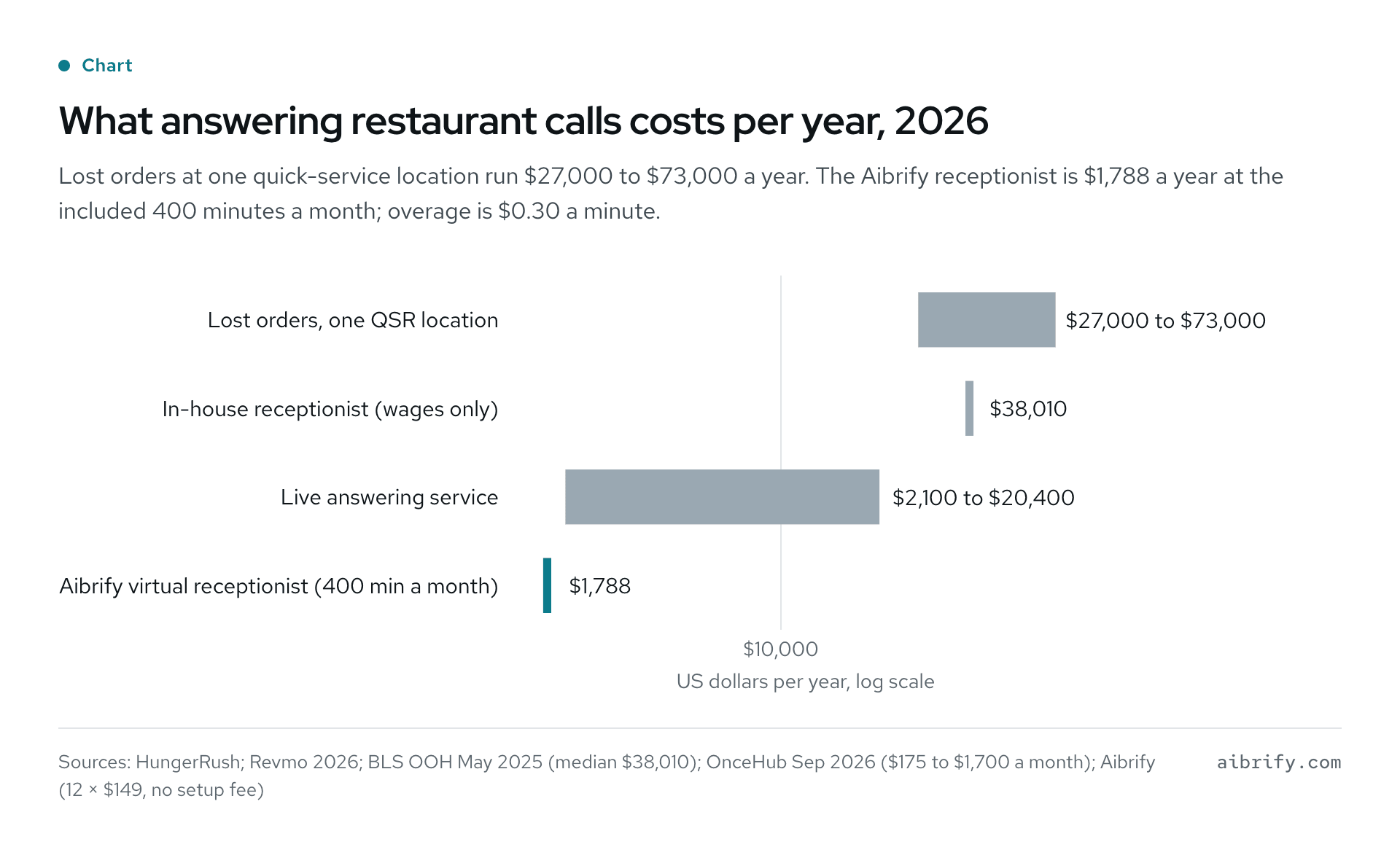
The chart compares annual figures from the sources above with the first-year cost of the Aibrify AI receptionist. The Aibrify bar is at the included 400 minutes a month; overage is $0.30 a minute. The table lists the basis for each bar.
| Option | Annual figure | Basis |
|---|---|---|
| Lost orders, quick-service location | $27,000–$73,000 | HungerRush model; Revmo 2026 report |
| In-house receptionist | $38,010 wages, before taxes and benefits | BLS median, May 2025 |
| Live answering service | $2,100–$20,400 | OnceHub tiers, $175–$1,700 a month |
| Aibrify AI receptionist, at 400 minutes a month | $1,788 a year | $149 × 12, at the included 400 minutes, no setup fee |
Frequently Asked Questions (FAQ)
How much does an AI receptionist for a restaurant cost?
Aibrify charges $149 a month with setup included; the plan includes 400 minutes and bills $0.30 for each extra minute. Live answering services charge $175 to $1,700 a month depending on call volume, and an in-house receptionist earns a median $38,010 a year in wages.
Can an AI receptionist take phone orders?
Yes, the Aibrify AI receptionist takes takeout and delivery orders from the restaurant's current menu, and the order is sent to the restaurant by text. Items that are not on the menu are not guessed: the receptionist transfers the call to a person. The owner gets a text summary of each call, and a monthly report of the calls it answered.
Does it answer in Mandarin as well as English?
Yes, the AI receptionist answers in the language the caller uses, English or Mandarin, on the same phone number. Cantonese is not supported yet. Bilingual answering is included in the $149 monthly plan and configured during setup, not sold as an add-on.
What happens when the receptionist cannot answer a question?
It transfers the call to the number the owner chose and texts the owner a summary. Anything outside the menu, opening hours, delivery area, and booking rules triggers a transfer. The owner also gets a monthly report of the calls it answered.
Is it legal to record restaurant calls in California?
Yes, with consent from everyone on the call, which Penal Code section 632 requires before a confidential call is recorded. The Aibrify AI receptionist opens every call with a notice that it is automated and recorded, so the consent rule is met. Business and Professions Code section 17941 covers automated accounts on websites and apps used to mislead, not phone calls; other states set their own rules.
How long does setup take?
Setup takes about a week. The owner sends the menu, hours, delivery zone, and transfer number, and Aibrify builds the call flow. The owner then test-calls the line and reports what to fix, and the receptionist goes live once the test calls are right.
How many calls does the 400-minute plan cover?
The 400-minute plan covers about 100 calls a month at four minutes each, or more for short order calls. Fifty calls a day at four minutes each is 6,000 minutes over 30 days, so a quick-service restaurant passes the allowance in the first week. The 5,600 minutes over it cost $1,680 a month at $0.30 a minute, which Aibrify quotes in writing before setup.
Will an AI receptionist replace the host or front counter?
No, it answers the phone so the host and counter staff can serve the people in front of them. Walk-in guests, complaints, and private event inquiries still go to a person; the receptionist's transfer rule sends them there and texts the owner a summary.
What Should You Do Next?
Count the calls the restaurant missed last week. Most phone systems show it; if not, the number of voicemails is a floor.
Then text Aibrify the menu link, the hours, and the number that should receive transfers. The plan is $149 a month with setup included, and the line is live in about a week. See the AI receptionist page or start a project. For Chinese restaurants, where English callers' orders are texted to the owner in Chinese, see phone answering for Chinese restaurants.


