

How Much Does Custom Software Cost in 2026?
Custom software costs $40,000 to $200,000 when an agency builds a simple or small application, and $200,000 to $400,000 for a mid-sized one. It costs $100 to $5,000+ when a studio scopes a single task at a fixed price. The average agency project came in at $132,480 and took 13 months, according to Clutch data compiled by Keyhole Software in January 2026.
Those two ranges describe different purchases. One is a whole application built by a team of five. The other is one automation, one tool, or one portal, built by a studio that quotes the scope in writing before work starts.
Aibrify is a software studio in Los Angeles that prices work by outcome, not by the hour. One automation costs $100, a focused tool $300, an application with logins $1,000, and a multi-role system starts at $5,000.
Every job gets a written scope and a fixed price first, and the client owns the code. This guide explains where the gap between $100 and $200,000 comes from, what each price buys, and when custom software is the wrong purchase.
Why Do Quotes Range From $100 to $200,000?
The spread comes from three things: the size of the unit being priced, the billing model, and the overhead of the team doing the work.
Agency guides price whole applications. Soltech puts small applications at $100,000 to $200,000 and mid-sized ones at $200,000 to $400,000. Keyhole's benchmark, drawn from more than 200 projects, lists a simple MVP at $40,000 to $120,000 over two to four months.
Hourly billing multiplies that spread. North American senior developers bill $125 to $250 per hour, mid-level developers $90 to $149, and juniors $55 to $100, per Keyhole. An eight-week build with two people at those rates lands in the five figures before design or testing.
Team overhead is the third driver. In Keyhole's mid-sized project breakdown, development is only 40 to 50 percent of the budget. Quality assurance takes 15 to 25 percent, design 10 to 20 percent, project management 10 to 15 percent, and infrastructure 5 to 10 percent.
A fixed-price studio removes two of the three drivers. The unit is one task, so there is no application-sized scope to fund.
The price is fixed in writing, so hours never accumulate. What remains is the work itself.
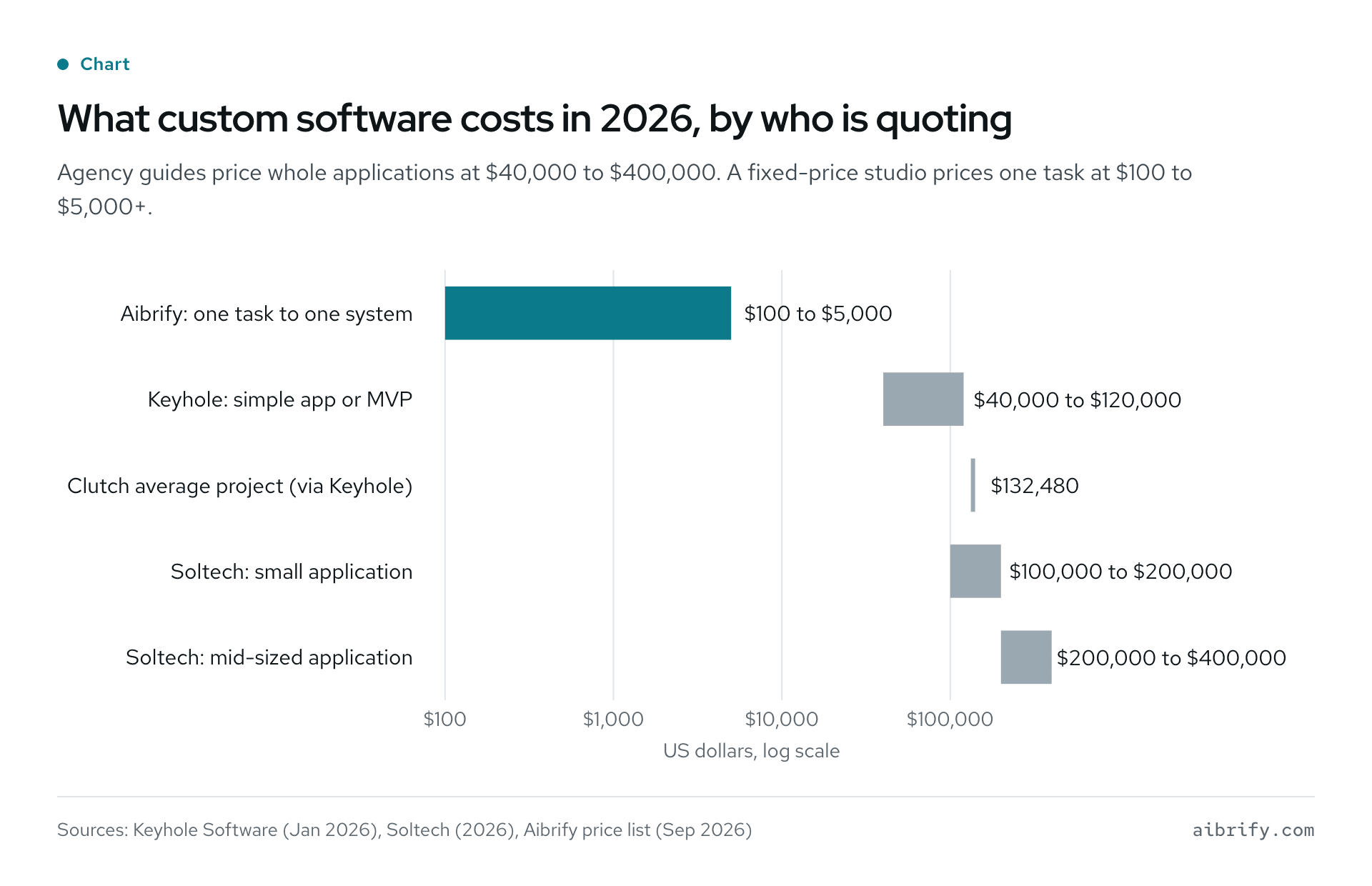
The chart above compares five published ranges on a logarithmic scale. The table lists the same numbers.
| Who is quoting | What is priced | Low | High | Source |
|---|---|---|---|---|
| Keyhole Software benchmark | Simple application or MVP | $40,000 | $120,000 | Keyhole, Jan 2026 |
| Clutch average (via Keyhole) | Typical agency project | $132,480 | $132,480 | Keyhole, Jan 2026 |
| Soltech guide | Small application | $100,000 | $200,000 | Soltech, 2026 |
| Soltech guide | Mid-sized application | $200,000 | $400,000 | Soltech, 2026 |
| Aibrify | One task to one system | $100 | $5,000+ | Aibrify price list |
What Does Each Fixed Price Actually Buy?
A fixed price is only useful if the scope behind it is concrete. Aibrify publishes four tiers, and each one maps to a kind of deliverable and a typical timeline.
| Tier | Price | What it is | Typical timeline | Example |
|---|---|---|---|---|
| Automation | $100 | One task that runs itself | Usually 2–3 days | A text reminder before every appointment |
| Tool | $300 | One focused tool with its own page | About a week | A booking page with a deposit |
| Application | $1,000 | An app with logins | 2–3 weeks | A catering order form that talks to the calendar |
| System | $5,000+ | Several roles, integrations, a plan for growth | Scoped together first | A client status portal for an accounting firm |
The automation tier covers a form that files itself, a reminder that sends on schedule, or a report that emails itself every Monday. Two to three days is enough because the work touches one workflow and one or two existing tools.
The tool tier adds a page of its own, such as a quote sheet a contractor fills in on site. A sign-in form for an open house or a QR menu with daily specials fits here too. Each takes about a week.
The application tier introduces logins, roles, and data that persists. An order form with deposits, a tracker a clinic uses for intake, or a portal where clients upload documents lives at this level. Delivery usually takes two to three weeks.
The system tier is scoped together first because it involves several roles and integrations. A wholesale ordering system with tiered prices, or a client portal with staff and customer views, starts at $5,000 and is quoted line by line.
The full tier list and the current prices are on the price list, and eight industries have example projects at each tier on the homepage.
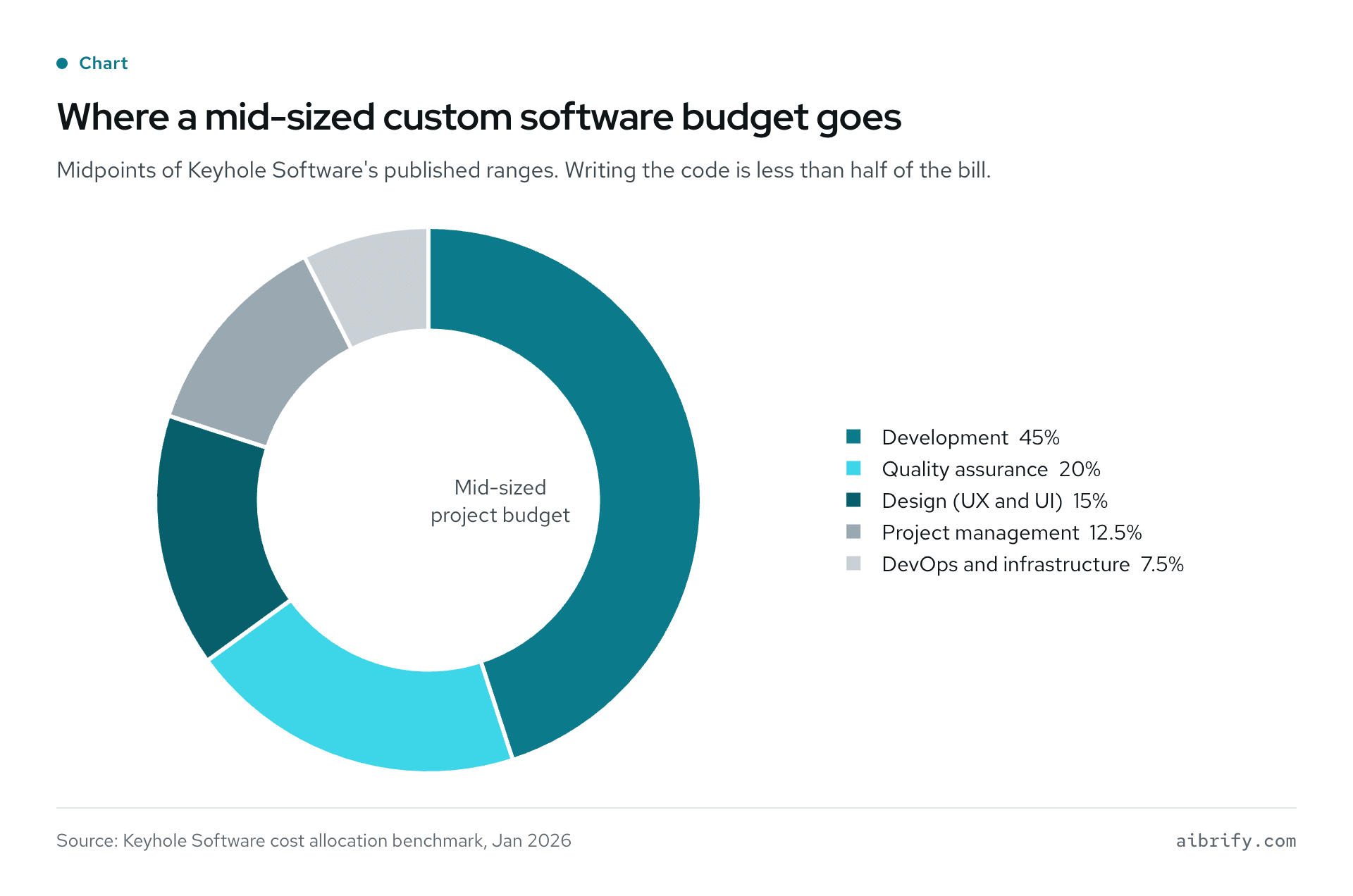
The donut shows the midpoint of each budget share in Keyhole's mid-sized project breakdown. The table gives the published ranges.
| Budget line | Share of a mid-sized project |
|---|---|
| Development | 40–50% |
| Quality assurance | 15–25% |
| Design (UX/UI) | 10–20% |
| Project management | 10–15% |
| DevOps and infrastructure | 5–10% |
How Is a Fixed Price Set Without Hourly Billing?
A fixed price works when the scope is small enough to estimate with confidence and written down before any code exists. Aibrify follows four steps.
- Brief. The client texts, emails, or messages on WeChat what the task is and which tools it touches. Aibrify replies within one business hour.
- Scope and fixed quote. A five-minute conversation turns the brief into a written scope: inputs, outputs, the tools involved, and what is out of scope. The fixed price attaches to that document.
- Build and review. The studio builds. The client checks the result on a phone, because that is where owners actually use it.
- Ship and hand over. The client owns the code. Hosting with Aibrify is optional at $10 to $30 a month, or the code can move anywhere.
Two rules keep the price fixed. Anything not in the written scope is a new quote rather than a surprise on the invoice. And the timeline is stated up front, so a "two to three days" automation is not billed for a week.
The same process is described in more detail under how an engagement works and in the guide to who owns the code.
What Costs Come After Launch?
Software keeps costing money after the first release, and agency projects budget for it. Keyhole estimates annual maintenance at 15 to 25 percent of the initial build. A $200,000 project therefore carries $30,000 to $50,000 a year in upkeep.
Hosting is on top of that. Keyhole puts hosting for agency-built applications at $500 to $10,000+ a month, or $6,000 to $120,000+ a year.
Smaller builds have smaller tails. A $100 automation that runs inside an existing tool has no server of its own to pay for, and changes are quoted separately. An application with logins needs hosting, which is why Aibrify quotes $10 to $30 a month and makes it optional.
Ownership decides whether upkeep is a choice. When the client owns the code, any developer can maintain it, and the hosting bill can move to any provider. When a vendor owns the platform, upkeep runs on the vendor's terms, the vendor dependency Syberry describes below.
| Cost after launch | Agency-built application | Fixed-price task |
|---|---|---|
| Maintenance | 15–25% of build cost per year (Keyhole) | Included fixes on delivery; changes quoted separately |
| Hosting | $500–$10,000+ per month, or $6,000–$120,000+ per year (Keyhole) | $10–$30 per month, optional |
| Ownership | Varies by contract | Client owns the code |
| Lock-in | Often tied to the vendor's stack | None; the code moves with the client |
When Is Custom Software the Wrong Purchase?
Custom software is the wrong purchase in three cases. A packaged tool already covers most of the job, the task changes every month, or the volume is too small to matter.
Off-the-shelf software wins when the job is common. LaunchPad Lab puts accounting, CRM, payroll, time tracking, and ticketing in that group. A vendor has already solved them, and getting done fast matters more than fit.
Syberry lists the trade: lower initial cost and quick deployment on one side, minimal customization and vendor dependency on the other. The build-or-buy guide works through that trade with three-year subscription math.
A spreadsheet plus one automation is often the honest answer, and the spreadsheet plus automation guide shows when it stops being enough. If the pain is "someone retypes this every week," a $100 automation that moves the data is cheaper than any application and ships in days.
Custom software earns its price when the workflow is the business. LaunchPad Lab calls the alternative the "workaround tax". Exporting data, juggling spreadsheets, and shadow IT are a custom build paid for in staff time and errors.
A contractor who quotes on site, a clinic that books after hours, or a wholesaler with tiered prices has a process no packaged tool matches. That is the case for a fixed-price build: scope one process, fix the price in writing, and weigh it against the staff time it replaces.
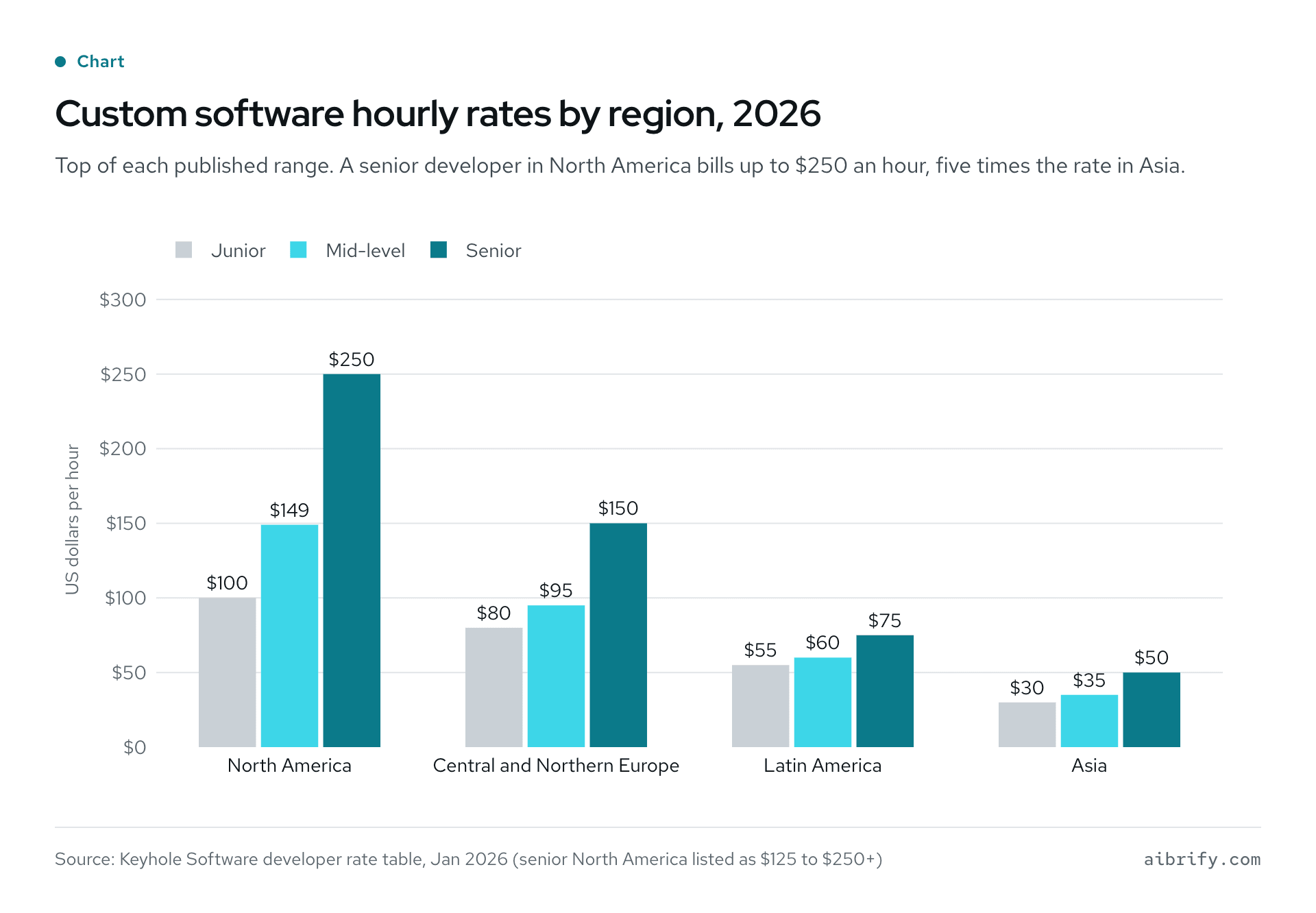
The chart plots the top of each hourly range Keyhole published for four regions and three seniority levels. The table lists both ends.
| Region | Junior | Mid-level | Senior |
|---|---|---|---|
| North America | $55–$100 | $90–$149 | $125–$250+ |
| Central and Northern Europe | $50–$80 | $65–$95 | $95–$150 |
| Latin America | $30–$55 | $35–$60 | $45–$75 |
| Asia | $20–$30 | $25–$35 | $30–$50 |
Hourly rates explain why offshore quotes look cheaper and why they are not the same purchase. A $30 hour still bills by the hour, and a task that takes 40 hours instead of 10 costs four times as much. A fixed price makes the hours the studio's problem.
What Does a First Project Cost at Each Tier?
Three example scopes from the price list show how the tiers play out in different businesses. Each is what the price buys, not a delivered project.
A restaurant, $100. A QR menu that shows the day's specials replaces a printed sheet. The owner edits one line in a spreadsheet, and the menu updates. The automation tier is priced at two to three days.
A clinic, $300. Appointment reminders that send by text the day before, with a reply that confirms or reschedules. The aim is fewer no-shows without a new front-desk hire. The tool tier is priced at about a week.
A contractor, $1,000. An estimate builder with a materials list, filled in on site from a phone. It emails a PDF to the customer before the truck leaves. The application tier is priced at two to three weeks.
Eight industries have three example projects each, with prices, in the examples by industry section. Anything not listed is scoped from a short text.
Frequently Asked Questions (FAQ)
How much does custom software cost for a small business?
Small businesses pay $100 to $5,000+ at a fixed-price studio like Aibrify, with the scope and price in writing first. An agency-built application runs $40,000 to $200,000 for a simple or small one and $200,000 to $400,000 for a mid-sized one. The difference is scope: a studio prices one task, an agency prices a whole system.
What can $100 of custom software actually buy?
One automation that runs itself: a text reminder before appointments, a form that files its own entries, or a report that emails on schedule. Aibrify delivers automations in two to three days. The task has to touch one workflow and one or two existing tools.
How long does custom software take to build?
Agency applications average 13 months, according to Clutch data cited by Keyhole Software. Fixed-price tasks are faster: an automation takes two to three days, a tool about a week, and an application with logins two to three weeks. Systems are scoped together first.
Is a fixed price cheaper than hourly billing?
A fixed price is cheaper when the scope is small and stable, because hours never accumulate past the quote. Hourly billing fits open-ended projects. North American developers bill $55 to $250 an hour, so a 40-hour task costs $2,200 to $10,000 hourly.
Who owns the code after a custom build?
The client owns the code in an Aibrify engagement, and hosting with the studio is optional at $10 to $30 a month. Ownership matters after launch: any developer can maintain owned code, and it can move to any hosting provider without a vendor's permission.
What are the hidden costs of custom software?
Maintenance is the largest hidden cost, at 15 to 25 percent of the build price per year for agency projects, per Keyhole Software. Keyhole puts hosting at $500 to $10,000+ a month, or $6,000 to $120,000+ a year. Fixed-price tasks carry smaller tails: optional hosting from $10 a month.
Should I buy software or build it?
Buy when a packaged tool covers most of the job and speed matters; a spreadsheet plus automation is often enough. Build when the workflow is specific to the business, or when a $100 automation removes a weekly manual task. LaunchPad Lab calls the alternative the workaround tax: exporting, re-typing and patching around a tool is paying for a custom build without owning one.
Can custom software be built in Chinese and English?
Yes, Aibrify works in English and Chinese. A brief can be sent in either language, and the finished tool can show whichever language the customers use. The language of the interface goes into the written scope like any other requirement, so it is settled before work starts.
What Should You Do Next?
Write down the one task that costs the most time each week. Note which tools it touches and what should happen instead. That is a brief.
Send it as a text or an email to Aibrify. Aibrify replies within one business hour, and a written scope with a fixed price follows before any work starts.
A first project can be as small as a $100 automation, priced at two to three days, or a $300 tool at about a week. The client owns the code either way. See the current prices or start a project.


