How Much Does It Cost to Make an App for Your Business?
The price depends on what you mean by "app". In 2026, agencies quote $25,000 to $80,000 for a mobile app on iOS and Android (RaftLabs). A simple web app runs $10,000 to $18,000 at agency prices (Sparkout).
A tool that does one job for your business costs far less. Aibrify, a software company in Los Angeles, charges $300 for a tool with its own page and $1,000 for an app with logins. A full system starts at $5,000, and every price is fixed and quoted in writing before work starts.
Three things set the number: the kind of app, who builds it, and whether they bill by the hour or by the job. This guide covers all three with 2026 figures, then the store fees and upkeep that outlast the build. For the general case, see how custom software is priced.
What Kind of App Do You Actually Need?
Three different things get called an app, and their prices differ by a factor of 100. A native mobile app is installed from the Apple App Store or Google Play. A web app opens in the browser on any phone or laptop and can be pinned to the home screen.
The third kind is an internal tool or automation: a form, a tracker, a report that sends itself. Customers never see it, so it needs no store listing, no icon and no review wait. Most small business ideas, a booking page, a menu, a quote form, belong to the second and third kinds.
| Kind of app | Who opens it | Store listing? | 2026 price range |
|---|---|---|---|
| Native mobile app, iOS and Android | Customers, on their phones | Yes | $25,000 to $80,000 at an agency (RaftLabs) |
| Web app | Customers or staff, in a browser | No | $10,000 to $18,000 for a simple one at an agency (Sparkout); $300 to $1,000 fixed at Aibrify |
| Internal tool or automation | Owner and staff | No | $8,000 to $20,000 at an agency (RaftLabs); $100 to $1,000 fixed at Aibrify |
Apple's own rules discourage a store app that only wraps a website. Guideline 4.2 reads:
Your app should include features, content, and UI that elevate it beyond a repackaged website. If your app is not particularly useful, unique, or "app-like," it doesn't belong on the App Store. (Apple)
If your idea is a menu, a sign-in form or a booking page, the web version is cheaper and that rule never comes up.
Signs you really need a native app
- It must work with no internet connection, for example a checklist used in a basement or on a job site.
- It needs deep access to the phone: Bluetooth hardware, background location or constant camera scanning.
- You plan to sell digital content or subscriptions inside the app and accept the store's cut.
Signs a web app or tool is enough
- Customers use it now and then: to book, order, pay a deposit or check a status.
- Staff use it at a desk, or on a phone that has a connection.
- You want to change it often without waiting for a store review.
- You would rather own it outright than rent it from a platform every month.
What Do Agencies Charge to Build an App in 2026?
Agency quotes for a small business app cluster between $10,000 and $80,000 in 2026, and the type of app explains most of the spread. Two dated price guides from firms that sell this work show the pattern. Both are vendor estimates rather than surveys.
Sparkout's guide, published April 14, 2026, lists simple web apps at $10,000 to $18,000 over 4 to 6 weeks (Sparkout). The same guide puts cross-platform mobile apps at $20,000 to $35,000 and native iOS and Android apps at $35,000 to $60,000 or more. Internal tools sit at $15,000 to $40,000.
RaftLabs publishes a cost model with a benchmark table (RaftLabs). A proof of concept or internal tool runs $8,000 to $20,000 over 3 to 6 weeks. A mobile app for both platforms is $25,000 to $80,000 over 10 to 16 weeks, and a marketplace $40,000 to $140,000.
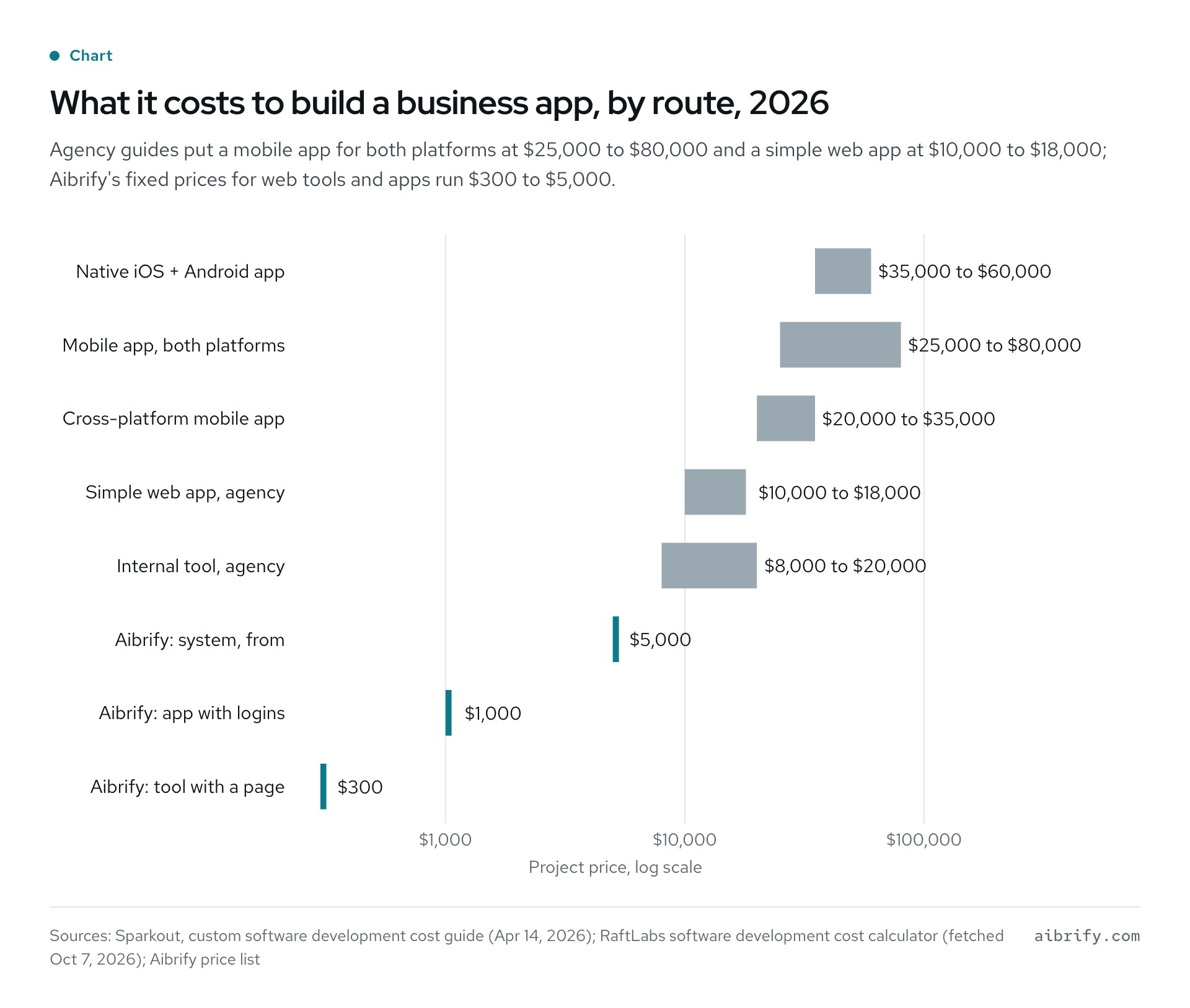
The chart shows agency ranges beside Aibrify's fixed prices.
| Route | Price range | Timeline | Source |
|---|---|---|---|
| Native iOS and Android app | $35,000 to $60,000+ | 4 to 6 months | Sparkout |
| Mobile app, both platforms | $25,000 to $80,000 | 10 to 16 weeks | RaftLabs |
| Cross-platform mobile app | $20,000 to $35,000 | 2 to 4 months | Sparkout |
| Simple web app | $10,000 to $18,000 | 4 to 6 weeks | Sparkout |
| Internal tool or proof of concept | $8,000 to $20,000 | 3 to 6 weeks | RaftLabs |
| Aibrify: system | From $5,000 | Scoped together first | Aibrify |
| Aibrify: application with logins | $1,000 | 2 to 3 weeks | Aibrify |
| Aibrify: tool with its own page | $300 | About a week | Aibrify |
Firms listed on Clutch's app developer directory show rates from $50 to $199 an hour, with minimum project sizes from $1,000 to $50,000 (Clutch). Six profiles from the first page, fetched in October 2026, are below.
| Firm on Clutch | Hourly rate | Minimum project |
|---|---|---|
| Goji Labs | $150 to $199 | $50,000+ |
| Kingsmen Digital Ventures | $150 to $199 | $10,000+ |
| AppMakers USA | $100 to $149 | $10,000+ |
| Wve Labs | $50 to $99 | $25,000+ |
| JPLoft | $50 to $99 | $10,000+ |
| ChopDawg.com | $50 to $99 | $1,000+ |
Location moves the rate. Sparkout puts US developers at $80 to $150 an hour or more, Eastern Europe at $40 to $70, India at $25 to $45 (Sparkout). Offshore rates cut the bill; you pay in time zones and a longer review loop.
What pushes an agency quote up
- Two platforms instead of one, or a native app where a web app would do.
- Logins, roles and permissions, which add screens for every role.
- Payments, and connections to tools you already run.
- Speed: RaftLabs says a rushed delivery costs roughly 30 percent more for the same scope (RaftLabs).
- Regulation: Sparkout says compliance work adds 20 to 50 percent to the overall cost (Sparkout).
If the project is closer to an automation than an app, see what business automation costs and consultant, agency or DIY.
What Do Freelance App Developers Charge?
Freelance mobile developers charge $61 to $80 an hour at the median, according to Arc's 2026 rate data. Arc says the figures come from more than 20,000 freelance developers on the Codementor platform (Arc). A single freelancer is often the lowest hourly rate you will find for native work.
Hiring instead of contracting does not escape the math. The median software developer earned $135,980 a year in May 2025 (BLS). Spread over 2,080 working hours, that is about $65 an hour before benefits, payroll taxes, equipment and your time managing the work.
The weakness of hourly pricing is not the rate but the unknown total. At those rates a 300-hour build comes to $18,300 to $24,000. Nobody can say in week one whether the job is 300 hours or 450.
Before you agree to an hourly job, ask for three numbers in writing: the estimated hours, the rate, and the cap. If the developer will not name a cap, budget for the estimate plus half again. Or sidestep the problem and ask for a fixed price up front.
Can a No-Code App Builder Do It for Less?
A no-code builder costs $25 to $59 a month for the first paid plan, as of October 2026, and you do the building. That is the cheapest line on any app budget, if your evenings are free and the app stays simple. Four widely used builders price their entry plans like this.
| Builder | First paid plan | Next plans | Billing shown |
|---|---|---|---|
| Glide | Basic, $25 a month | Plus $50, Pro $125 | Monthly rate |
| Adalo | Starter, $36 a month | Professional $52, Team $160 | Billed annually; monthly billing costs 20% more |
| FlutterFlow | Basic, $39 a month | Growth $80, Business $150 for the first seat | Monthly billing |
| Bubble | Starter, $59 a month | Growth $209, Team $549 | Billed annually |
Three costs hide behind the subscription. First, your time: a builder is cheap, an owner's weekends are not. Second, the fee never ends: Bubble's Starter plan alone is $3,540 over five years (Bubble), and Adalo's Starter is $2,160 (Adalo).
Third, the app lives on the builder's platform. Before you commit, find out whether you can export your app and your data, and what the next plan up costs. A booking page that outgrows the entry plan can cost more per month than hosting a built app.
Tools that write code from a prompt (Cursor, Lovable, Bolt, Replit) are a fourth option, and the code is yours to keep. When the result needs a developer to finish or stabilize it, Aibrify charges $100 for a diagnosis within 24 hours, credited to the fix. Fixes are $100 or $300, stabilization is $1,000 (details), and what it costs to fix a vibe-coded app has the background.
What Are the App Store Fees and Upkeep Costs?
Publishing a native app costs $99 a year for the Apple Developer Program (Apple) and $25, once, for a Google Play account (Google). Selling inside the app costs more. Both stores take 15 percent of the first $1 million a developer earns each year (Apple, Google).
Above $1 million, Google charges 30 percent (Google) and Apple's standard rate of 30 percent applies (Apple). The cut covers digital goods: paid apps, in-app purchases and subscriptions. Physical goods and services used outside the app are different.
Apple's guideline 3.1.3(e) allows other payment methods for them, so a haircut or a meal paid through your app carries no commission (Apple). That matters for most small business apps, where the thing being sold happens in the real world.
Launching takes time as well as money. Google requires a closed test before launch for personal accounts created after November 13, 2023: at least 12 testers for 14 continuous days (Google). Apple says it reviews at least 50 percent of submissions in under 24 hours and 90 percent in under 48 hours (Apple).
Both stores also force updates. From April 28, 2026, apps uploaded to App Store Connect must be built with Xcode 26 and an iOS 26 SDK (Apple). Google Play's deadline is August 31, 2026: new apps and updates must target Android 16 (Google).
Existing apps must target Android 15 to remain available to new users (Google). In practice that means paying a developer to touch the app yearly, even when nothing about your business changed.
A web app has none of this: no store fee, no commission, no SDK deadline, and no review queue when you change a price. It needs hosting, which Aibrify provides for $10 to $30 a month, or which you can place anywhere.
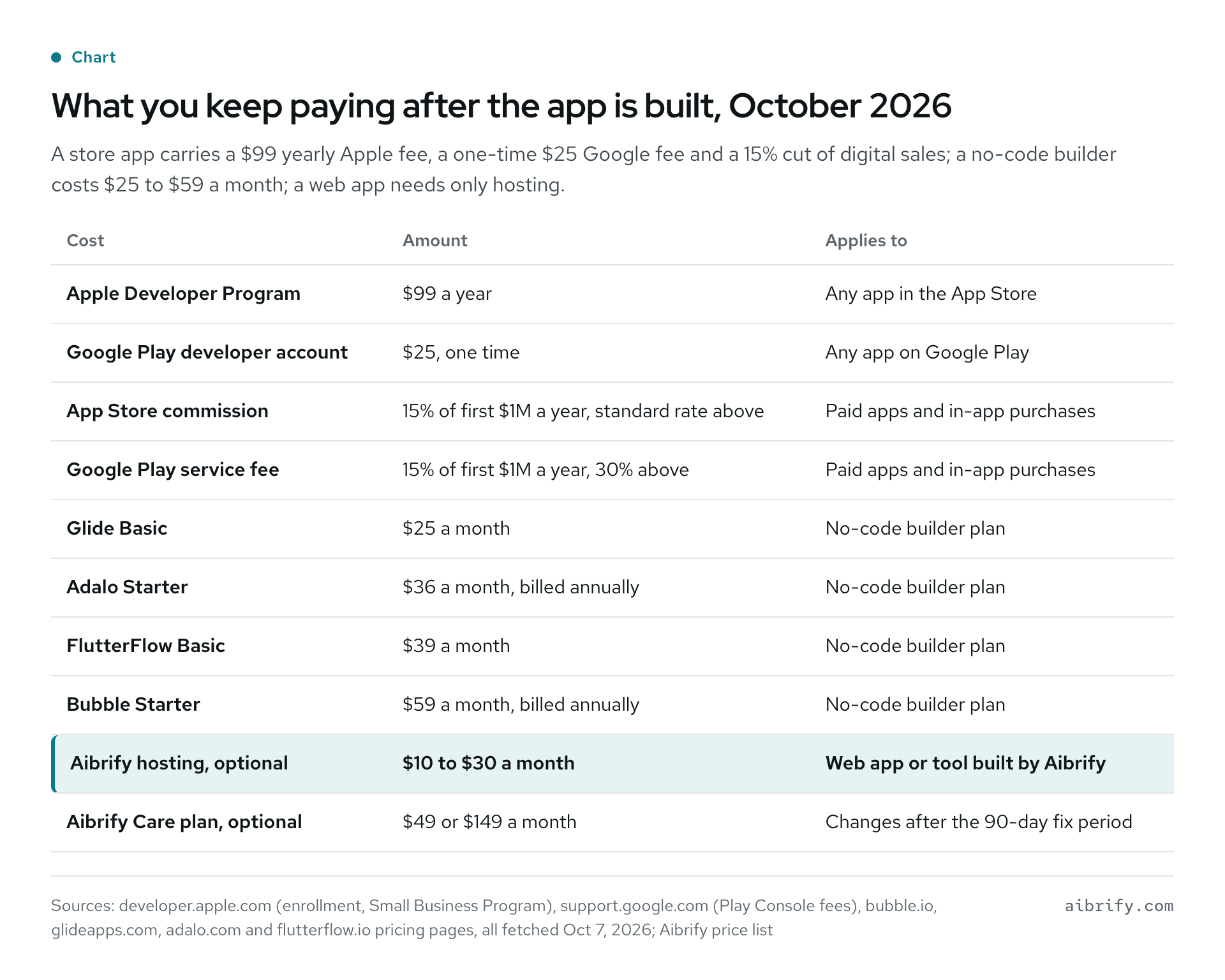
The table lists what each route costs after launch.
| Cost | Amount | Applies to |
|---|---|---|
| Apple Developer Program | $99 a year (Apple) | Any app in the App Store |
| Google Play developer account | $25, one time (Google) | Any app on Google Play |
| App Store commission | 15% of the first $1 million a year, standard rate above (Apple) | Paid apps and in-app purchases |
| Google Play service fee | 15% of the first $1 million a year, 30% above (Google) | Paid apps and in-app purchases |
| Glide Basic | $25 a month (Glide) | No-code builder plan |
| Adalo Starter | $36 a month, billed annually (Adalo) | No-code builder plan |
| FlutterFlow Basic | $39 a month (FlutterFlow) | No-code builder plan |
| Bubble Starter | $59 a month, billed annually (Bubble) | No-code builder plan |
| Aibrify hosting, optional | $10 to $30 a month | Web app or tool built by Aibrify |
| Aibrify Care plan, optional | $49 or $149 a month | Changes after the 90-day fix period |
When Is a Web App or Internal Tool the Better Choice?
A web app or internal tool wins whenever customers use it occasionally and staff use it with a connection. That describes most small business software.
The budget gap is not 20 percent. It is the gap between a $300 booking page and a store app starting near $25,000 (RaftLabs). A few examples from Aibrify's price list show the kind of software each idea really is.
| The idea | What it really is | Fixed price |
|---|---|---|
| Customers book and pay a deposit (salon) | Booking page with deposit | $300 |
| A menu with today's specials (restaurant) | QR menu with daily specials | $100 |
| Catering orders with a deposit (restaurant) | Catering order form with deposit | $1,000 |
| A sheet the crew fills in on site (contractor) | Photo-to-quote sheet | $300 |
| Memberships and packages in one place (salon) | Membership and package tracker | $1,000 |
| A portal where clients check case status (law firm, accountant) | Client status portal | $5,000+ |
Each one runs in the browser and pins to a phone's home screen, so it feels like an app to whoever uses it. None of them needs a store account, a review, or a yearly SDK update. For a closer look at the smallest tier, read what a $300 tool looks like.
If the data already lives in a spreadsheet, read spreadsheet automation versus a custom app and Excel to web app before paying for anything. If a subscription product already does the job, custom software versus off the shelf explains when to buy instead of build.
What Does Aibrify Charge to Build an App for a Small Business?
Aibrify builds small business software at four fixed prices, from $100 for one automation to $5,000 and up for a system. The quote is in writing before work starts and does not move. Details and examples are on the automation page.
| Tier | Fixed price | What it is | Time | Example |
|---|---|---|---|---|
| One automation | $100 | A form, a reminder, a report that sends itself | 2 to 3 days | Review request after each visit |
| Tool with its own page | $300 | A booking page, quote sheet, sign-in form or request page | About a week | Booking page with deposit |
| Application with logins | $1,000 | A portal, tracker or order form that talks to your other tools | 2 to 3 weeks | Wholesale order form with price tiers |
| System | $5,000+ | Several roles, integrations, a plan for growth | Scoped together first | Client status portal |
What every job includes:
- A written scope and a fixed price before work starts.
- You check the work on your phone as it comes together.
- You own the code, the repository and the accounts from delivery.
- Hosting with Aibrify is optional, between $10 and $30 monthly, or take it anywhere.
- Anything broken in the delivered scope is fixed at no cost for 90 days.
After 90 days, changes are quoted at the same fixed prices, or a Care plan covers them. The $49 plan includes 1 hour of changes a month with a reply in 2 business days. The $149 tier covers 4 hours, answered the next business day.
Compare that with a builder subscription that bills whether or not anything changed. Pricing and custom software have the full list. Every tool integrates with the software you already use, so a booking page can read your calendar and send texts without replacing anything.
To start, answer the four questions in the brief, or send a text, email or WeChat message. You get a reply within 1 business hour, with no sales call and no meeting required.
How Do You Get an Accurate Quote?
The fastest route to an accurate quote is a one-page brief: who uses the app, what they do in it, what happens next. Developers price uncertainty, so every gap in the brief turns into padding or into hourly billing. How to write a software brief walks through the questions that matter.
Then ask every bidder the same five questions:
- Is the price fixed, and will it be in writing before anyone starts?
- Who owns the code, repository and accounts at delivery? Who owns the code explains why that matters.
- What happens when something breaks in month two, and what does it cost?
- What will I pay every month after launch: hosting, store fees, subscriptions?
- How do I get my data out if I leave?
An hourly estimate without a cap is not a price, and a monthly subscription is a price that never stops. A fixed quote with ownership and a 90-day fix period is the only one of the three you can budget and forget.
Frequently Asked Questions
How much does it cost to make an app for a small business in 2026?
RaftLabs puts an agency-built mobile app for iOS and Android at $25,000 to $80,000; Sparkout puts a basic web app between $10,000 and $18,000. Both are 2026 vendor guides. Aibrify's fixed prices for small business web tools are $300 for a one-page tool and $1,000 when it needs logins.
How much does it cost to create a simple app?
A few-screen app costs $10,000 to $18,000 when an agency builds it (Sparkout), or $8,000 to $20,000 as an internal tool (RaftLabs). At Aibrify the same work is a fixed $300, or $1,000 if users log in. Either way, get the scope in writing first.
Is a web app cheaper than a mobile app?
Yes, by a wide margin. A web app skips the $99 Apple fee (Apple), the $25 Google Play fee (Google), the commission, the SDK deadlines and the review queue. In Sparkout's agency pricing a small web app is $10,000 to $18,000, against a two-platform mobile app of $25,000 to $80,000 in RaftLabs' model.
How much does it cost to put an app on the App Store and Google Play?
Apple's Developer Program is $99 a year (Apple); a Google Play developer account is $25, paid once (Google). On paid apps and in-app purchases, each store keeps 15 percent of a developer's first $1 million in yearly earnings (Apple, Google). Services delivered in the real world, like a repair or a dinner, can use other payment methods.
How much does an app developer charge per hour?
Arc's 2026 data puts freelance mobile developers at a median of $61 to $80 per hour (Arc). Agencies listed on Clutch charge between $50 and $199 an hour; minimums run $1,000 to $50,000. US rates start at $80 an hour and reach $150 or more, against $25 to $45 in India, in Sparkout's guide.
Can I build my business app with a no-code tool instead?
Yes, and the building is on you. In October 2026, entry plans cost $25 a month at Glide, $36 at Adalo, $39 at FlutterFlow and $59 at Bubble. You pay with evenings, a fee that never stops, and an app that lives on someone else's platform, so read the export terms first.
How much does it cost to maintain an app each year?
A store app needs the $99 yearly Apple fee (Apple), hosting, and developer time for forced updates. Apple requires Xcode 26 builds starting April 28, 2026 (Apple), and Google Play requires Android 16 targets from August 31, 2026 (Google). A web app from Aibrify needs hosting, $10 to $30 monthly, plus an optional Care plan at $49 or $149.
What does Aibrify charge to build a custom app for my business?
Aibrify, based in Los Angeles, quotes every small business app at a fixed price. A tool on its own page is $300, an application with logins is $1,000, and a system with several roles starts at $5,000. The quote comes in writing first, the code and accounts are yours, and anything broken in scope is repaired free for 90 days.