How Much Does Business Automation Cost for a Small Business?
Business automation for a small business costs from $0 a month to $25,000 or more up front in 2026, depending on who builds it. Tool plans run from free to about $104 a month, consultants bill $100 to $300 an hour, and agency projects start near $3,000. Aibrify, a software company in Los Angeles, builds the same work at fixed prices of $100, $300, $1,000 or $5,000 and up.
The spread is wide because "automation" covers four different purchases. One owner buys a $20 Zapier plan and wires it up on a Sunday afternoon. Another signs a $15,000 agency contract with a monthly retainer on top.
This guide prices each route with sources you can check. It then lists what moves a quote up or down, and shows how to work out payback from your own payroll numbers.
What Are the Four Ways to Pay for Automation?
Small businesses pay for automation in four ways: a monthly tool plan, an hourly consultant, an agency project fee, or a retainer. A fifth option, one fixed price per job, is how Aibrify works. The table gives the 2026 price band for each, and the sections below show where every figure comes from.
| Way to pay | Typical 2026 price | What you get |
|---|---|---|
| Tool plan, built yourself | $0 to $103.50 a month | A Zapier, Make or n8n account and your own evenings |
| Hourly consultant | $100 to $300 and up an hour | A specialist's time, billed as it goes |
| Agency project | $3,000 to $15,000 and up | A scoped build, often with a retainer afterwards |
| Monthly retainer | $500 to $5,000 a month | Monitoring, updates and small changes |
| Fixed price per job (Aibrify) | $100 to $5,000 and up | A written scope, one price, 90 days of free fixes |
The first four bands come from vendor pricing pages and two 2026 cost guides. The fifth comes from Aibrify's published price list. None of the bands include the owner's own hours spent describing the work, which is real but rarely counted.
A useful way to read the table is by what you are actually buying. A tool plan buys capacity, an hourly consultant buys time, and an agency or fixed-price job buys an outcome. The route that costs least per month is not always the one that costs least per finished automation.
What Do Automation Tools Cost per Month?
The three common automation platforms cost between $0 and $103.50 a month on their entry and mid-level plans, as of October 2026. The price rises with volume: tasks on Zapier, credits on Make, and workflow executions on n8n.
| Platform and plan | Monthly price | What is included |
|---|---|---|
| Zapier Free | $0 | 100 tasks a month, two-step Zaps |
| Zapier Professional | $29.99 ($19.99 billed annually) | 750 tasks a month, multi-step Zaps, premium apps |
| Zapier Team | $103.50 ($69 billed annually) | 2,000 tasks a month, 25 users |
| Make Free | $0 | 1,000 credits a month, 2 active scenarios |
| Make Core | $12 | 10,000 credits a month, unlimited active scenarios |
| Make Pro | $21 | 10,000 credits a month, priority execution |
| n8n Starter | 20 euros, billed annually | 2,500 workflow executions, unlimited steps |
| n8n Pro | 50 euros, billed annually | 10,000 workflow executions, unlimited steps |
Zapier's Professional plan is $29.99 a month for 750 tasks, or $19.99 a month on annual billing (Zapier pricing). The free plan allows 100 tasks a month, and the Team plan is $103.50 a month for 2,000 tasks and 25 users. Annual billing is 33% off the monthly rate.
Make meters usage in credits. Its Core plan is listed at $12 a month for 10,000 credits, Pro at $21 and Teams at $38 (Make pricing). A free tier covers 1,000 credits a month.
n8n sells Starter at 20 euros a month, billed annually, for 2,500 executions (n8n pricing). Pro is 50 euros for 10,000 executions, and a self-hosted version is on GitHub.
Those are platform fees alone. Builts AI, an automation consultancy, estimates the full monthly tool stack for most small businesses at $200 to $600 (Builts AI, 2026). That figure adds a CRM, messaging APIs, hosting and monitoring to the platform fee.
SoluLab's July 2026 guide to AI automation cost puts ongoing fees at $50 to $300 a month for a do-it-yourself setup (SoluLab). For a consultant-built setup its band is $200 to $800 a month.
The catch with per-task pricing is growth. Builts AI notes that a $49 plan covering 2,000 tasks can jump to $299 or more at 10,000 tasks (Builts AI).
What Do Automation Consultants and Agencies Charge?
Consultants bill $100 to $300 and up an hour. Agencies quote $3,000 to $15,000 and up per project, and retainers run $500 to $5,000 a month. The figures come from two 2026 cost guides and one consultancy's own price page.
Hourly consultants
New Leaders, a consultancy, describes the hourly model as "typically ranging from $100 to $300+ per hour" (New Leaders). At those rates a 20-hour build costs $2,000 to $6,000 before any software. The open question with hourly work is how many hours it takes, and that number is only known at the end.
The same page puts project fees at "$3,000 for a basic CRM automation setup to $50,000+ for enterprise-level operational overhauls". Its retainer band is $1,500 to $5,000 a month for ongoing support, software maintenance and continuous optimization.
Agency project tiers
Builts AI's 2026 guide, published in February and updated in April, prices three tiers. Simple single-process automations start at $3,000 and multi-step workflows run $5,000 to $10,000 (Builts AI). Full overhauls with 3 to 5 connected systems reach $15,000 or more.
The guide's headline figure is "$3,000 to $15,000 to build, plus $200 to $600 per month in tool subscriptions".
SoluLab's guide splits the market differently. A do-it-yourself no-code setup is $0 to $3,000 and a consultant-built project is $3,000 to $15,000 (SoluLab). Custom development is $10,000 to $25,000 or more.
SoluLab's summary line: "most small businesses spend $1,500 to $25,000 upfront, plus $50 to $2,000 a month ongoing" (SoluLab).
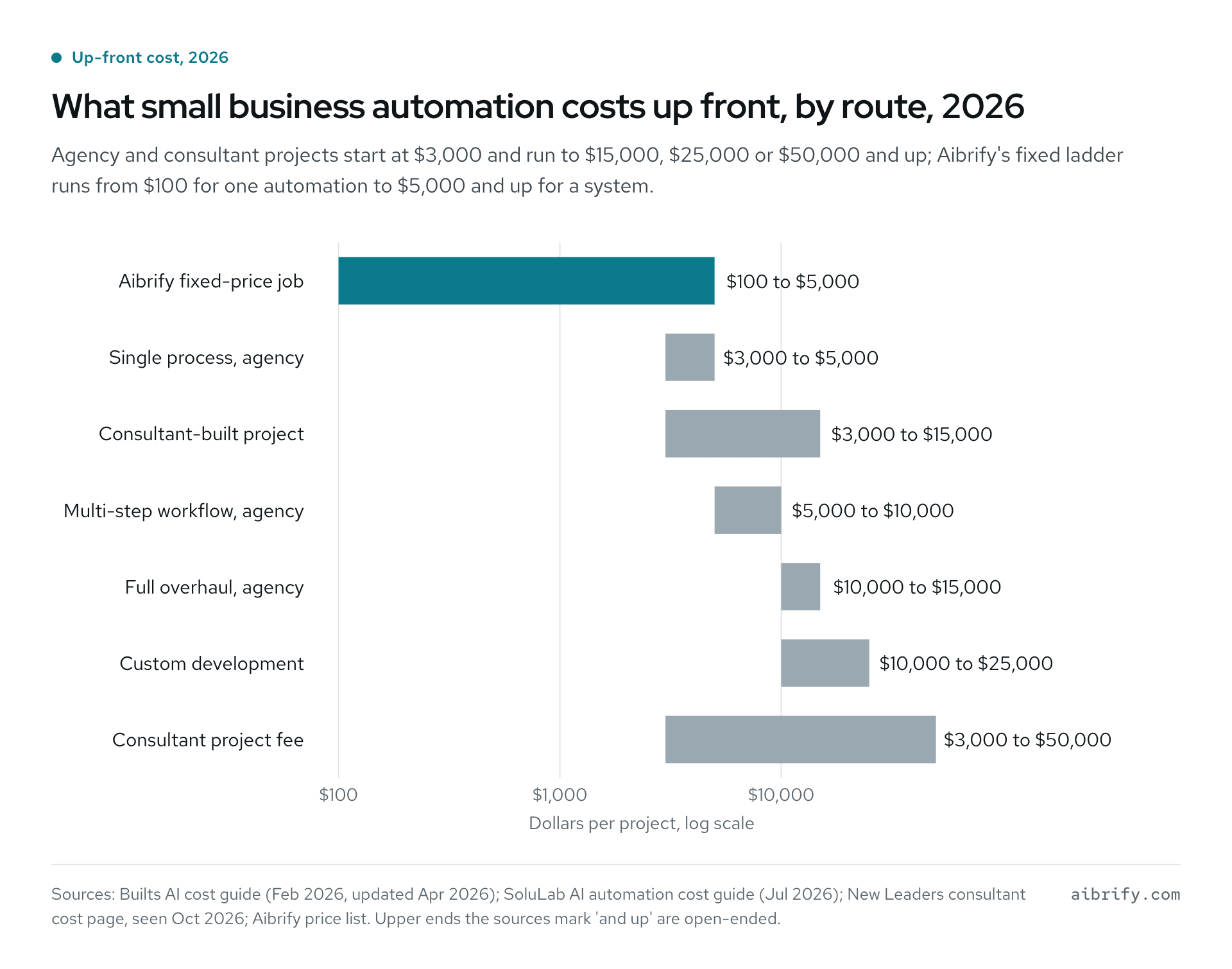
The chart shows the up-front price band for each route on a log scale. The table below carries the same figures with their sources.
| Route (source) | Up-front cost | Ongoing cost |
|---|---|---|
| Fixed price per job (Aibrify) | $100 to $5,000 and up | $0, or $10 to $30 hosting, or $49 to $149 Care |
| Single process, agency (Builts AI) | $3,000 to $5,000 | $200 to $600 tools, $500 to $1,500 retainer |
| Consultant-built (SoluLab) | $3,000 to $15,000 | $200 to $800 a month |
| Multi-step workflow, agency (Builts AI) | $5,000 to $10,000 | $200 to $600 tools, $500 to $1,500 retainer |
| Full overhaul, 3 to 5 systems (Builts AI) | $10,000 to $15,000 and up | $200 to $600 tools, $500 to $1,500 retainer |
| Custom development (SoluLab) | $10,000 to $25,000 and up | $500 to $2,000 and up a month |
| Consultant project fee (New Leaders) | $3,000 to $50,000 and up | $1,500 to $5,000 retainer |
Retainers
Builts AI prices a retainer at $500 to $1,500 a month for monitoring, updates and optimization (Builts AI). New Leaders quotes $1,500 to $5,000 a month for the same kind of support. At the top of that band a retainer costs $60,000 a year, which is more than most of the builds it maintains.
What Does Automation Cost After It Is Built?
After the build, plan on $12 to $800 a month in software and $0 to $5,000 a month in support, depending on the route. The low end is a single Make or Zapier plan with nobody on call. The high end is an agency retainer plus a full tool stack.
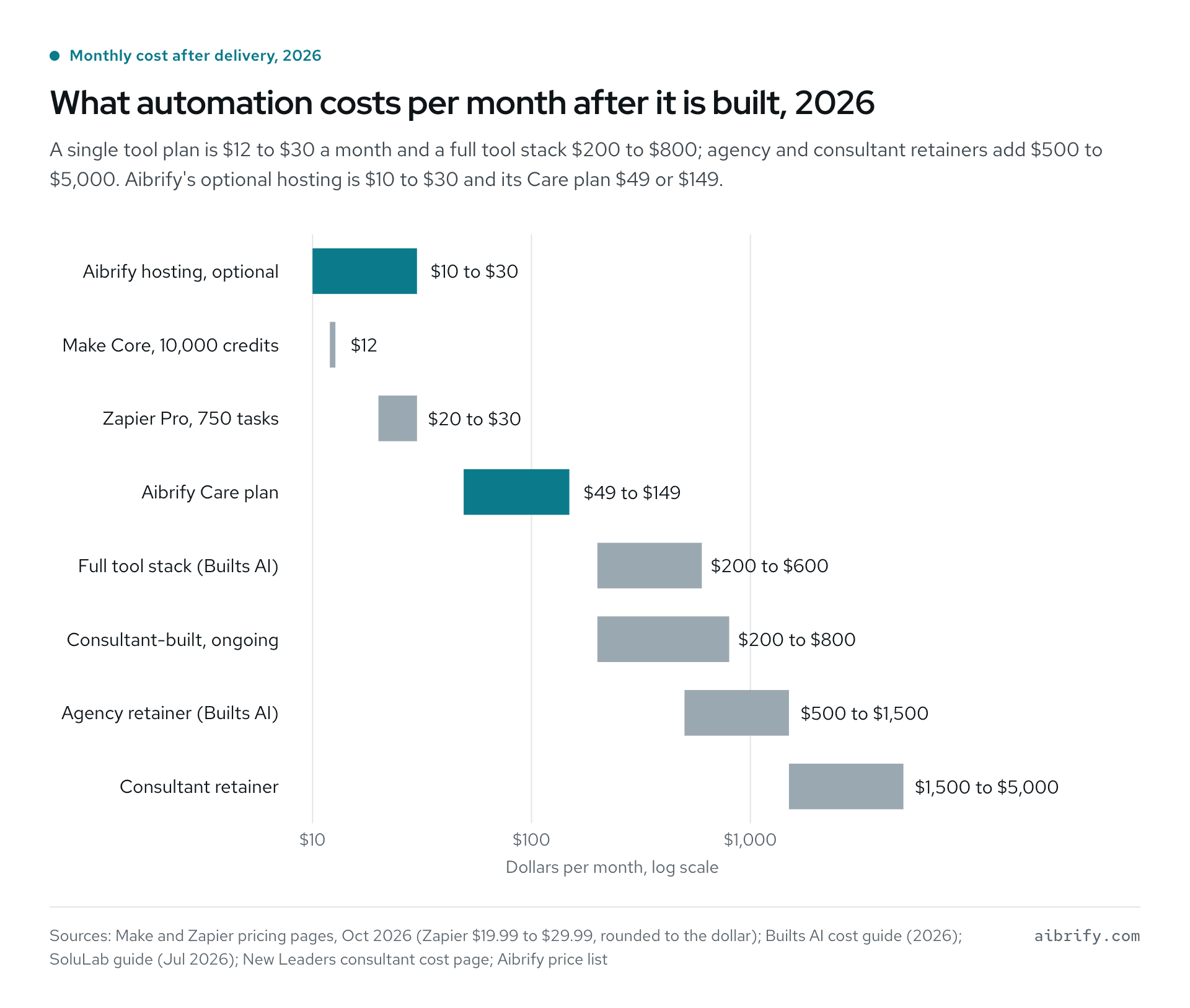
The chart shows what each route costs per month after delivery, rounded to the dollar. The same numbers are in the table below.
| Monthly item (source) | Cost per month |
|---|---|
| Aibrify hosting, optional | $10 to $30 |
| Make Core, 10,000 credits | $12 |
| Zapier Professional, 750 tasks | $19.99 to $29.99 |
| Aibrify Care plan | $49 or $149 |
| Full tool stack (Builts AI) | $200 to $600 |
| Ongoing cost, consultant-built (SoluLab) | $200 to $800 |
| Agency retainer (Builts AI) | $500 to $1,500 |
| Consultant retainer (New Leaders) | $1,500 to $5,000 |
Aibrify's after-delivery costs are the two highlighted rows. Hosting with Aibrify is optional at $10 to $30 a month, and the client can host anywhere else. Anything broken in the delivered scope is fixed free for 90 days.
After the 90 days, changes are quoted at the same fixed prices, or an optional Care plan covers them. Care is $49 a month for 1 hour of changes, with a reply within 2 business days. The $149 plan gives 4 hours a month and a reply the next business day.
What Drives the Price Up or Down?
Six things move an automation quote more than anything else: systems touched, data quality, logins, volume, hosting, and who fixes it later. The sources above put numbers on the first four.
- Systems connected. Builts AI says each pricing factor can shift a build by $1,000 to $5,000 (Builts AI). Niche integrations that need custom API work add $2,000 to $5,000. A full overhaul earns its $15,000 and up price by connecting 3 to 5 systems.
- Data quality. SoluLab budgets $500 to $5,000 for cleaning records before automating them (SoluLab). It advises adding 20 to 30% to any quote when records are inconsistent. A spreadsheet with three date formats costs more to automate than one with a single format.
- Logins and roles. A form that sends a text needs no accounts. A portal where clients sign in needs authentication, permissions and a database, which is why Aibrify's ladder steps from $300 to $1,000 at that point.
- Volume. Zapier Professional is $29.99 at 750 tasks and Team is $103.50 at 2,000 tasks (Zapier pricing). A workflow that runs 300 times a day will cost more in tool fees than one that runs 3 times.
- Hosting. Software on a platform you rent carries that platform's monthly fee for as long as it runs. Software you own can sit on a $10 to $30 a month server, or move.
- Who fixes it. A retainer at $500 to $5,000 a month covers fixes whether or not anything breaks. A 90-day fix period followed by quoted changes or a $49 Care plan covers the same risk at a different price.
Two of the six are decisions the owner makes before asking for a quote. Cleaning the data first and keeping the first version free of logins will pull most quotes down. The other four depend on the problem, and a good scope states them in writing.
How Do You Work Out the Payback With Your Own Numbers?
Multiply the minutes a task takes each day by your working days and convert to hours. Price those hours at the loaded wage of whoever does the task. Then divide the automation's price by that yearly value to get the payback period.
The worked example below uses public wage data in place of your payroll, and the table lets you read off your own case.
The wage to use
The Bureau of Labor Statistics reports a median wage of $21.64 an hour, or $45,010 a year, for general office clerks in May 2025 (BLS Occupational Outlook Handbook). Secretaries and administrative assistants had a median of $23.23 an hour, or $48,310 a year (BLS Occupational Outlook Handbook). Wages are not the whole cost of an hour.
In June 2026, benefits were 30.0% of employer compensation costs for private industry workers (BLS Employer Costs for Employee Compensation). Wages and salaries were the other 70.0%, so dividing a wage by 0.70 adds the benefits share. A clerk at $21.64 costs about $30.91 an hour, and an administrative assistant at $23.23 costs about $33.19.
If the owner does the task, the hour is worth whatever the owner would otherwise bill or sell. Most owners put that number well above $31. Use yours.
A worked example
Take a task that eats 15 minutes every working day: copying the day's orders from email into a spreadsheet, say. Over 250 working days that is 62.5 hours a year. At $30.91 an hour the task costs about $1,932 a year in staff time.
A $100 automation that removes the task pays for itself in about three weeks. A $1,000 application pays back in about 6 months. A $3,000 agency build, the entry price in the Builts AI guide, takes about 19 months on the same task.
| Time saved each day | Hours a year | Value a year at $30.91 | $100 automation | $1,000 application | $3,000 agency build |
|---|---|---|---|---|---|
| 15 minutes | 62.5 | $1,932 | 3 weeks | 6.2 months | 18.6 months |
| 30 minutes | 125 | $3,864 | 10 days | 3.1 months | 9.3 months |
| 1 hour | 250 | $7,729 | 5 days | 1.6 months | 4.7 months |
| 2 hours | 500 | $15,457 | 3 days | 0.8 months | 2.3 months |
The table shows why price matters most for small tasks. At two hours a day, every route pays back inside a quarter and the choice comes down to quality and ownership. At 15 minutes a day, only the cheap routes make sense at all.
What the table leaves out
Monthly fees come off the savings. A $1,500 a month retainer on the 15-minute task costs $18,000 a year to protect $1,932 of savings, so it never pays back. A $12 Make plan on the same task costs $144 a year and barely dents the result.
The automation also has to remove the task, not move it. If staff still check the spreadsheet by hand after the automation fills it, count only the minutes that actually disappear. Running the numbers on paper before buying anything takes ten minutes and settles most arguments about price.
What Does Aibrify Charge for Business Automation?
Aibrify charges $100 for one automation, $300 for a tool with its own page, and $1,000 for an application with logins. A system with several roles and integrations is $5,000 and up. Every price is fixed and quoted in writing before work starts; the full offer is on the automation service page and the pricing page.
| Price | What it covers | Examples | Time to ship |
|---|---|---|---|
| $100 | One automation | A form, a reminder, a report that sends itself, a text that goes out when something happens | Usually 2 to 3 days |
| $300 | One tool with its own page | A booking page, a quote sheet, a sign-in form, a request page | About a week |
| $1,000 | An application with logins | A portal, a tracker, an order form that talks to your other tools | 2 to 3 weeks |
| $5,000 and up | A system | Several roles, integrations, a plan for growth | Scoped together first |
Automations at Aibrify integrate with the tools you already use. One can read a spreadsheet, a form, a calendar, a text message or an email, and send texts, emails or WeChat messages. Typical $100 first projects are a review request after each visit, deadline reminders, or low-stock alerts from a spreadsheet.
Three terms apply to every job.
- The client checks the work on their phone as it comes together.
- The client owns the code, the repository and the accounts from delivery.
- Faults in the delivered scope are repaired at no charge for 90 days. After that, new work is priced from the same ladder or covered by Care at $49 or $149 a month.
That ownership is the main difference from a retainer or a rented platform. The post on who owns the code covers the details, and custom software at a fixed price explains how the larger tiers are scoped. For the phone itself, Aibrify sells a separate product, Aibrify Desk, an AI receptionist at $179 a month with 400 minutes included.
To start, answer the four questions in the short brief, or send a text, an email or a WeChat message. Aibrify replies within 1 business hour with a written scope and a fixed price. There are no sales calls and no meetings required.
Which Option Fits Your Business?
Three questions pick the route: how much work you will do yourself, how many systems are involved, and whether you want ownership. The four cases below cover most small businesses.
- Build it yourself on a tool plan when the workflow is two or three steps and volume is low. Budget $0 to $30 a month plus the evenings to learn the tool.
- Hire by the hour when you already have automations and need a tweak measured in hours, not weeks. Expect $100 to $300 an hour and ask for an estimate of hours in writing.
- Hire an agency on a project and retainer when 3 to 5 systems and several departments are involved and the budget is above $10,000. The retainer should be priced before the build is signed.
- Buy one fixed-price job at a time when you want one problem solved at a known price and want to own the code. Start with the smallest version that removes the task, as in the post on automations for $100.
The companion guide to automation consultants, agencies and DIY goes deeper on the first three. For ideas on what to automate first, see the 20 workflows by industry and the comparison of spreadsheet automation versus a custom app.
Whatever the route, get the price in writing before work starts, and confirm who owns the result. Those two lines on paper decide more of the final cost than the hourly rate ever does. The automation service page shows how Aibrify states both.
Frequently Asked Questions
How much does business automation cost for a small business?
For automation in 2026, a small business pays between $0 a month and $25,000 or more up front. Tool plans such as Zapier, Make and n8n run from free to $103.50 a month, and consultants bill $100 to $300 an hour. Agency projects start at $3,000 and often reach $15,000, while Aibrify's fixed prices run from $100 to $5,000 and up.
What does an automation agency charge?
Agencies price by tier rather than by the hour. Builts AI's 2026 guide lists $3,000 to $5,000 for one process, $5,000 to $10,000 for a multi-step workflow, and $15,000 or more for an overhaul. SoluLab's July 2026 guide puts consultant-built projects at $3,000 to $15,000 and custom development at $10,000 to $25,000 or more.
How much does an automation consultant cost per hour?
Automation consultants typically charge $100 to $300 or more an hour, according to the New Leaders consultancy guide. A 20-hour build at those rates costs $2,000 to $6,000 before software fees. Hourly billing suits small tweaks to existing automations; for a new build, a fixed project price removes the uncertainty about the total.
Is Zapier cheaper than hiring someone to build an automation?
Zapier is cheaper per month but not always per finished automation. As of October 2026, Zapier charges $29.99 a month, or $19.99 billed annually, for its Professional plan with 750 tasks. The owner still spends hours building and maintaining the Zaps, while a $100 fixed-price automation has no monthly fee and is built by someone else.
What are the hidden costs of business automation?
The common hidden costs are monthly tool subscriptions, data cleanup, retainers, and the owner's own time spent on scoping. Builts AI estimates tool stacks at $200 to $600 a month and retainers at $500 to $1,500 a month. SoluLab budgets $500 to $5,000 for cleaning records before automation and suggests adding 20 to 30% to quotes when data is inconsistent.
How long does it take for business automation to pay for itself?
Payback is the automation's price divided by the yearly value of the time it saves. At the May 2025 median clerk wage of $21.64 plus a 30% benefits share, a 15-minute daily task costs about $1,932 a year. A $100 automation pays back in about three weeks, a $1,000 application in about 6 months, and a $3,000 agency build in about 19 months.
How much does Aibrify charge for one automation?
Aibrify charges $100 for one automation: a form, a reminder, a report that sends itself, or a text that goes out when something happens. The price is fixed and quoted in writing before work starts, and the automation usually ships in 2 to 3 days. A 90-day free fix period covers the delivered scope, and no monthly fee is required.
Who owns the automation after it is built?
Ownership depends on the route: on a tool plan, the workflow lives in the vendor's account and stops when the subscription does. With agencies, ownership is set by the contract and often tied to a retainer. At Aibrify, the client owns the code, the repository and the accounts from delivery, with hosting at $10 to $30 a month or anywhere else.