


What Does a $300 Tool Look Like for a Small Business?
A $300 tool is focused software with its own page: a booking page for small business owners, a quote sheet or a sign-in form. Aibrify builds it in about a week at a fixed price agreed in writing, and the client owns the code. The subscription alternative runs $16 to $61 a month for Acuity Scheduling or $49 a month per location for Square Plus.
The two differ in what is built. A subscription is one page configured for many businesses and billed every month. A $300 tool is built around one workflow, stores exactly the data the owner needs, and carries no monthly fee beyond optional hosting.
Aibrify is a software studio in Los Angeles with four fixed tiers: a $100 automation, a $300 tool, a $1,000 application and a $5,000+ system. This guide walks through three $300 tools screen by screen: what each shows, stores, connects to, and deliberately leaves out.
Why Does a Booking Page for Small Business Owners Fit the $300 Tier?
Because customers want to book without calling, and a deposit changes who shows up. In a 2021 GetApp survey of 217 US consumers, nearly 70 percent said they would choose to book online when the option exists. Another 94 percent said they would be more likely to choose a new provider that offers online booking.
The phone is the friction. In the same survey, 59 percent pointed to the inconveniences of booking by phone, and 42 percent named being put on hold. A booking page takes the request with nobody on hold and no call to miss.
The deposit is the other half. Booksy, a salon booking platform, reports 20 percent fewer cancellations for providers who add cancellation fees. It also reports up to $400 a month in recovered revenue from deposits, with the note that results vary.
| What the evidence says | Figure | Source |
|---|---|---|
| Would choose to book online when the option exists | Nearly 70% | GetApp, 217 US consumers, 2021 |
| More likely to choose a new provider with online booking | 94% | GetApp, 2021 |
| Cite the inconvenience of booking by phone | 59% | GetApp, 2021 |
| Fewer cancellations after adding cancellation fees | 20% | Booksy usage data |
| Recovered revenue per month from deposits | Up to $400 | Booksy usage data |
The evidence on text reminders, which every booking page in this guide sends, is in the $100 automations guide.
Example 1: What Does a $300 Booking Page With a Deposit Include?
A $300 booking page shows the services, the open times and a deposit step, then confirms by text. Take a nail salon with two chairs that asks for a $20 deposit on every appointment. The example is hypothetical; the prices are Aibrify's.
Screens. Four, built for a phone first, because that is where clients book:
- A service list with prices and durations.
- A calendar that shows only open slots.
- A deposit page that takes a card.
- A confirmation with the address and the cancellation rule.
What it stores. Name, phone, service, time, deposit status and a note. The list lives in a spreadsheet or a small database the owner can open, filter and export.
What it connects to. The salon's calendar so slots stay accurate, a payment processor for the deposit, and a text service for confirmations and reminders. Stripe charges 2.9 percent plus 30 cents on a domestic online card payment, per its pricing page. A $20 deposit therefore costs 88 cents to collect.
What it does not do. No staff logins, no client accounts, no memberships and no payroll. A membership and package tracker with logins is the $1,000 application listed for salons on the homepage.
The same page fits a med spa, a tutor or a clinic taking non-clinical bookings. What changes between them is the service list and the deposit rule, both set in the written scope.
Example 2: What Does a $300 Photo-to-Quote Sheet Include?
A photo-to-quote sheet lets a contractor build a quote on site from a phone and send a PDF before leaving the driveway. Take a painting contractor who quotes six jobs a week from a price list in a spreadsheet.
Screens. Three, all usable with one thumb on a job site:
- A job form with the customer, the address, photos and measurements.
- A line-item list that pulls unit prices from the contractor's own price sheet.
- A preview that becomes a PDF sent by email or text.
What it stores. Each job with its photos, measurements, line items, total and the date sent. A quote can be reopened, revised and sent again.
What it connects to. The price sheet the contractor already edits, email or text for delivery, and the calendar for an optional start date. The prices stay in the spreadsheet where they live today, so the contractor keeps editing the same file.
What it does not do. No materials database with supplier prices, no crew logins, no invoicing. The estimate builder with a materials list is the $1,000 tier, and a follow-up text three days after the quote is a $100 automation.
A Harvard Business Review study of 1.25 million sales leads measured what speed is worth. Firms that tried to reach a customer within an hour were nearly seven times as likely to qualify the lead as those an hour slower. The audit covered web leads, not painting quotes; whether the first hour matters as much for a quote is the contractor's own test.
Example 3: What Does a $300 Open-House Sign-In With Follow-Up Include?
An open-house sign-in replaces the clipboard with a tablet form, logs every visitor, and sends the follow-up the same day. Take an agent who holds two open houses a weekend and follows up from the car on Monday, if at all.
Screens. Four, from the front door to the follow-up:
- A tablet sign-in form: name, phone, email, agent status and timeline.
- A thank-you text within minutes with the listing link.
- A second text or email a day later.
- A visitor list per property for the agent.
What it stores. Visitors by property, their answers, which follow-ups were sent, and any replies. The agent exports the list to whatever CRM they already use.
What it connects to. A text service, the agent's email, and a spreadsheet export. The existing CRM stays the system of record; the tool feeds it.
What it does not do. No pipeline stages, no drip campaigns that run for months, no MLS integration. Those are CRM features, and the real estate follow-up guide covers where a CRM fits.
The same Harvard Business Review team audited 2,241 US companies with a web-generated test lead. Only 37 percent responded within an hour and 23 percent never responded. Among companies that responded within 30 days, the average response time was 42 hours.
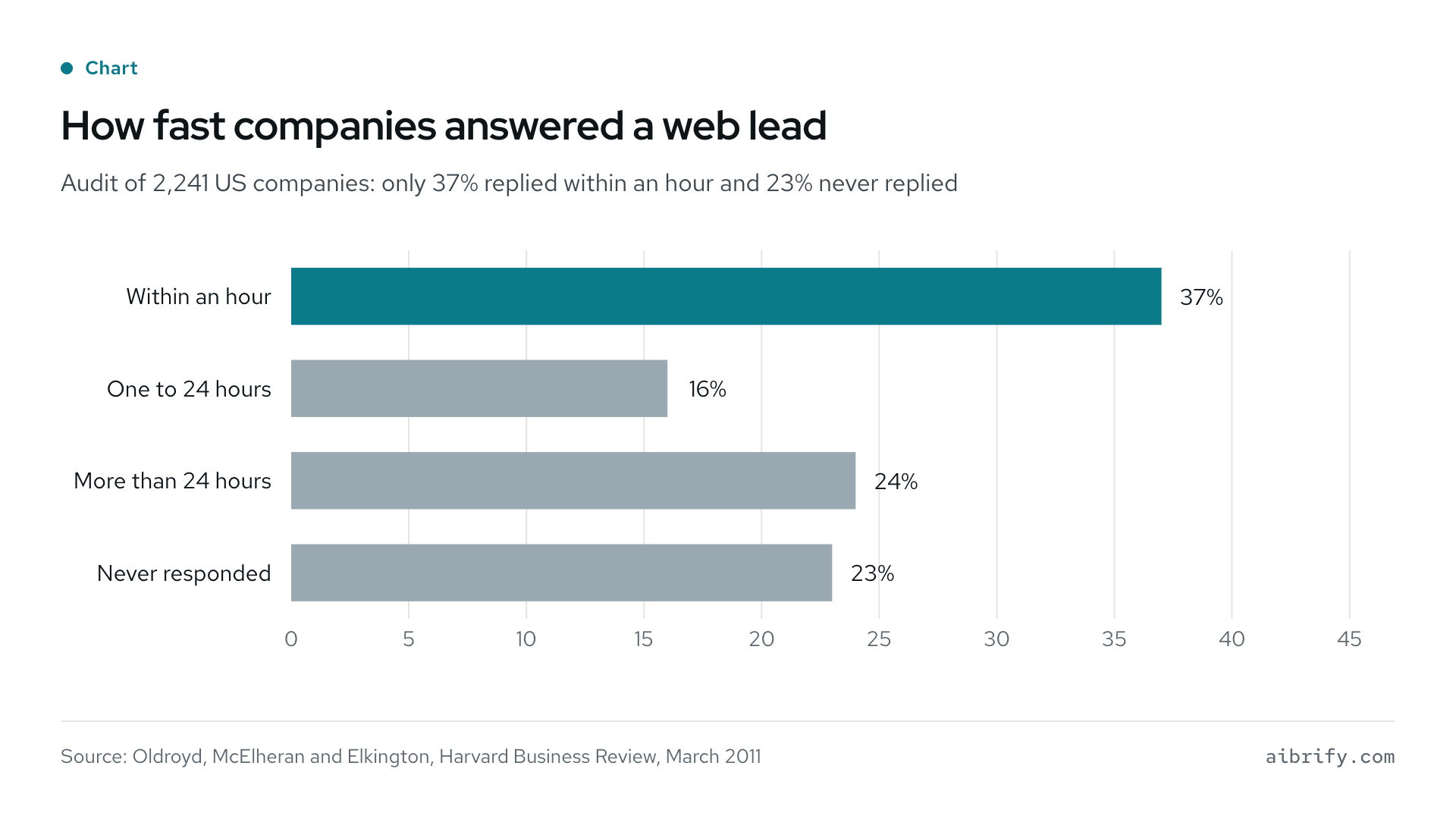
The chart shows the response-time split from the audit. The table lists the same figures.
| Response to a web-generated test lead | Share of 2,241 companies |
|---|---|
| Within an hour | 37% |
| One to 24 hours | 16% |
| More than 24 hours | 24% |
| Never responded | 23% |
A sign-in tool that texts within minutes is one way for a solo agent to reach the first group; the audit did not test it.
What Does a $300 Tool Cost Over Three Years Compared With a Subscription?
Over three years, a $300 tool with hosting at $10 to $30 a month costs $660 to $1,380. Acuity Standard costs $972 on annual billing, and Square Plus costs $1,764 for one location.
The subscription prices come from the vendors' own pages. Acuity Scheduling lists Starter at $16 a month billed annually or $20 monthly, Standard at $27 or $34, and Premium at $49 or $61. Calendly lists Standard at $10 per seat per month and Teams at $16 per seat, with payment collection through Stripe and PayPal from Standard up.
Square's unified plans, announced in October 2025, price Square Free at $0, Square Plus at $49 and Square Premium at $149 a month per location. A second location on Square Plus or a second seat on Calendly doubles the bill; Acuity's Standard plan covers up to six calendars at $27. A $300 tool is priced once.
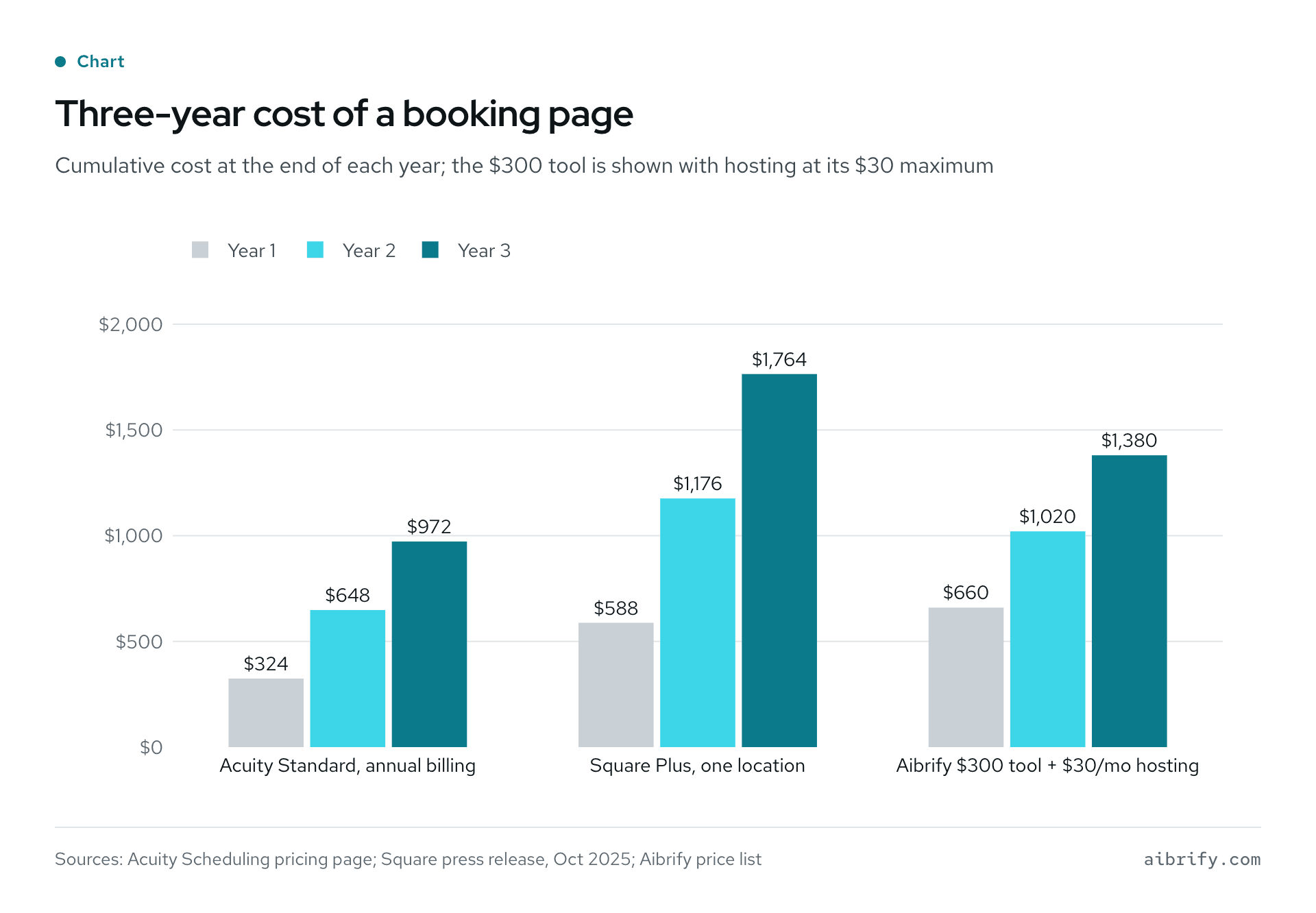
The chart stacks the cumulative cost at the end of each year, with hosting at its $30 maximum. The table adds the $10 hosting case, a single Calendly seat, and the arithmetic.
| Option | Year 1 | Year 2 | Year 3 | Arithmetic |
|---|---|---|---|---|
| Acuity Standard, annual billing | $324 | $648 | $972 | $27 × 12 per year |
| Square Plus, one location | $588 | $1,176 | $1,764 | $49 × 12 per year |
| Calendly Standard, one seat | $120 | $240 | $360 | $10 × 12 per year |
| Aibrify $300 tool, $30 a month hosting | $660 | $1,020 | $1,380 | $300 + $30 × 12 per year |
| Aibrify $300 tool, $10 a month hosting | $420 | $540 | $660 | $300 + $10 × 12 per year |
Two notes cut the other way. A single calendar on Acuity Starter costs $576 over three years and a Calendly Standard seat $360, both less than any build with hosting. And processing fees apply either way, so they do not change the comparison.
| Processor and payment type | Fee | Cost to collect a $20 deposit |
|---|---|---|
| Stripe, online domestic card | 2.9% + 30¢ | $0.88 |
| Stripe, in-person card | 2.7% + 5¢ | $0.59 |
| Square, online (Free plan) | 3.3% + 30¢ | $0.96 |
| Square, in-person (Free plan) | 2.6% + 15¢ | $0.67 |
| Square, keyed or card on file | 3.5% + 15¢ | $0.85 |
The Square rates are from its fees page, and Premium lowers in-person to 2.4 percent plus 15 cents. The Stripe rates are from its pricing page above.
What Is Included in the $300 and What Is Not?
The $300 covers the written scope, the build, one round of review on a phone, and fixes for anything broken in that scope. It does not cover changes after delivery, which are quoted separately in writing.
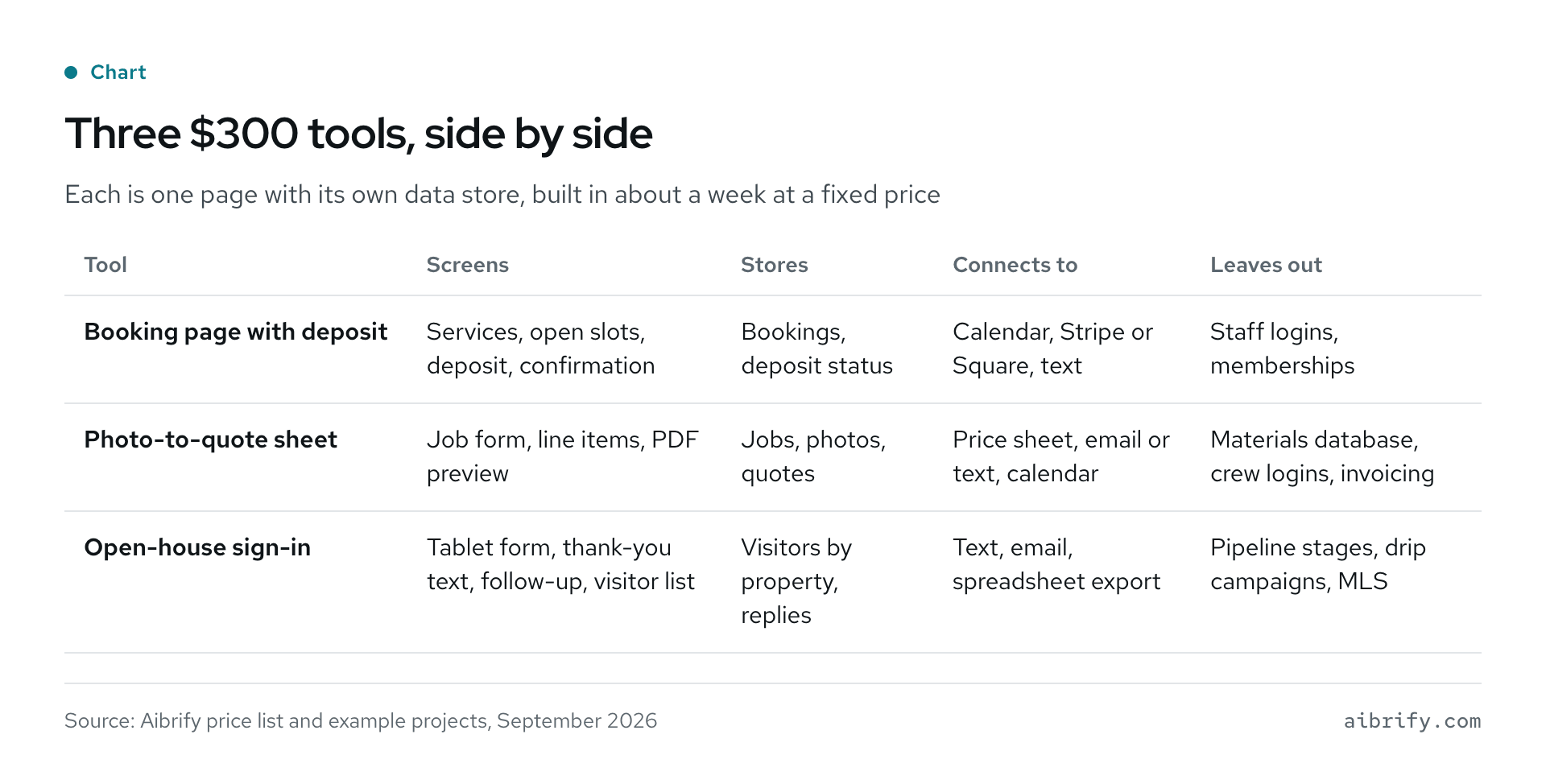
The image summarises the three examples. The table is the text version.
| Tool | Screens | Stores | Connects to | Leaves out |
|---|---|---|---|---|
| Booking page with deposit | Services, open slots, deposit, confirmation | Bookings, deposit status | Calendar, Stripe or Square, text | Staff logins, memberships |
| Photo-to-quote sheet | Job form, line items, PDF preview | Jobs, photos, quotes | Price sheet, email or text, calendar | Materials database, crew logins, invoicing |
| Open-house sign-in | Tablet form, thank-you text, follow-up, visitor list | Visitors by property, replies | Text, email, spreadsheet export | Pipeline stages, drip campaigns, MLS |
The build follows Aibrify's four steps. A five-minute brief by text, email or WeChat comes first, and Aibrify replies within one business hour. A written scope with the fixed $300 price follows, then the build, then a review on the owner's phone, all within about a week.
The client owns the code and can take it anywhere, with optional Aibrify hosting at $10 to $30 a month. The ownership guide explains what the handover includes, and the cost guide places the $300 tier between the $100 and $1,000 tiers.
When Is a $300 Tool the Wrong Choice?
There are four reasons to skip the $300 tier. A $16 plan already fits, several people need logins, the job is a one-way message, or the workflow is still changing.
A $16 plan already fits. One calendar, standard services, no custom rule about deposits or timing. Acuity Starter or Square Free covers it, and the build-or-buy guide explains why buying wins when a packaged tool covers most of the job.
Several people need logins. Once staff need their own views, or customers need accounts, the job is a $1,000 application. A membership tracker, a document intake portal or a wholesale order form with tiers lives there.
The job is a one-way message. A reminder, an alert or a report that emails itself has no page and no customer input. That is a $100 automation, and paying $300 for it buys nothing extra.
The workflow is still changing. A tool freezes a process into screens. If the salon has not decided whether to take deposits, or the contractor changes the price list weekly, settle the process on a spreadsheet first. Spreadsheet plus automation or a custom app covers that decision.
There is also the case where the tool would help everyone in the trade. Post it on the wish wall: every month Aibrify builds one requested tool for free, and anyone can use it.
Frequently Asked Questions (FAQ)
How much does a custom booking page cost for a small business?
A custom booking page with a deposit costs $300 at Aibrify, fixed in writing, with delivery in about a week and optional hosting on top. Subscription alternatives run $16 to $61 a month for Acuity Scheduling and $49 a month per location for Square Plus. The page and the code belong to the owner after delivery.
What is included in a $300 tool?
A $300 tool includes a written scope, one page or form built for a phone, its data store, and links to existing tools. It also includes a review round and fixes for anything broken in the delivered scope. Changes after delivery are quoted separately in writing, and the client owns the code.
Can a $300 booking page take deposits?
Yes, through a payment processor such as Stripe, which charges 2.9 percent plus 30 cents on a domestic online card payment. A $20 deposit therefore costs 88 cents to collect. The deposit rule, the refund window and the cancellation notice are written into the scope before the build starts.
Is a $300 tool cheaper than Acuity or Square Appointments?
Over three years, a $300 tool with $10 to $30 a month hosting costs $660 to $1,380. Acuity Standard on annual billing costs $972, Square Plus costs $1,764 for one location, and Acuity Starter costs $576. The build wins on fit and ownership; on price it beats a second Square location and loses to one Acuity Starter or Calendly Standard seat.
How long does a $300 tool take to build?
About a week. The brief takes five minutes by text or email, and a written scope with the fixed price follows before any work starts. The build runs against the owner's real services, prices or listings, and the owner reviews the result on a phone before it goes live.
Who owns the booking page after it is built?
The client owns the code and the data, and can host the page anywhere. Hosting with Aibrify is optional at $10 to $30 a month, and the handover includes the code and the credentials. A subscription page ends with the subscription; whether the booking history can be exported first depends on the vendor's terms.
What is the difference between a $300 tool and a $1,000 application?
A $300 tool is one page or form with a single data store, used by customers or by the owner. A $1,000 application adds logins, roles and records shared between several people, such as a client portal or a membership tracker. Multiple users with their own views is the dividing line.
Can the tool work in Chinese and English?
Yes: Aibrify works in both languages, so a booking page, a quote PDF or a sign-in form can show English, Chinese or both. Confirmation texts follow the customer's choice. The languages are set in the written scope and cost nothing extra at the $300 price.
What Should You Do Next?
Name the page the business is missing: a way to book, a quote before leaving the driveway, or a sign-in that follows up. Three lines cover the brief: what the page must show, what it must save, and which tool it must talk to.
Text or email those three lines to Aibrify; the reply comes within one business hour. The written scope with a fixed $300 price arrives before any work starts, delivery takes about a week, and the client owns the code. Start a project with the three lines, or read the current prices first.


