What Is Missed Call Text Back and How Much Does It Cost?
Missed call text back is a small automation. When a call to your business rings out, the caller gets a text within seconds that names your business and asks what they need.
In 2026 it comes bundled in business phone apps from $19 a user a month and in texting platforms from $39 a month. All-in-one marketing CRMs sell it from $97 a month. Aibrify, a software company in Los Angeles, builds the same automation for a fixed $100.
After delivery you pay only your own messaging bill, a few dollars a month at small business call volumes. The code, the messaging account and the number stay in your name.
This guide covers the mechanic, the consent and registration rules, and every option with its October 2026 price. It ends with the case for having the call answered instead, which is what Aibrify Desk does.
Why Does a Missed Call Cost More Than It Looks?
Because most missed callers never reach you again, and a call-back from an unknown number usually goes unanswered. Invoca's 2026 benchmark, built on 70 million business calls, found that only 56% of calls were answered by a person. Removing quick hang-ups helps a little: 65% of calls over 15 seconds and 71% of calls over 30 seconds reached someone.
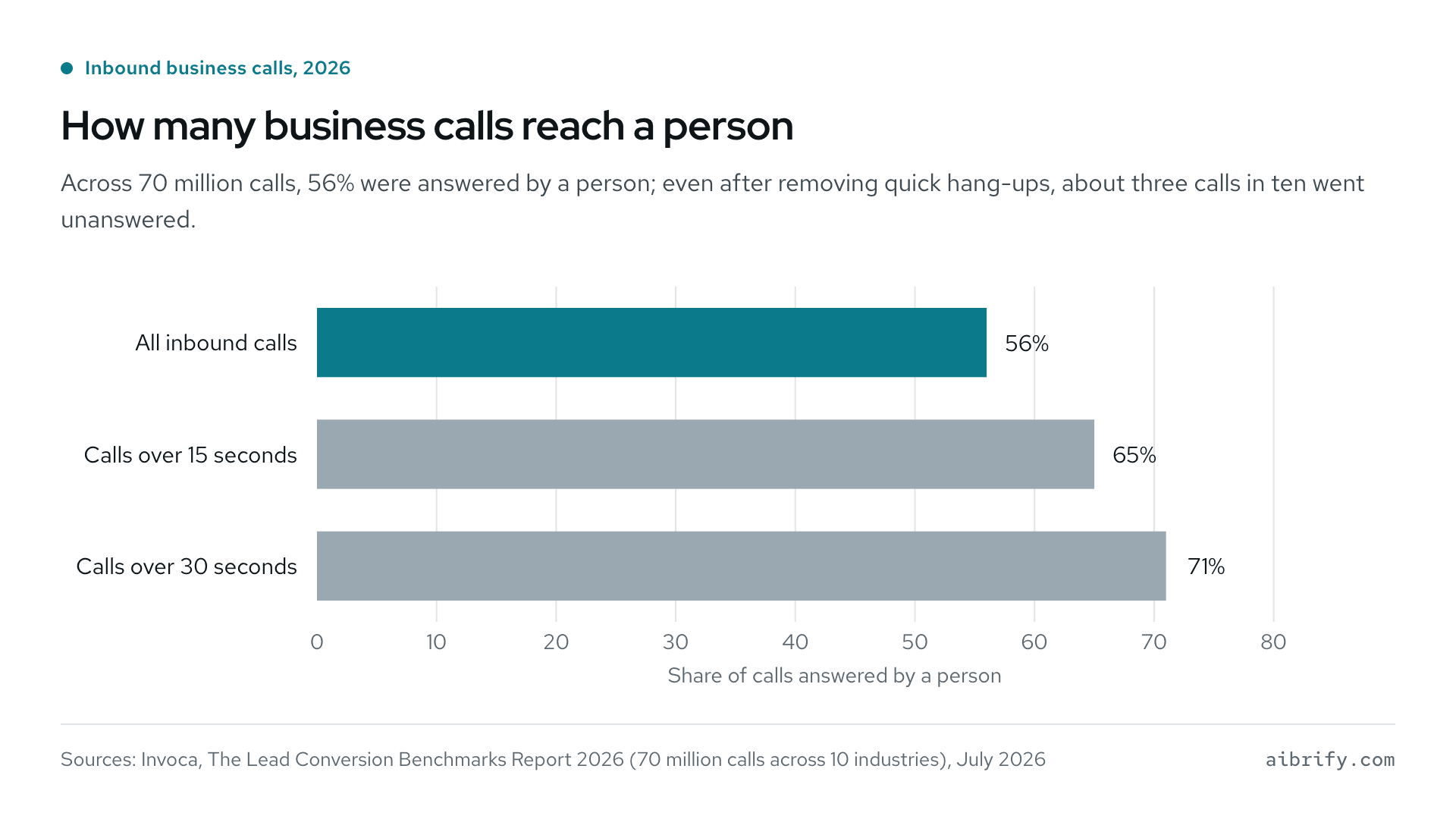
Invoca's three answer rates, repeated in the table.
| Calls measured | Answered by a person |
|---|---|
| All inbound calls | 56% |
| Calls longer than 15 seconds | 65% |
| Calls longer than 30 seconds | 71% |
Small businesses are no exception. In early 2025, Ohio State researchers posing as dog owners called more than 5,000 veterinary practices in six states. They got an appointment 67% of the time.
The failures came when callers "couldn't connect with staff or were on hold for excessively long periods", with five minutes as the cutoff. Only in almost 4% of cases was the practice full and not taking new patients.
Calling back does not repair it. In a 2020 Pew Research survey of 10,211 adults, eight in ten said they generally do not answer calls from unknown numbers. Two thirds (67%) let it ring and check voicemail only if one is left, so your call-back often becomes a second missed call.
A text lands differently. It arrives on a device that 98% of US adults own, by Pew's 2025 count of 5,022 adults. It stays on the screen until it is read, and the caller does not have to pick up or recognize your number.
How Does Missed Call Text Back Work?
A missed call becomes a text through three parts. A line reports the missed call, a texting-enabled number sends the message, and a short script connects the two. The script fires when the ring timeout passes with no answer, takes the caller's number, and sends your prewritten message.
| Step | What happens | Who does it |
|---|---|---|
| The call rings out | Nobody picks up before the ring timeout, or every line is busy | Your phone line |
| The miss is recorded | The caller's number and the time are captured | Phone system or forwarding number |
| The text goes out | Your prewritten message leaves from a texting-enabled number | The automation |
| You are told | The caller's number reaches you by text, email or a row in your sheet | The automation |
| The caller replies | A real conversation starts, on your schedule | You, from your phone |
Which number sends the text? Often the one the customer dialed. When your main line cannot text, the automation uses a second number and puts your business name in the first line.
GoHighLevel's own documentation describes the same trigger: the feature "automatically sends a text message to a caller when their inbound call is missed". Only calls "that go unanswered past your incoming call timeout" count, and answered calls never trigger it. Every tool on the market works this way; the differences are price, who owns the setup, and what else comes in the box.
What should the text say?
Three things, in this order: who you are, that you saw the call, and one question. No offers, no links to promotions, and a way to opt out. Keep it to one message segment, because providers such as Twilio bill per segment.
Hi, this is [business name]. Sorry we missed your call. Is this about a repair today, or can we call you back after 2 pm? Reply STOP to opt out.
This is [clinic name]. We saw your call and will phone you back within the hour. To book now, reply with a day and time that suits you. Text STOP to end messages.
[Restaurant name] here, sorry we missed you. For a table tonight, reply with party size and time. For catering, reply CATER and we will call you.
What missed call text back does not do
It does not answer the call, so it cannot book, quote, or calm an upset customer. Some callers who wanted a person right now will dial the next business while your text arrives.
That gap is what an AI receptionist closes, and the last two sections compare the two approaches.
What Rules Apply When You Text a Caller Back?
Three sets of rules apply: the TCPA as written in the FCC's rules, carrier registration for business texting (A2P 10DLC), and your messaging provider's policy. This section states what those documents say; it is not legal advice, so check the setup with your lawyer.
For marketing texts, the FCC's rules require "prior express written consent": a signed written agreement that authorizes the seller to send advertisements or telemarketing messages. A text-back that only acknowledges the call and asks what the caller needs is a reply, not a campaign. Adding a coupon or a promotion changes its character.
Twilio's messaging policy puts it plainly: "If an individual sends a message to you, you may respond in an exchange with that individual". That "conversational engagement does not provide you necessary consent" for marketing, and every message must "clearly identify you". Senders are also required to "retain proof of all consents obtained from recipients".
| Rule | What the document says | Source |
|---|---|---|
| Marketing consent | A signed written agreement that authorizes the seller to send advertisements or telemarketing messages | 47 CFR 64.1200 |
| Revoking consent | Any reasonable manner counts, including the words stop, quit, end, revoke, opt out, cancel or unsubscribe sent by reply text | 47 CFR 64.1200; FCC order adopted February 15, 2024 |
| Time to honor a revocation | "Within a reasonable time not to exceed ten business days" | 47 CFR 64.1200 |
| Confirmation text | One text confirming the opt-out is allowed if it has no marketing and is the only further message | 47 CFR 64.1200 |
| Hours for solicitations | Not before 8 am or after 9 pm, local time at the called party's location | 47 CFR 64.1200 |
| Sender identity and STOP | Every message must identify the sender; the first message carries "Reply STOP to unsubscribe" or an equivalent | Twilio Messaging Policy |
| Carrier registration | "Anyone sending SMS/MMS messages over a 10DLC number from an application to the US must register for A2P 10DLC" | Twilio A2P 10DLC docs |
The opt-out rule changed in 2024. The FCC's order of February 15, 2024 made revocation "in any reasonable manner" explicit, set the ten-business-day limit, and allowed a single confirmation text.
Providers now catch those words for you. Twilio treats STOP, UNSUBSCRIBE, END, QUIT, STOPALL and CANCEL as opt-outs by default, and added REVOKE and OPTOUT on May 13, 2025.
What A2P 10DLC registration involves
A2P 10DLC is the carriers' registry for business texts sent from regular ten-digit local numbers. You register a brand (who is sending) and a campaign (what you send, and how people opt in, opt out and get help). Twilio's documentation says unregistered senders "will receive additional carrier fees for sending unregistered traffic", while registration brings lower filtering and higher throughput.
The fees are small. Twilio lists a one-time $4.50 brand fee and $41.50 for standard brand vetting. Quo charges a $19.50 one-time review plus $1.50 to $3 a month, and Textline adds a $15 campaign fee each month on 10DLC numbers.
Budget a one-time fee under $50 and a monthly fee under $20. Ask who holds the registration, because it follows the account, not the business.
Which Missed Call Text Back Options Exist and What Do They Cost?
Five kinds of options exist: your phone's decline-with-text replies, a business phone app, a texting platform, an all-in-one marketing CRM, and an automation you own. Prices below are from each vendor's pricing page as of October 2026.
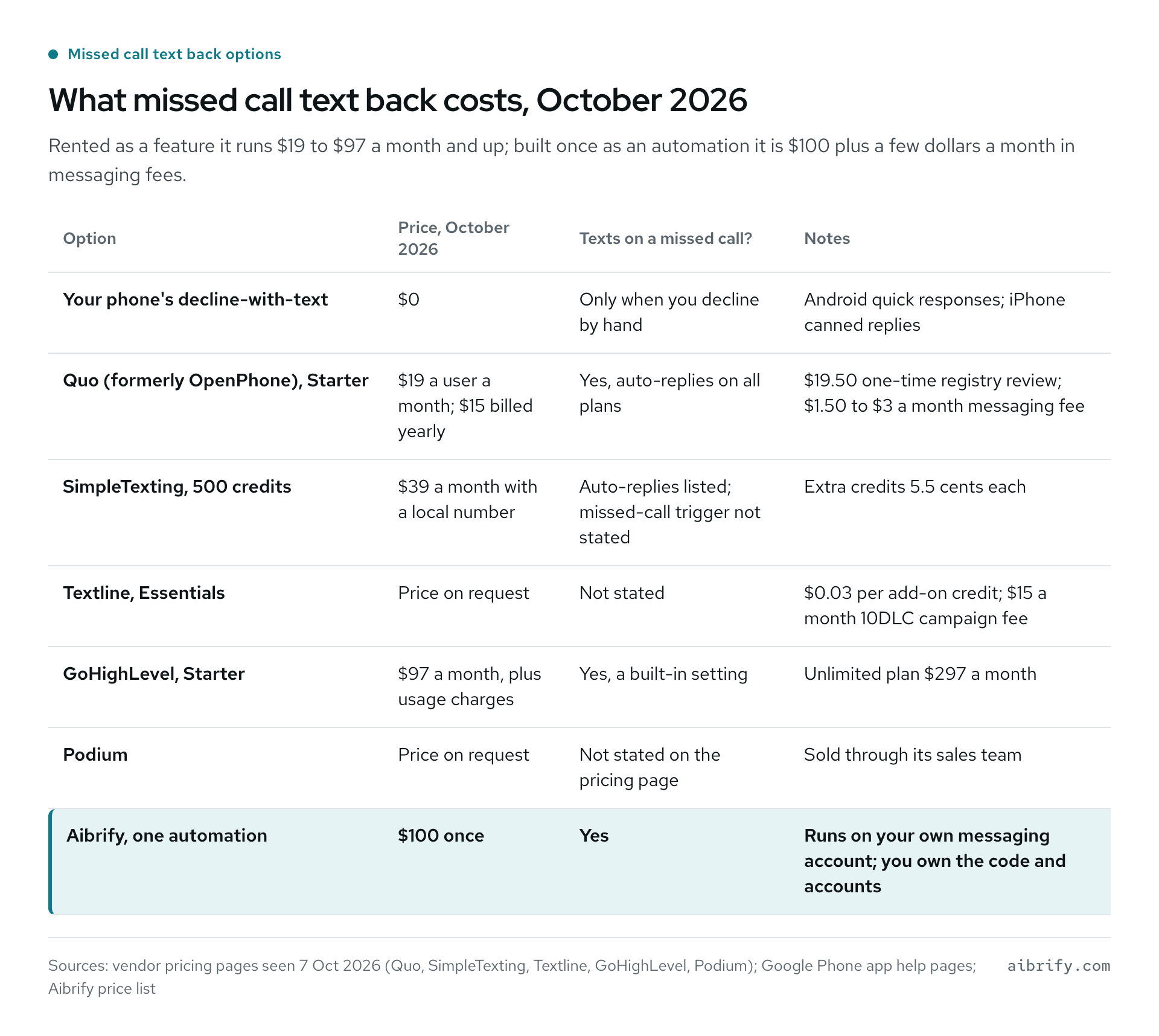
The same data follows, with notes.
| Option | Price, October 2026 | Texts on a missed call? | Notes |
|---|---|---|---|
| Your phone's decline-with-text | $0 | Only when you decline the call by hand | Android quick responses; iPhone has the same kind of canned replies |
| Quo (formerly OpenPhone), Starter | $19 a user a month; $15 billed yearly | Yes, auto-replies on all plans | $19.50 one-time registry review; $1.50 to $3 a month messaging fee |
| SimpleTexting, 500 credits | $39 a month with a local number | Auto-replies listed; a missed-call trigger is not | Extra credits 5.5 cents; carrier fees about $0.0025 a message |
| Textline, Essentials | Price on request | Not stated | $0.03 per add-on credit; its numbers carry no voice service |
| GoHighLevel, Starter | $97 a month, plus usage charges | Yes, a built-in setting | Unlimited plan $297 a month; 3 sub-accounts on Starter |
| Podium | Price on request | Not stated on the pricing page | Sold through its sales team |
| Aibrify, one automation | $100 once | Yes | Runs on your own messaging account; you own the code and the accounts |
The phone itself
Android's Phone app can reject a call with a text: "To reject the call and send a text message to the caller, tap Message". The canned replies live under Quick responses, where you can edit the wording. iPhone offers the same kind of decline-with-text replies.
The catch is the word "reject". The text goes out only when you see the call and decline it. A call that rings out while you are under a sink or with a patient sends nothing.
Google's Take a Message on Pixel 6 and later answers a missed call with a greeting and saves a transcript. It does not text the caller either.
What the $97-a-month CRM includes that a $100 automation does not
GoHighLevel's Starter plan is $97 a month for three sub-accounts, unlimited contacts and users, and "all core features"; "usage based charges apply". Missed call text back is one setting in a system that also holds pipelines, calendars, a two-way inbox and email campaigns. If your team will live in that system every day, the price buys a lot.
If you only want the text, the arithmetic is different. Twelve months of Starter is $1,164 before usage, and the feature switches off the month you stop paying. A $100 automation that you own keeps running, and the saving covers other automations that remove different chores.
What the automation costs to run
The running cost is your messaging bill. On Twilio's US price list, a local number is $1.15 a month and each outbound text segment is $0.0083. Carriers add $0.0035 (AT&T) to $0.005 (Verizon) per message, so one hundred missed calls cost about $1.33 in texts.
| Monthly volume | Texts sent | Message cost (segment plus carrier fee) | Number | Total before campaign fee |
|---|---|---|---|---|
| 50 missed calls | 50 | about $0.67 | $1.15 | about $1.82 |
| 100 missed calls | 100 | about $1.33 | $1.15 | about $2.48 |
| 300 missed calls | 300 | about $3.99 | $1.15 | about $5.14 |
Hosting the script with Aibrify is optional at $10 to $30 a month, or it runs anywhere you choose. Either way the total stays under one month of the CRM.
A payback check with your own numbers
Use your call log, not a vendor's statistic. Count the calls you missed last month, estimate how many of those callers would have booked, and multiply by your average ticket. If you missed 40 calls, one in ten would have booked, and a job is worth $300, the gap is $1,200 a month.
Against that number, every option on the table pays back inside a month if it rescues a single job. The question is not whether to text missed callers. It is whether to rent the feature every month or own it for $100.
How Do You Set Up Missed Call Text Back Without a CRM?
Setting it up without a CRM takes a texting-capable number, a messaging account in the business's name, a short script, and an afternoon of testing.
- Step 1: Decide which number receives calls and which sends texts. If they differ, the first line of the text carries your business name.
- Step 2: Forward unanswered calls from your main line to the number the automation watches, or connect a business line that reports missed calls.
- Step 3: Open the messaging account in the company's name and complete A2P 10DLC brand and campaign registration before the first text.
- Step 4: Write the message: identity, acknowledgment, one question, and an opt-out line.
- Step 5: Choose where the caller's number lands: a text to you, an email, or a row in the spreadsheet you already use.
- Step 6: Test with your own phone and a friend's: ring out, read the text, reply STOP, and confirm nothing else arrives.
- Step 7: Review the log after two weeks and change the question if the replies point to a better one.
A software company can do steps 2 through 6 in a few days. At Aibrify that is the $100 automation: written scope and fixed price first, and you check the work on your phone as it takes shape.
You own the code, the repository and the accounts from delivery, and anything broken in the delivered scope is fixed free for 90 days. The ownership guide explains what you receive.
When Should the Call Be Answered Instead of Texted?
When the caller needs an answer now: a table tonight, a same-day repair, a cancellation, a question about hours or prices. A text-back buys time; an answered call closes the loop. Aibrify Desk is an AI receptionist that answers the call itself for $179 a month with 400 minutes included.
Extra minutes are $0.30 each, setup is included, and the plan is month to month. Desk works in English, Mandarin and Spanish (Cantonese is not supported). The business keeps its number and forwards calls.
Every call opens by saying it is an AI assistant, and the call is transcribed with no audio kept. Desk books appointments into its own calendar, answers common questions from material the owner provides, and takes messages. When it is unsure it transfers to a person, and a summary follows each call by email or Slack, in Chinese or English.
| Missed call text back | Aibrify Desk | |
|---|---|---|
| What the caller gets | A text within seconds | A conversation in English, Mandarin or Spanish |
| Books an appointment | No, the caller replies and you book | Yes, into Desk's calendar |
| Answers questions | No | Yes, from the owner's material |
| Takes a message | Yes, by reply text | Yes, with a summary by email or Slack |
| Transfers to a person | No | Yes, when unsure |
| Price | $100 once, plus a few dollars a month to run | $179 a month, 400 minutes included |
The two are not rivals. A clinic, a plumber or a salon can run both: Desk takes the forwarded calls, and the text-back covers any line that still rings out. Restaurants get reservations and questions today; phone ordering for restaurants is coming soon.
Industry pages explain the setup for restaurants, HVAC companies, dental offices and salons. The cost guide compares Desk with other receptionist services.
What Does Aibrify Charge for Missed Call Text Back?
At Aibrify, missed call text back is a single $100 automation, and it usually ships in two to three days. The price is fixed and quoted in writing before work starts. The job includes the owner alert and the log to a sheet you already keep.
The automation integrates with the tools you already use. It can read your calendar, a form or an email, and send texts, emails or WeChat messages.
| Project | Price | What you get | Time |
|---|---|---|---|
| Missed call text back | $100 | The text, the owner alert, the log, STOP handling, registration set up in your name | 2 to 3 days |
| Text-back with a booking page | $300 | The text links to a page where the caller picks a time; reminders included | About a week |
| Missed-call tracker with logins | $1,000 | Every missed call becomes a lead with a status, owner and follow-up date, shared by the team | 2 to 3 weeks |
| Phone answered by Aibrify Desk | $179 a month | The call is answered, booked or transferred; summary after each call | Month to month |
After the 90-day fix window, changes are quoted at the same fixed prices, or a Care plan covers them. Care is $49 a month for one hour of changes, with a reply in two business days. The $149 plan covers four hours a month with a reply the next business day.
To start, answer the four questions at aibrify.com/start, or send a text, email or WeChat message. You get a reply within one business hour with the scope in writing and the price locked. No sales calls and no meetings are required.
The automation page lists the other $100 jobs, from appointment reminders to the 20 workflows owners automate first.
Frequently Asked Questions
What is missed call text back?
Missed call text back is an automation that sends a text to any caller whose call to your business goes unanswered. The message leaves within seconds of the ring timeout, names the business, and asks what the person wanted. The owner receives the caller's number by text, email or a spreadsheet row, and the conversation continues by text.
How much does missed call text back cost in 2026?
As of October 2026, Quo's Starter plan is $19 a user a month and SimpleTexting starts at $39 a month with a local number. GoHighLevel's Starter plan is $97 a month plus usage, while Podium and Textline quote prices on request. Aibrify builds the automation once for $100; after that you pay only messaging fees, a few dollars each month.
Is missed call text back legal under the TCPA?
The FCC's rules require signed written consent for advertisements and telemarketing texts. A plain acknowledgment sent to someone who just called you is a different message from a marketing campaign, and adding an offer changes that. Honor any opt-out within ten business days, identify your business in every message, and ask your lawyer to look over the wording.
Do I have to register for A2P 10DLC to send these texts?
Yes, when the texts come from a regular ten-digit local number through software. Twilio's documentation says anyone sending application-to-person messages over a 10DLC number to the US must register, and unregistered traffic draws extra carrier fees and filtering. Twilio lists a one-time $4.50 brand fee; providers add monthly campaign fees of $1.50 to $15.
Can my cell phone text a caller back automatically?
Only when you decline the call by hand. Android's Phone app sends a quick response when you tap Message on an incoming call, and iPhone has equivalent canned replies. When a call goes unanswered because you are busy, nothing goes out; that gap is what missed call text back software covers.
Which number does the text come from?
A number that can send texts, usually the number the customer dialed. When the main line is a landline or a personal cell phone, the automation sends from a second, texting-enabled number instead. That text opens with the business name, so the caller knows who is writing and can reply.
What should a missed call text say?
Your business name, an acknowledgment of the call, and a single question about what the caller needs. Add an opt-out line such as "Text STOP to opt out", keep the message to one segment, and leave out offers and promotional links. Make the question about the service people most often call for, so the reply is useful before you call back.
Should I use missed call text back or an AI receptionist?
Use a text-back when callers can wait for your reply and the main cost of a missed call is the lost contact. Use an AI receptionist such as Aibrify Desk ($179 a month, 400 minutes included) when callers want a booking, a price or an answer now. Many businesses run both: the receptionist answers, and the text-back covers calls that still ring out.