


How Do You Write a Software Brief in 5 Minutes?
Answer five questions in plain language: the task, who does it now, which tools it touches, what should happen instead, and what "done" looks like. That is enough for Aibrify to reply with a written scope and a fixed price before any work starts. The alternative is expensive: 47 percent of unsuccessful projects fail to meet their goals because of poor requirements management, according to PMI's 2014 in-depth report.
A software brief is a short, plain-language description of one task a business wants software to do, not a specification. The owner writes it in the owner's words, with the numbers the owner already knows. A studio answers a software brief with a written scope and a fixed price.
Aibrify is a software studio in Los Angeles with four fixed prices: a $100 automation, a $300 tool, a $1,000 application or a $5,000+ system. Every job starts with the scope on paper. This guide gives the five questions, two filled-in briefs, a list of what to leave out, and what happens after you press send.
Why Does a Short Brief Beat a Long Requirements Document?
Because projects fail by missing the point, not by missing detail. The Standish Group's 1994 CHAOS report ranked user involvement (15.9 percent) and a clear statement of requirements (13.0 percent) among the top three success factors. A five-question brief is the user writing one requirement.
In PMI's 2018 Pulse of the Profession, the top cause of failed projects was a change in the organization's priorities, at 39 percent. A change in project objectives followed at 37 percent, and inaccurate requirements gathering at 35 percent.
The same report found that 52 percent of projects completed in the previous 12 months experienced scope creep, up from 43 percent five years earlier. It put the waste from poor project performance at 9.9 percent of every dollar invested.
Requirements alone carry a measurable cost. PMI's 2014 report found 5.1 percent of every project dollar wasted through poor requirements management, or $51 million for every $1 billion spent. It also found "inaccurate requirements gathering" named as a primary cause of failure by 37 percent of organizations, up from 32 percent a year earlier.
The pattern is old. The Standish Group's original CHAOS report from 1994 found only 16.2 percent of software projects finished on time and on budget. Another 52.7 percent were completed late or over budget at 189 percent of the original estimate, and 31.1 percent were cancelled.
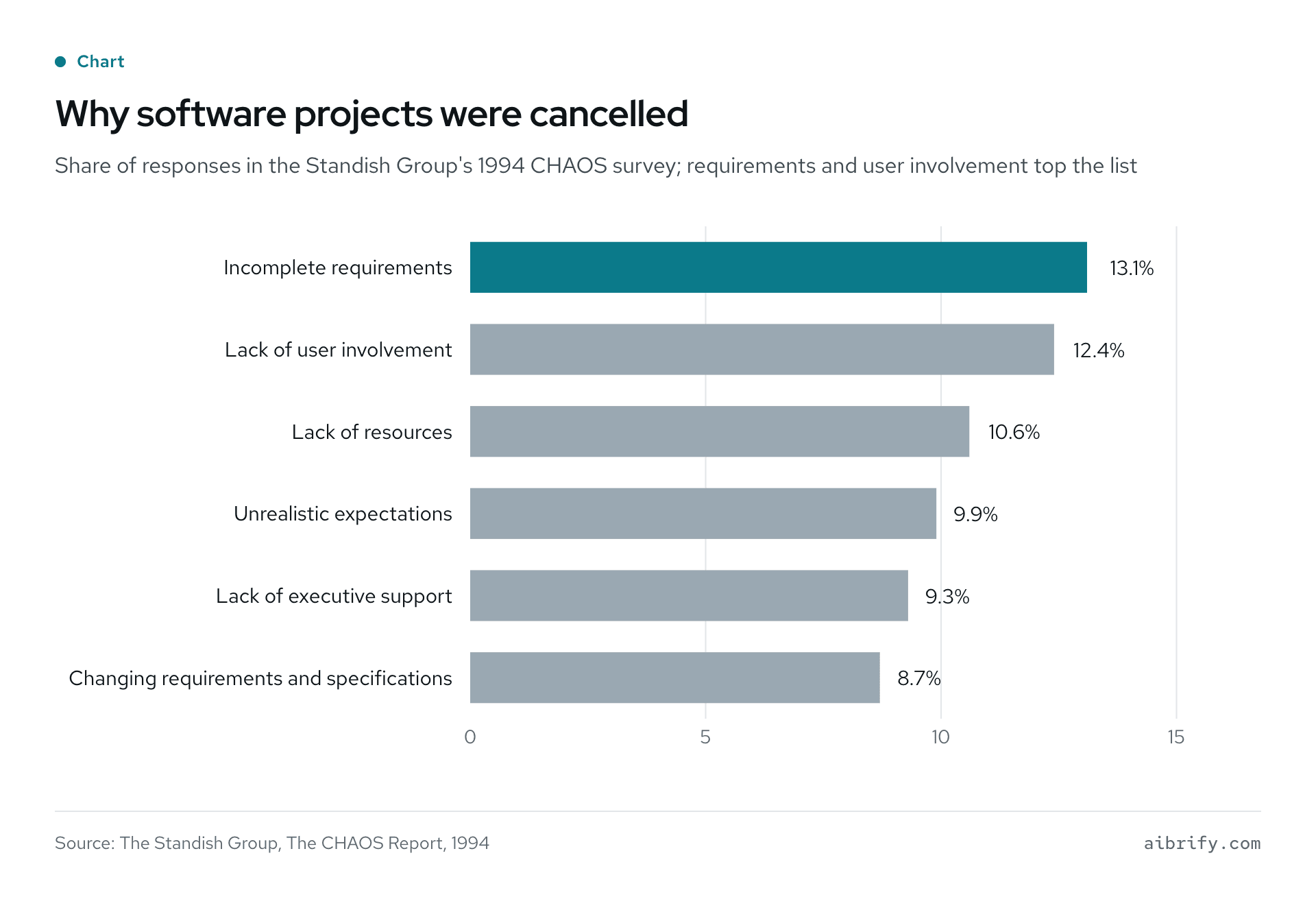
The chart shows the six most-cited factors behind cancelled projects in the 1994 report. The table lists the same figures.
| Factor behind cancelled projects | Share of responses |
|---|---|
| Incomplete requirements | 13.1% |
| Lack of user involvement | 12.4% |
| Lack of resources | 10.6% |
| Unrealistic expectations | 9.9% |
| Lack of executive support | 9.3% |
| Changing requirements and specifications | 8.7% |
The top two factors on that list are the mirror image of the two success factors above.
What Are the Five Questions in a Software Brief?
The five questions cover the task, the person, the tools, the outcome and the test. Each takes about a minute to answer, and the answers together are the brief.
1. What is the task? One sentence with a trigger and an action. "When a customer books, text them the day before" is a task; "we need a booking system" is a wish. A good answer names the moment the task starts.
2. Who does it now, and how often? A person, a frequency and a rough time. "Mei, every morning, about 40 minutes." This answer sets the value of the work, and it tells the studio which tier fits. Entrepreneurs spend 36 percent of a 45.5-hour week on administrative tasks, per a Time etc survey of 251 US entrepreneurs, so the minutes add up.
3. Which tools does it touch? Name them: Google Sheets, Square, Gmail, a paper diary, the shop's phone number. "Our spreadsheet" is fine; "our system" is not, because a studio cannot quote a connection to a tool it cannot name.
4. What should happen instead? Describe the outcome from the customer's side or the owner's side, never from the software's. "The customer gets a text at 10 a.m. the day before, with the address and a way to reply." Leave out how the software would do it.
5. What does "done" look like? A test the owner can run. For example: I book a fake appointment for tomorrow, and the text arrives at ten. If nobody can describe the test, the scope is not ready, and the price would be a guess.
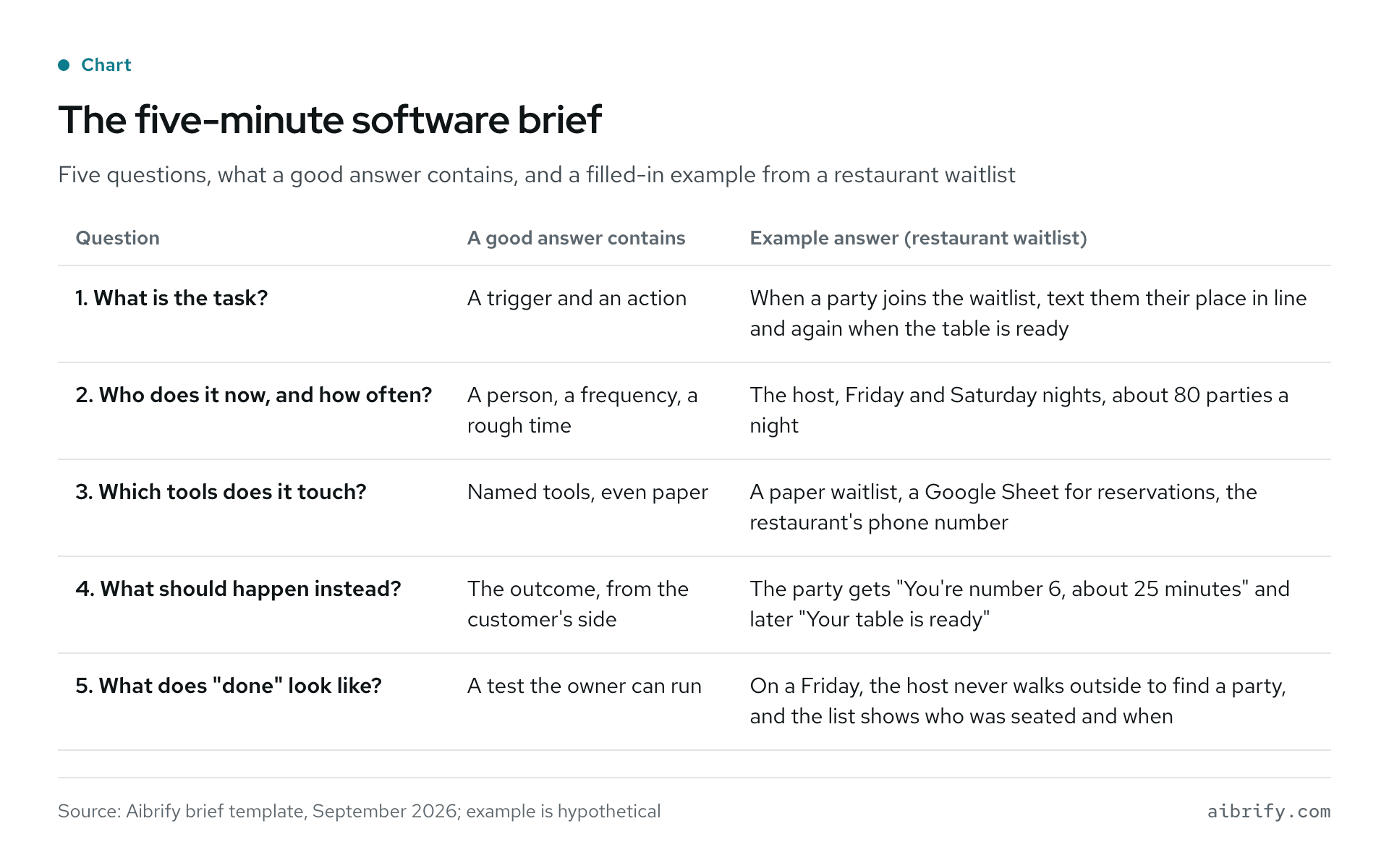
The image is the template as a card. The table is the same template with an example column.
| Question | A good answer contains | Example answer (restaurant waitlist) |
|---|---|---|
| 1. What is the task? | A trigger and an action | When a party joins the waitlist, text them their place in line and again when the table is ready |
| 2. Who does it now, and how often? | A person, a frequency, a rough time | The host, Friday and Saturday nights, about 80 parties a night |
| 3. Which tools does it touch? | Named tools, even paper | A paper waitlist, a Google Sheet for reservations, the restaurant's phone number |
| 4. What should happen instead? | The outcome, from the customer's side | The party gets "You're number 6, about 25 minutes" and later "Your table is ready" |
| 5. What does "done" look like? | A test the owner can run | On a Friday, the host never walks outside to find a party, and the list shows who was seated and when |
What Does a Filled-In Brief Look Like for a Restaurant?
Take a 60-seat restaurant that keeps a paper waitlist on Friday nights and sends the host outside to find each party. The example is hypothetical; the numbers in it are the owner's own estimates, and the prices are Aibrify's.
- Task. When a party joins the waitlist, text them their place in line, and text again when the table is ready.
- Who does it now. The host, Friday and Saturday nights. Around 80 parties a night, and a walk outside for each one.
- Tools. A paper waitlist, a Google Sheet for reservations, Square for payments, and the restaurant's phone number.
- What should happen instead. The host types a name and a phone number into a list on a tablet. The party gets "You're number 6, about 25 minutes." When the host taps "ready," the party gets "Your table is ready."
- Done looks like. On a Friday, the host never walks outside to find a party, and the list shows who was seated and when.
What comes back is a written scope for reservation and waitlist texts at $300, delivered in about a week. In scope: the tablet list, the two texts, and a day's history. Out of scope: online reservations from the website, which is a separate tool, and answering the phone, which is the virtual receptionist.
The brief took the owner five minutes because every answer was something the owner already knew. Nothing in it describes software.
What Does a Filled-In Brief Look Like for a Clinic?
Take a dental office where the front desk spends the afternoon calling tomorrow's patients to confirm. The brief covers non-clinical work only: the reminder carries the appointment time and a way to reply, and clinical questions go to staff.
- Task. The day before each appointment, text the patient to confirm, and let them reply to confirm or ask to reschedule.
- Who does it now. The front desk, every afternoon, about an hour of calls and voicemails for the next day's 30 patients.
- Tools. The practice calendar, which can export or share the day's list, and the office's phone number for texts.
- What should happen instead. At ten the day before, a text arrives with two options: C to keep the appointment, R to move it. Replies land on a list the desk sees, and an R triggers a call back from staff.
- Done looks like. By 4 p.m., tomorrow's list shows confirmed, unconfirmed and reschedule requests without a call being made.
The evidence behind the request is public. In a randomized trial at a pediatric clinic, the no-show rate was 23.5 percent with text reminders and 38.1 percent without, per Lin and colleagues. A review of 29 studies priced an automated reminder at €0.14 against €0.90 for a staff phone call, per Hasvold and Wootton.
What comes back is a scope for appointment reminders that cut no-shows at $300, about a week. Out of scope: anything clinical in the message. The intake form that becomes a PDF is a separate $300 tool listed for clinics on the homepage.
What Should You Leave Out of a Brief?
Leave out technology choices, design opinions, future features, competitor feature lists and account details. Each one makes the quote slower or wrong.
Technology choices. "Build it in X" or "use this platform" ties the studio's hands before the task is understood. Name the tools the business already uses; let the studio choose the rest.
Design opinions. Colors, fonts and layouts come after the scope. A brief that starts with the look of the page has not yet said what the page does.
Future features. "And later it should also…" is how a $300 tool becomes a $5,000 system before it exists. Write the brief for the task that will still matter in three months. A change in priorities was the top cause of failure in PMI's 2018 survey.
Competitor feature lists. "Like the app the salon down the street uses" describes a product, not a task. The studio needs the task; it can look at the product later.
Account details. No passwords, card numbers or patient names in a text or an email. Access is arranged after the scope is signed, through the owner's own accounts.
What Happens After You Send the Brief?
Aibrify replies within one business hour, by text, email or WeChat, with either a question or the written scope. The scope follows once the five answers are clear, and it comes before any work starts.
- Brief. The five answers, sent as text, email or WeChat. A photo of the paper waitlist or a screenshot of the spreadsheet helps.
- Scope and fixed quote. A written document listing inputs, outputs, tools, what is out of scope, the fixed price and the timeline. The price attaches to that document.
- Build and review. The studio builds against the owner's real data. The owner runs the "done" test from question five on a phone.
- Ship and hand over. The client owns the code and can take it anywhere. Hosting with Aibrify is optional at $10 to $30 a month, and fixes for anything broken in the delivered scope are included.
If the scope comes back larger than expected, split it. The first deliverable should be the $100 automation or $300 tool inside the larger request. The $1,000 application comes after the first one has run for a month.
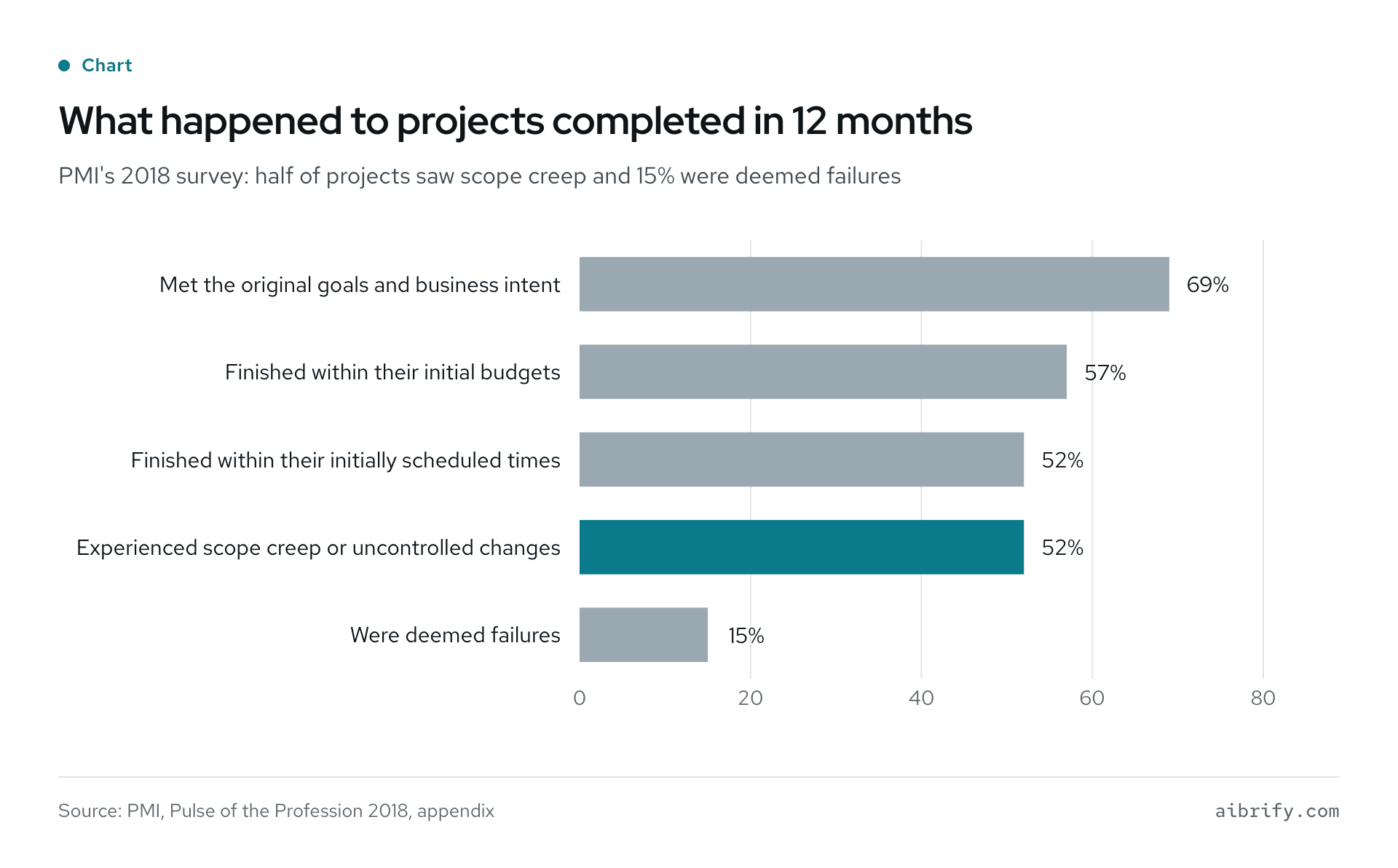
The chart shows what practitioners reported about the projects completed in their organizations over 12 months. The table lists the figures a written scope is designed to protect against.
| Projects completed in the past 12 months that… | Share reported |
|---|---|
| Met the original goals and business intent | 69% |
| Finished within their initial budgets | 57% |
| Finished within their initially scheduled times | 52% |
| Experienced scope creep or uncontrolled changes | 52% |
| Were deemed failures | 15% |
A written scope and a fixed price move the budget risk to the studio; the timeline in the scope is what protects the schedule. Anything outside the document is a new quote, not a surprise. The ownership guide covers what the handover includes.
When Is a Five-Minute Brief Not Enough?
The five-minute brief has four limits. The workflow is not settled, the job is a multi-role system, nobody can describe "done," or the request is a product.
The workflow is not settled. If the restaurant changes how the waitlist works every weekend, software would freeze the wrong version. Run it on a spreadsheet for two weeks, then write the brief; spreadsheet plus automation or a custom app explains where the line is.
The job is a multi-role system. A client portal with staff and customer views, or a wholesale system with tiered prices, is the $5,000+ tier. The five questions are still the first message, but the scope is written together, in more than one conversation.
Nobody can describe "done." A brief is a test in disguise. If the fifth answer is "we'll know it when we see it," the reply from a studio should be more questions, not a price.
The request is a product. "An app like the one the big chains use" is a product with dozens of tasks inside it. Pick the one task that costs the most time this week and brief that. The build-or-buy guide covers when a packaged product is the better answer.
One more case is welcome. If the brief describes something every business in your trade needs, post it on the wish wall. Every month Aibrify builds one requested tool for free, and everyone can use it.
Frequently Asked Questions (FAQ)
What is a software brief?
A software brief is one task a business wants software to do, described in plain language in five parts. The parts are the task, who does it now, which tools it touches, what should happen instead, and what "done" looks like. It is not a technical specification, and a studio replies to it with a written scope and a fixed price.
How long should a software brief be?
Five answers of one to three sentences each is enough for a fixed quote on a $100 automation or a $300 tool. Longer briefs tend to add technology choices and future features, which are the two things a studio has to set aside before it can quote. A photo of the current process helps more than extra pages.
Do I need to know the technology to write a brief?
No. The brief names the tools the business already uses, such as a spreadsheet or a payment app, and describes the outcome from the customer's side. Choosing the technology is the studio's job; a brief that dictates it forces the studio to price a constraint before understanding the task.
What if I don't know how long the task takes now?
Estimate it and say so. "About an hour a day, I think" is a usable answer, because the studio needs the order of magnitude, not a timesheet. Entrepreneurs in a Time etc survey spent 36 percent of a 45.5-hour week on admin; the right unit is hours a week, not minutes.
How fast will I get a quote after sending a brief?
Aibrify replies within one business hour, Pacific time, by text, email or WeChat. The reply is either a clarifying question or the written scope with a fixed price, and the scope always arrives before any work starts. A brief that answers all five questions gives the studio what it needs to write the scope without a second round.
What happens if the scope changes after the quote?
Anything outside the written scope is quoted separately in writing before it is built, so the original price never moves. Fixes for anything broken in the delivered scope are included. Changing priorities and objectives were the top two causes of project failure in PMI's 2018 survey, which is why the scope is fixed in writing.
Can I send the brief in Chinese?
Yes, by text, email or WeChat in either language, because Aibrify works in English and Chinese. The written scope comes back in the language of the brief. The finished tool can show English, Chinese or both at no extra cost within the fixed price.
Can I use a brief for a $5,000 system?
Yes, as the first message: a multi-role system with integrations is scoped together in more than one conversation. The five questions still open it, because they identify the one task that matters most. A $300 tool that proves the workflow is a sensible first step toward the system.
What Should You Do Next?
Open a note on a phone tonight, take the task that cost the most time this week, and answer the five questions for it. A photo of how the task is done today, a paper list or a screenshot, is worth a paragraph.
Text or email that note to Aibrify; a reply comes within one business hour, then a written scope with a fixed price. The scope comes before any work starts, the five-question format fits a $100 automation or a $300 tool best, and the client owns the code. The note goes in through start a project; the current prices are on the same page.


