

How Many Calls Do Dental and Medical Clinics Miss?
Small healthcare practices miss about 1 in 4 incoming calls, according to Solutionreach. A two-provider dental office taking 40 calls a day misses 10 to 14 of them. A February 2026 analysis by Peerlogic of 4,280 calls across 26 dental practices found 38 percent went unanswered.
Solutionreach reports that most of those callers never call back. A dental answering service, live or automated, is the usual fix; this guide prices every option.
A dental answering service is a live operator or an AI receptionist that picks up when the front desk cannot. It books and reschedules, gives hours and directions, takes messages, and passes clinical questions to staff. In 2026 the price runs from $99 a month for a live service to $149 a month for the Aibrify AI receptionist.
The misses cluster at two times: the busiest hour at the front desk, and the hours after the desk goes home. Roughly 30 percent of dental calls arrive outside normal operating hours, per the same Peerlogic analysis.
Aibrify builds and runs an AI receptionist that answers a clinic's line day and night, in English and Mandarin. Bookings, hours, directions and messages stay with the line; anything clinical goes to the on-call number. The plan is $149 a month with 400 minutes included and setup included, live in about a week; the receptionist page lists the terms.
What Does a Missed Call Cost a Clinic?
A missed new-patient call costs a dental office $700 to $1,200 in first-year value, using Solutionreach's benchmarks. Eye care practices lose $300 to $600 per new patient and medical practices $200 to $450. Dental Economics puts the first-year production of a new dental patient at $850 to $1,300, with lifetime value of $8,000 to $10,000.
Solutionreach's weekly model is simple. At an average new patient value of $850, the 10 to 14 daily misses at a two-provider practice leak roughly $3,000 a week.
Dental Economics works the arithmetic for a larger office with 300 to 500 calls a month. A 35 percent miss rate leaves 105 to 175 calls unanswered each month, and 60 to 65 percent of those are new-patient related. The magazine puts the annual impact for many practices at $100,000 to $200,000 or more.
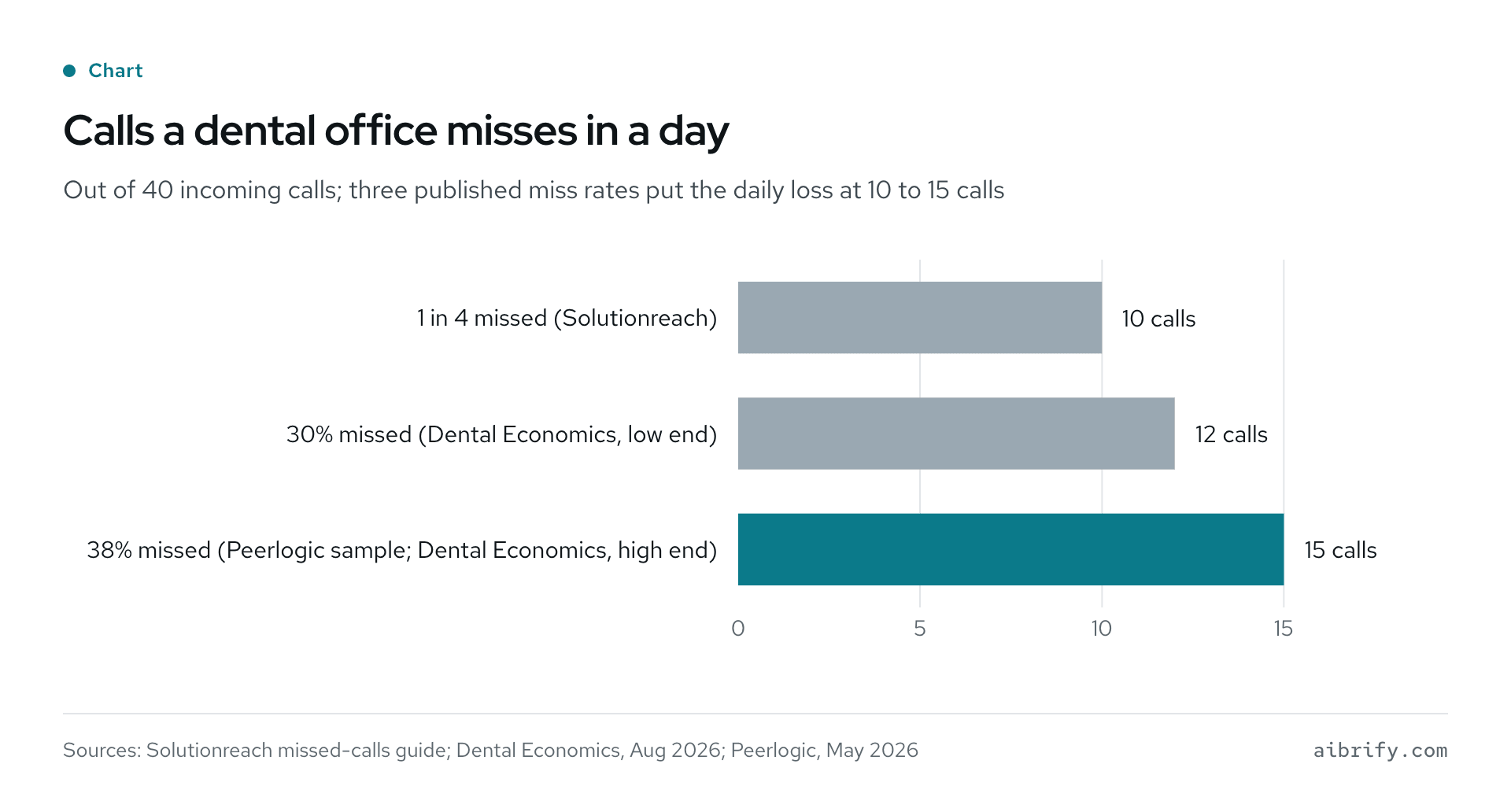
The chart applies three published miss rates to the 40 calls a day Solutionreach uses for a two-provider dental office. The table shows the arithmetic.
| Miss rate | Where it comes from | Missed calls a day, out of 40 |
|---|---|---|
| 1 in 4 | Solutionreach: small healthcare practices, peak and after-hours windows | 10 |
| 30% | Dental Economics: low end of the business-hours benchmark | 12 |
| 38% | Peerlogic: 4,280 calls across 26 practices; Dental Economics: high end | 15 |
That 60 to 65 percent share means the lost calls skew toward new business, and Solutionreach adds that most of those patients never call back.
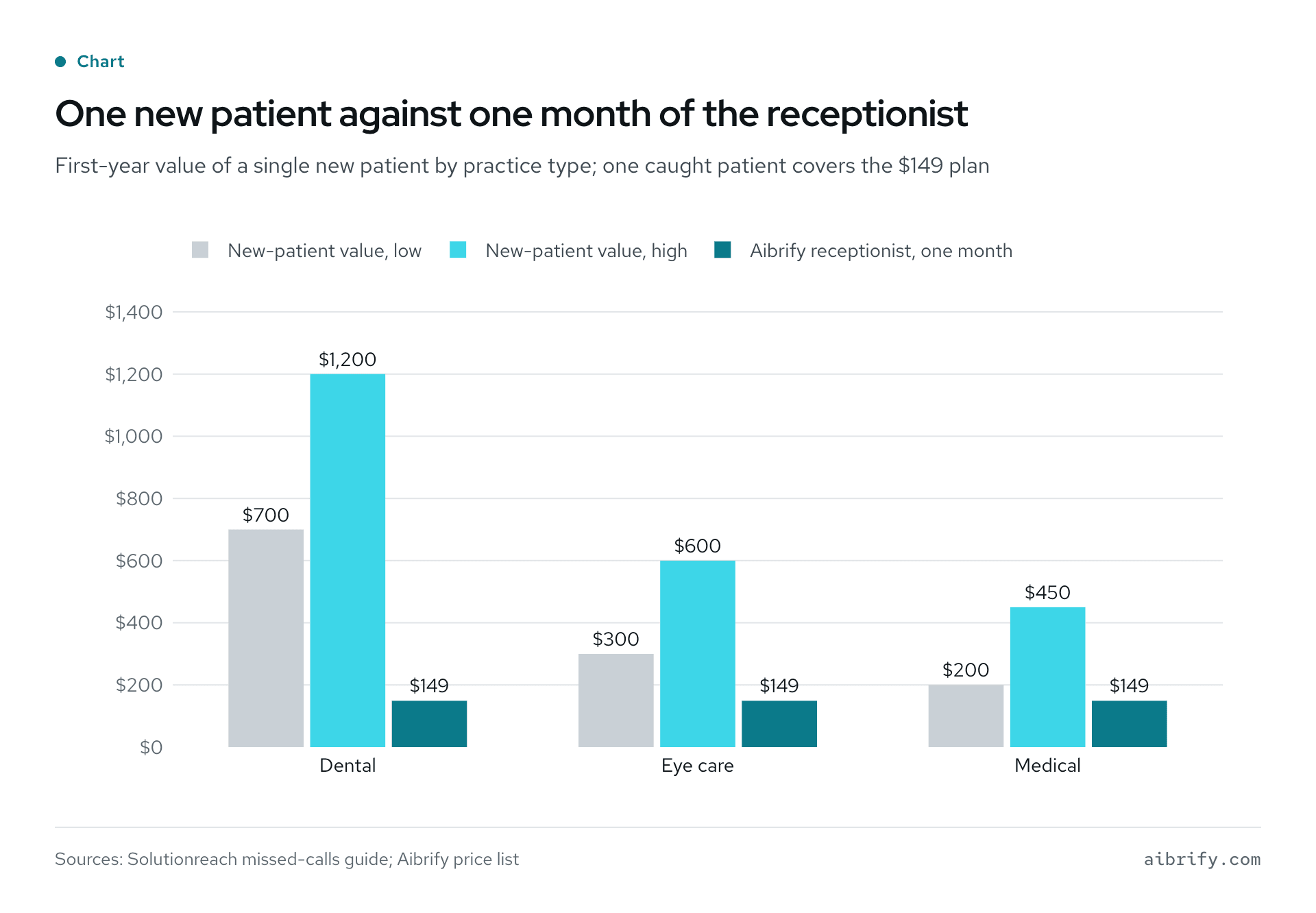
The chart sets Solutionreach's new-patient values beside the $149 monthly plan. The table lists the figures.
| Practice type | New-patient value, low | New-patient value, high | One month of the Aibrify AI receptionist |
|---|---|---|---|
| Dental | $700 | $1,200 | $149 |
| Eye care | $300 | $600 | $149 |
| Medical | $200 | $450 | $149 |
The table sets Solutionreach's benchmarks against the plan price; it does not predict how many new patients a line will catch. Dental value is five to eight times the $149 month and medical value one to three times. The break-even in either case is one new patient a month.
Why Do Clinics Miss Calls at Peak Times and After Hours?
Clinics miss calls because one front desk handles check-in, checkout, insurance and the phone at once. The phone also keeps ringing after that desk closes.
Solutionreach puts daily volume at a small practice at 30 to 60 calls. Peerlogic found that about three in ten dental calls come in outside operating hours, and those callers meet a recording rather than a person.
Voicemail does not catch what the desk drops. More than 75 percent of patients who reach voicemail hang up without leaving a message, according to PatientXpress.
Call-backs fail for a second reason. Solutionreach reports that 80 percent of Americans do not answer cellphone calls from unknown numbers, and 14 percent never check the voicemail. The office that returns a missed call the next morning is often calling a number that will not pick up.
| Where calls are lost | What happens | Source |
|---|---|---|
| Peak windows in office hours | The desk is on another call or with a patient; 1 in 4 calls missed | Solutionreach |
| After hours | Roughly 30% of dental calls arrive outside operating hours | Peerlogic, Feb 2026 analysis |
| Voicemail | More than 75% of callers hang up without leaving a message | PatientXpress, Apr 2026 |
| Next-morning call-back | 80% of Americans ignore unknown numbers; 14% never check voicemail | Solutionreach |
What Does a Dental Answering Service Cost After Hours?
A dental answering service costs $175 to $700 a month at small-business volume, per OnceHub's September 2026 pricing guide; AI receptionists run $25 to $300.
A clinic has four ways to cover the phone after hours. It can extend staff hours, subscribe to a live answering service, use an AI receptionist, or leave voicemail on. Each has a monthly price and a ceiling on what it can do.
Extend staff hours. The median receptionist earned $38,010 a year, or $18.27 an hour, in May 2025, per the Bureau of Labor Statistics. Healthcare and social assistance employs 42 percent of them. OnceHub puts the loaded cost at about $54,400 a year once benefits and payroll taxes are counted, and one person still covers one shift.
Subscribe to a live answering service. That is the $175 to $700 category in OnceHub's guide. Operators take messages and, on some plans, book into the practice's calendar.
PATLive is a typical example. It charges $99 a month for 50 minutes, $349 for 200 and $759 for 500. Extra minutes cost $1.79 to $2.29, and 24/7 answering and Spanish are included.
Use an AI receptionist. AI receptionists run $25 to $300 a month in the same guide. The test is whether the product books from the clinic's own schedule rules and transfers the rest, or only takes a message.
Leave voicemail on. Voicemail is free, and it loses more than 75 percent of the after-hours callers who hear it.
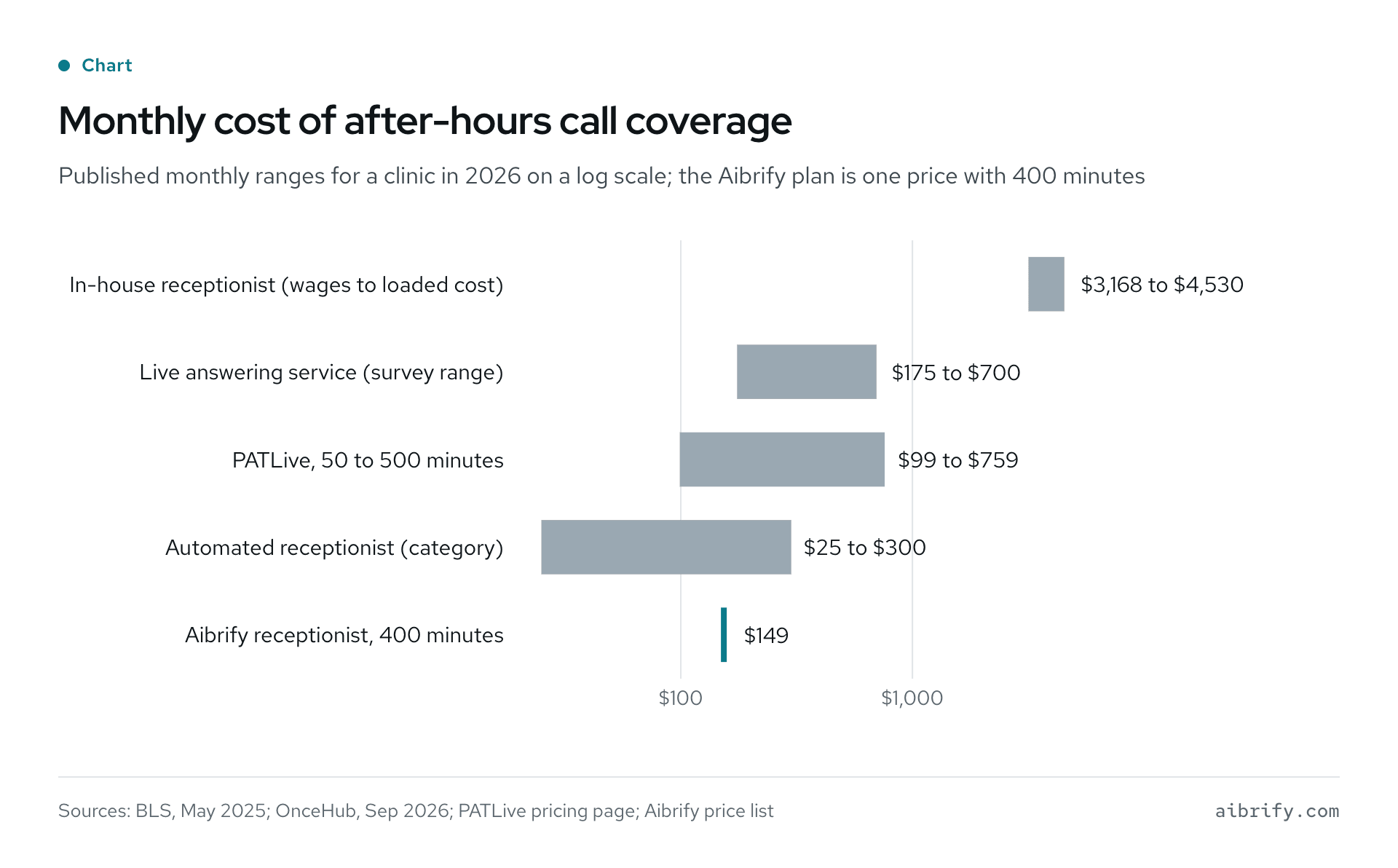
The chart shows each option's monthly range on a log scale. The table adds the sources and what the money buys.
| Option | Monthly cost | Included | After hours | Source |
|---|---|---|---|---|
| In-house receptionist | $3,168 in wages; about $4,530 with benefits and payroll taxes | One shift | Only on shift | BLS, May 2025; OnceHub, Sep 2026 |
| Live answering service, guide range | $175–$700 | Varies by plan | Yes | OnceHub, Sep 2026 |
| PATLive | $99 to $759; $1.79–$2.29 a minute over | 50 to 500 minutes | Yes, 24/7 | PATLive pricing page |
| AI receptionist, category | $25–$300 | Varies by product | Yes | OnceHub, Sep 2026 |
| Aibrify AI receptionist | $149; setup included; $0.30 a minute over | 400 minutes | Yes, 24/7 | Aibrify price list |
| Voicemail | $0 | Nothing | Loses over 75% of callers | PatientXpress, Apr 2026 |
The comparison of AI receptionists and answering services goes through the three paid categories in more detail.
What Can an AI Receptionist Take, and What Goes to Staff?
An AI receptionist takes the non-clinical calls: scheduling, rescheduling, hours, directions, which insurance the office accepts, and messages. Clinical questions go to staff. The line between the two is written down during setup, and the receptionist transfers whenever a call crosses it.
Dental Economics puts the new-patient share of missed calls at 60 to 65 percent, and a new patient's first call is a scheduling call. Those are the calls a script can carry: check the schedule rules, offer a slot, confirm, text the office a summary. A patient describing pain, bleeding, or a reaction to a medication is transferred to the on-call number with a text summary.
| Call type | Who handles it | What happens |
|---|---|---|
| New patient wants an appointment | Receptionist | Books from the clinic's schedule rules, confirms on the call, texts the office a summary |
| Reschedule or cancel | Receptionist | Takes the request and the reason and texts them to the office |
| Hours, directions, parking, insurance accepted | Receptionist | Answers from the clinic's own list |
| Message for the office | Receptionist | Takes the message and texts it to the office |
| Symptom, pain, medication or treatment question | Staff | Transfers to the on-call number with a summary |
| Anything the receptionist is unsure about | Staff | Transfers rather than guessing |
Every call opens with a notice. California requires all-party consent to record a confidential communication under Penal Code section 632, which sets a fine of up to $2,500 per violation.
The receptionist states at the start that it is automated and that the call is recorded. A caller can ask for a person at any point. Clinics outside California follow their own state's rule.
The receptionist does not replace an on-call clinician, and Aibrify makes no claims about medical privacy regulation. The clinic decides what the receptionist may say, following its own policies.
How Does the Aibrify AI Receptionist Go Live at a Clinic?
The receptionist goes live in about a week, on the clinic's existing number, following the four steps Aibrify uses for every project.
- Brief. The office manager texts or emails the hours, the services, the schedule rules, the insurance list, and the number that should receive transfers. Aibrify replies within one business hour.
- Scope and fixed quote. A five-minute conversation sets what the receptionist may say and what goes to staff. The written scope and the price, $149 a month with setup included, come before any work starts.
- Build and review. The office calls the line and tries to break it: ask a clinical question, ask for a Saturday slot, ask in Mandarin. Wrong answers are fixed before launch.
- Ship and hand over. Every call is answered in English or Mandarin, whichever the caller uses. The office gets a text summary of each call in Chinese or English, and a monthly report of the calls it answered.
The plan includes 400 minutes a month, then $0.30 a minute. The clinic keeps its own number, and calls forward to the receptionist when the line is busy or after hours; forwarding is a setting on the clinic's phone system. The price list has the current terms.
What Does a Month Look Like for a Two-Provider Dental Office?
Take a hypothetical two-provider dental office that gets 40 calls a day and misses 12 of them, the middle of Solutionreach's 10 to 14 range. Over 22 working days that is 264 missed calls. At four minutes each, catching all of them takes about 1,056 minutes.
The Aibrify plan covers the first 400 minutes for $149, and the remaining 656 minutes cost $0.30 each, or about $197. The month comes to roughly $346, with no setup fee.
Two published rates give the other side of the ledger, from different samples, so the product is an illustration rather than a forecast. Dental Economics' new-patient share is 60 to 65 percent of misses; Peerlogic's conversion in its call-center sample is 25 percent. Applied to 264 missed calls, that is about 160 new-patient calls and roughly 40 booked patients.
At $700 each, the low end of Solutionreach's dental range, the illustration gives $28,000 in first-year value against a $346 month. The real number is lower, because some callers reach the desk on a second try. A clinic can replace every benchmark in the table with its own call log and rerun the arithmetic.
| Line | Figure | Basis |
|---|---|---|
| Missed calls a day | 12 | Solutionreach: 10 to 14 of 40 calls |
| Missed calls a month | 264 | 12 × 22 working days |
| Minutes to answer them | 1,056 | 4 minutes a call |
| Aibrify plan | $149 | 400 minutes included |
| Extra minutes | $197 | 656 × $0.30 |
| Month total | $346 | No setup fee |
| New-patient calls among the misses | About 160 | 60% of 264, Dental Economics |
| Patients booked | About 40 | 25% conversion, Peerlogic |
| First-year value | $28,000 | 40 × $700, Solutionreach low end |
Three fixed-price projects sit beside the receptionist for clinics. A review request after each visit costs $100. Appointment reminders that cut no-shows cost $300, and an intake form that produces a PDF costs $300.
The clinic examples list all three, and the cost guide explains the $100 to $5,000+ ladder behind them.
When Is an After-Hours Receptionist the Wrong Choice?
Four situations argue against an AI receptionist. The after-hours calls are clinical, the volume is too low, a call center already answers, or the callers speak a language the receptionist lacks.
The calls are clinical. A surgical practice whose after-hours calls are post-operative questions needs an on-call clinician or a nurse line. Software that takes those calls and transfers them adds a step without adding care. The receptionist earns its price when most calls are bookings, hours, and messages.
Volume is too low. A solo practice that misses two calls a week may lose less than the $149 plan in a slow month. Voicemail plus a rule that every message is returned by 9 the next morning is the better buy there. A week with a tally sheet at the desk settles it before any money changes hands.
A call center already answers. Practices inside a dental group often have a scheduling center on the line. Peerlogic's 38 percent unanswered rate was measured at call centers, so the question is whether the center answers, not whether it exists.
Callers need a language the receptionist lacks. The Aibrify AI receptionist answers in English and Mandarin, as the bilingual AI receptionist guide explains. A practice whose after-hours callers mostly speak Spanish is better served by a live service with Spanish-speaking staff, which PATLive includes at no extra charge.
The restaurant AI receptionist guide walks through the same trade-offs in a business where nearly every call is an order.
Frequently Asked Questions (FAQ)
How many calls does a dental office miss?
About 1 in 4, according to Solutionreach, which estimates that a two-provider dental practice taking 40 calls a day misses 10 to 14 of them. Peerlogic measured 38 percent unanswered in a February 2026 sample of 4,280 calls from 26 practices. Dental Economics cites a benchmark of 30 to 38 percent during business hours.
What does a missed call cost a dental practice?
A missed new patient is worth $700 to $1,200 in the first year, per Solutionreach, and Dental Economics puts lifetime value at $8,000 to $10,000. Dental Economics estimates the annual impact at $100,000 to $200,000 or more for many practices. New-patient calls make up 60 to 65 percent of the misses.
How much does a dental answering service cost?
OnceHub's September 2026 pricing guide puts live answering services at $175 to $700 a month for a small business. PATLive, a typical provider, starts at $99 a month for 50 minutes and reaches $759 for 500. The Aibrify AI receptionist costs $149 a month with 400 minutes included and no setup fee.
Can an AI receptionist book dental appointments after hours?
Yes: the Aibrify AI receptionist books against the clinic's own scheduling rules, confirms the slot on the call, and texts the office a summary with the caller's name and number. Peerlogic found about 30 percent of dental calls arrive outside operating hours. More than 75 percent of callers who reach voicemail hang up without leaving a message, per PatientXpress.
What happens when a patient asks a clinical question?
The receptionist transfers the call to the on-call number the clinic chose and sends a text summary. It is set up to transfer symptoms, pain, medication, and treatment questions rather than answer them. The clinic writes the list of transfer triggers during setup and can change it by texting Aibrify the new list.
Is it legal to record patient calls in California?
Yes, with consent from everyone on the call. California Penal Code section 632 requires every party's consent before a confidential call is recorded, with a fine of up to $2,500 per violation. The Aibrify AI receptionist opens every call by stating that it is automated and recorded, and other states set their own rules.
Does an AI receptionist replace the front desk at a clinic?
No: the receptionist answers the calls the desk cannot reach, the ones that ring during check-in, at lunch, and after closing. The front desk keeps every patient in the room, every clinical question, and every transferred call. The office also gets a monthly report of the calls it answered.
How long does it take to set up an after-hours receptionist for a clinic?
About a week: the office sends its hours, services, schedule rules and transfer number, and Aibrify writes the scope and builds the call flow. The office then test-calls the line until the answers are right. The monthly plan is $149 with 400 minutes included and no setup fee.
What Should You Do Next?
Start with last week's call log, including the calls that rang after closing. Most phone systems report the count, and the voicemail total is a floor if they do not. Put that number beside Solutionreach's $700 to $1,200 new-patient value and the $149 plan; the clinic's own figures, not this guide's benchmarks, decide it.
When the count justifies it, text or email Aibrify the clinic's hours, services and the on-call number for clinical transfers. A written scope and a fixed price follow, $149 a month with setup included, and the line is live in about a week. The AI receptionist page has the terms; start a project to send the brief.


