What Can a Small Landlord or Property Manager Automate for a Fixed Price?
Four workflows cover most of the repeat work at a small property office. They are a maintenance request form ($300), rent and lease-renewal reminders ($100), a showing scheduler ($300) and an owner report that sends itself ($100). Aibrify, a software company in Los Angeles, builds each one as a fixed-price automation on the spreadsheet, calendar and phone the office already uses.
For the phone itself, an AI receptionist answers after hours at $179 a month, 400 minutes included. Every price in this guide is put in writing before any work begins. A small business with a dozen doors has the same list of chores as a management company, without the staff.
Most US rentals are run by their owners rather than by companies. HUD's 2021 Rental Housing Finance Survey counted 19.3 million rental properties holding 49.5 million units, and about 70% of those properties belong to individual investors. Only about 22% of one-to-four-unit properties are managed professionally.
So property management workflow automation for a small office rarely means a new platform. It means the rent roll in a spreadsheet, the phone and the inbox, with the repeat steps handed to software. The table lists the four workflows, the event that triggers each, and its fixed price.
| Workflow | Trigger | What the automation does | What it replaces | Price |
|---|---|---|---|---|
| Maintenance request form | Tenant opens the link | Collects unit, problem, photos, urgency and entry permission; texts the owner; confirms to the tenant | Voicemails, texts and the call to ask which unit | $300 |
| Rent and renewal reminders | A date in the rent roll | Texts or emails the tenant before the due date and after the grace period; flags leases ending soon | Monthly manual texts and missed notice deadlines | $100 |
| Showing scheduler | A prospect picks a slot | Confirms by text, reminds the morning of, reopens cancelled slots, sends the day's list | Phone tag and double-booked showings | $300 |
| Owner report | The first of the month | Builds a one-page statement from the sheet and emails it to each owner | An afternoon in a spreadsheet | $100 |
| After-hours phone | A call nobody picks up | Aibrify Desk answers, takes the request or books the showing, passes emergencies to a person | Voicemail and next-morning callbacks | $179 a month |
Where Does a Property Office Lose Time?
Maintenance, the phone and lease renewals take the most hours, and each has a number attached. The Bureau of Labor Statistics counted 460,400 property, real estate and community association managers in 2025. Their median pay was $69,990 a year, or $33.65 an hour, which is the going rate for an hour of phone tag.
The BLS lists their duties as collecting monthly fees, inspecting buildings and arranging repairs, the same list a self-managing landlord carries. Repairs are also why owners bring in help. In Buildium's 2026 State of the Property Management Industry Report, 56% of owners said maintenance support was the main reason they hired a property manager.
The same report found that only 8% of companies had fully automated any process. AI adoption, by its count, rose from 20% in 2024 to 58% in 2025. Tools are being tried; whole workflows are rarely finished.
Renters have their own list. AppFolio's 2026 Renter Preferences Report surveyed 3,002 US renters and found that 84% prioritize an online portal, while only 59% have access to one. For emergencies, 66% prefer a phone call; for nonemergencies they move to email (51%) or text (43%).
Renewals follow from service. Among residents satisfied with maintenance, 56% plan to renew, against 31% of those who are not. The chart shows what renters asked for in that survey.
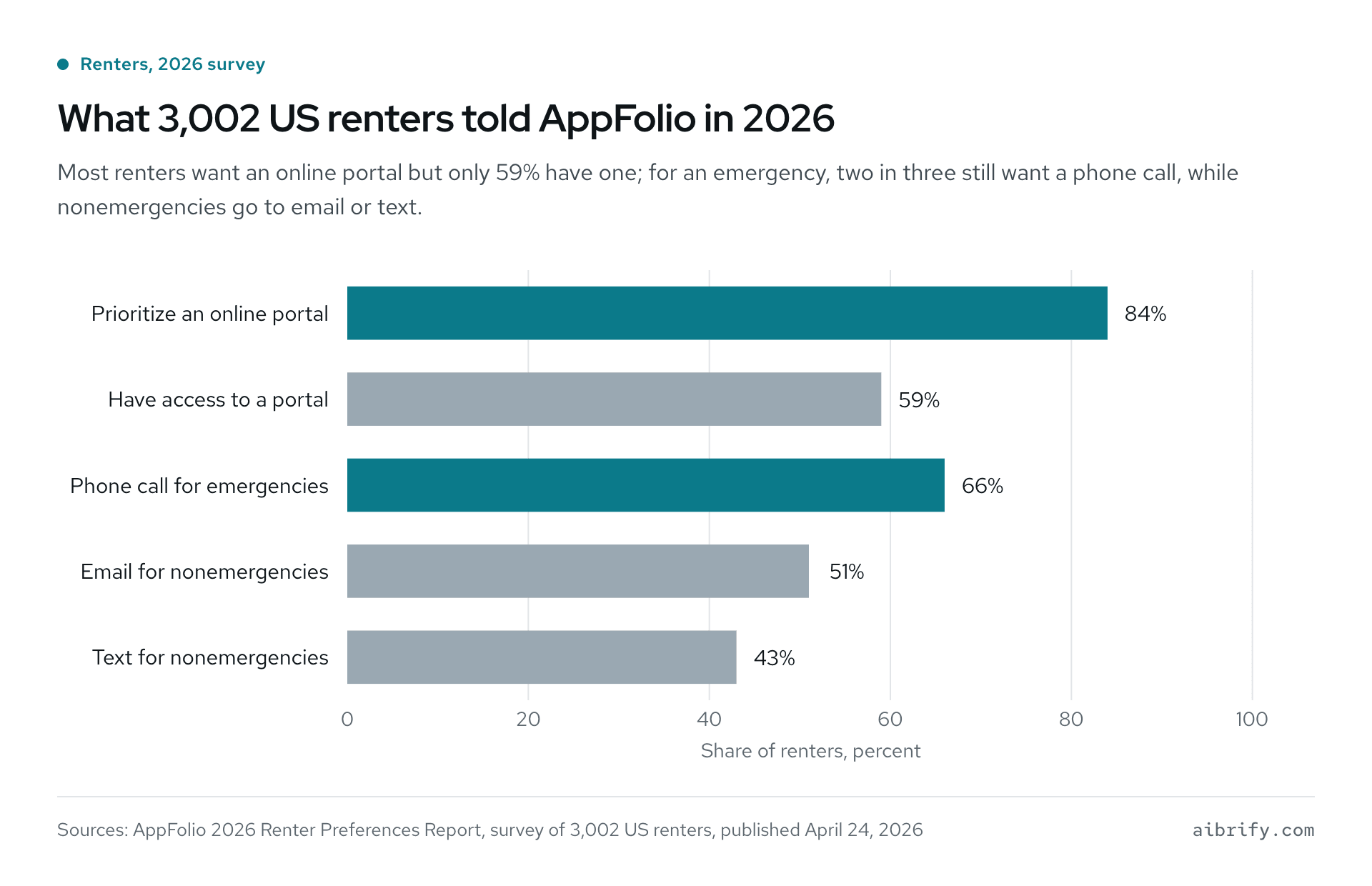
The table repeats the chart's data.
| What renters said | Share |
|---|---|
| Prioritize an online portal | 84% |
| Have access to a portal | 59% |
| Prefer a phone call for emergencies | 66% |
| Prefer email for nonemergency issues | 51% |
| Prefer text for nonemergency issues | 43% |
Three gaps follow: a request channel other than the phone, a phone that is answered at night, and reminders that go out on their own.
How Does a Maintenance Request Form Work?
The maintenance request form is a $300 page the tenant opens from a text, a fridge magnet or a QR code by the door. The tenant fills in unit, problem, photos, how urgent it is, and whether a technician may enter when nobody is home. Nothing is downloaded and nobody creates an account.
On submit, the tenant gets a confirmation text with a reference number. The owner or manager gets a text and an email with every detail, and the request lands in a sheet with a status column. When the status changes to scheduled, the tenant gets the time window by text; when it changes to done, the tenant receives a two-question follow-up.
What the form asks
- Unit and name, pre-filled when the tenant opens a personal link.
- Problem type: plumbing, electrical, appliance, heating and cooling, pests, locks, or other.
- A description and up to five photos or a short video.
- Urgency: emergency, this week, or whenever convenient.
- Permission to enter, and the best times to come.
- A line at the top: for gas, fire or flooding, call 911 first, then the office's emergency line.
Why the form pays for itself
Speed is what renters notice. In AppFolio's survey, 85% of renters with online portal access were satisfied with their maintenance experience, against 78% of those without. Among satisfied residents, 79% said issues were resolved within a few days or less, while 53% of unsatisfied residents waited weeks or more.
A form does not fix a faucet faster. It removes the two calls it takes to learn which unit, which faucet, and when someone is home. The same building block, a form that becomes a PDF and a text, is described in what a $300 tool looks like.
How Do Automated Rent Reminders and Lease-Renewal Reminders Work?
Automated rent reminders are a $100 automation that reads the rent roll and sends a text or an email on a schedule. The rent roll stays where it is: a spreadsheet with unit, tenant, rent, due date, lease end, mobile number and a consent column. Nothing is retyped, and a change in the sheet changes the next message.
Lease-renewal reminders run from the same sheet. They go to the owner, not the tenant, because renewing, changing the rent or ending a lease is the owner's decision. A typical schedule looks like this.
| When | Who gets it | What it says |
|---|---|---|
| Three days before the due date | Tenant | Rent is due on the 1st; pay the usual way; reply STOP to opt out |
| The due date | Tenant | Rent is due today |
| After the grace period in the lease and state law | Tenant | Rent is late; the fee named in the lease applies |
| The day a payment is marked received | Tenant | Payment received, thank you |
| 120 days before the lease ends | Owner | Decide: renew, change the rent, or end the lease |
| 90 and 30 days before the lease ends | Owner | Written notice deadlines for the state (see below) |
What state rules say about late fees and notices
Late-fee timing is set by state law, and the schedule follows it. In Texas, a late fee must be named in the written lease and must be reasonable. It may be charged only once rent has remained unpaid two full days after the date it was due.
The Texas statute treats a fee as reasonable at up to 12% of the rent in a structure with four or fewer units. In larger structures the figure is 10%, for leases signed or renewed on or after September 1, 2019. The "rent is late" text in Texas therefore waits until the third day.
Renewal reminders follow notice rules. In California, a rent increase of 10% or less needs 30 days' written notice, and one over 10% needs 90 days. That is the state Attorney General's summary of Civil Code 827, which also says a call, text or email about an increase is not enough.
The same page notes the Tenant Protection Act cap for covered units: 5% plus the cost-of-living change, at most 10% a year. The reminder tells the owner when the written notice has to go out. It does not send the notice, and none of this is legal advice.
Consent for texts
Texts to a mobile number are regulated. Under the FCC rules at 47 CFR 64.1200, autodialed or prerecorded calls and texts to a cell phone need the called party's prior express consent. A message that includes an advertisement needs prior express written consent.
The same rule says a request to revoke consent, made in any reasonable way, must be honored within ten business days at most. In practice that means three things:
- A consent line in the lease or the application, next to the mobile number.
- A reply-STOP line on every text.
- A stop list the automation updates by itself, so a STOP today means no text tomorrow.
A plain rent reminder carries no advertisement, but the consent column still decides who is texted and who is emailed.
How Does Showing Scheduling Work?
A showing scheduler is a $300 web page that lists the open slots for a unit and lets a prospect book one. The prospect enters a name, an email and a mobile number, then receives a confirmation text and a reminder the morning of the showing. If the prospect cancels, the slot opens again and the manager is texted; the day's list arrives by email early in the morning.
Every day a unit sits empty has a price. The Census Bureau put the median asking rent for vacant units at $1,531 in the second quarter of 2026, about $50 a day. The national rental vacancy rate in the same release was 7.3%.
A scheduler that fills a Saturday with six showings instead of three phone-tag appointments earns back its price in the first week it saves. The savings are in days, not in software.
Platforms sell this piece too, and the prices here are as of October 2026. Buildium's Showings Coordinator starts at $41 a month, plus a $25 setup fee on Essential, the obvious pick for a Buildium office. For a landlord working from a spreadsheet and a calendar, a $300 page bought once does the same booking job.
Software also keeps showings even-handed. The Fair Housing Act prohibits discrimination by landlords on the basis of race or color, religion, sex, national origin, familial status and disability. A page that offers every prospect the same slots and the same three questions is a record that the process was identical for all.
The three questions: planned move-in date, pets, and whether the listed rent and requirements work for the prospect. Nothing on the form asks about a protected class. What happens after the showing is covered in real estate lead follow-up automation.
What Is an Owner Report That Sends Itself?
An owner report costs $100 and turns the rent and expense sheet into a one-page statement. The statement goes out by email on the first of the month, one per owner or per property. For a manager, that is the owner statement without the afternoon in spreadsheets.
For a self-managing landlord, the same page goes to a partner, a spouse or the accountant. A typical layout has six blocks.
- Header: the property's name and the reporting period.
- Income: rent due, rent collected, and what is outstanding, by unit.
- Expenses: date, vendor, amount, and a link to the receipt.
- Maintenance: requests opened, closed and still open, with days to close.
- Occupancy: vacant units, days vacant, showings booked.
- Notes: anything the owner has to decide this month.
Buildium's report found that 75% of property managers plan to grow in 2026, while only 55% expanded in 2025. A report that writes itself is one task that does not grow with the door count. The sheet stays the source of truth; the report is a view of it, so a correction in the sheet corrects the report.
When a sheet stops being enough, spreadsheet automation vs a custom app covers the next step.
What Do Property Management Platforms Charge in 2026?
Platform prices run from $12 a month to a quote. At October 2026 prices, RentRedi charges $29.95 a month billed monthly, $20 a month on a six-month term, or $12 a month billed annually. Every term includes unlimited properties and tenants, and tenant screening is paid by the tenant at $39.99.
Buildium's plans start at $62 a month for Essential, $192 for Growth and $400 for Premium. AppFolio's Core plan is price on request, with a minimum spend and a 50-unit minimum. Buildium does not say on its page how many units each starting price covers.
| Tool and plan | Price in October 2026 | Notes |
|---|---|---|
| RentRedi | $29.95 a month; $20 on a six-month term; $12 billed annually | Unlimited properties and tenants; screening $39.99 paid by the tenant |
| Buildium Essential | Starting at $62 a month | Showings Coordinator from $41 a month extra; $99 setup per business bank account |
| Buildium Growth | Starting at $192 a month | Showings Coordinator setup fee waived |
| Buildium Premium | Starting at $400 a month | Highest published tier |
| AppFolio Core | Price on request | Minimum spend and 50-unit minimum |
These platforms do accounting, screening, payments and listings, which the four automations in this guide do not. The question is not platform or automation. It is what the office already has, and what it lacks.
Three cases come up most often.
- A spreadsheet office with 4 to 20 doors: the $100 reminders and the $300 request form cover the biggest gaps, with no monthly fee.
- An office that already runs a platform: one automation for the gap, say a bilingual request form, or a report in the owner's format.
- An office past 50 units choosing accounting software: pick the platform first, then add automations for what it leaves out.
AI automation for property management does not have to mean a new platform. The four workflows above run on the sheet, the calendar and the phone line already in the office, and every one has a fixed price. The chart compares a first year of each option.
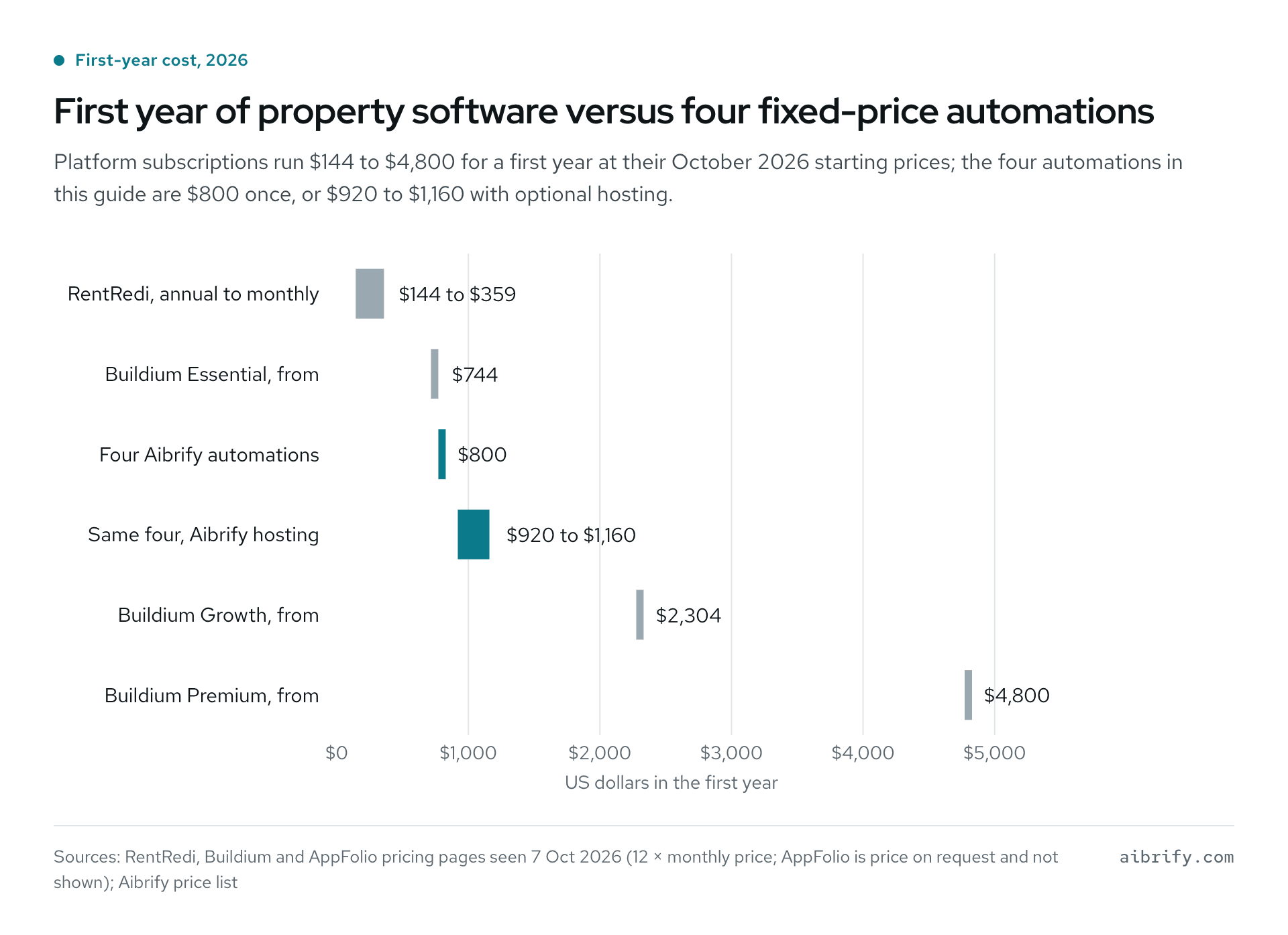
The table shows the math.
| Option | First-year cost | How it is calculated |
|---|---|---|
| RentRedi, annual billing | $144 | 12 × $12 |
| RentRedi, monthly billing | $359 | 12 × $29.95 |
| Buildium Essential, starting price | $744 | 12 × $62 |
| Four Aibrify automations | $800 once | $300 + $100 + $300 + $100 |
| The same four, hosted by Aibrify | $920 to $1,160 | $800 plus $10 to $30 a month |
| Buildium Growth, starting price | $2,304 | 12 × $192 |
| Buildium Premium, starting price | $4,800 | 12 × $400 |
The platforms include accounting, payments and screening; the $800 buys four jobs and nothing else. The comparison is about the price of the missing piece, not about a replacement.
What Should the Phone Do After Hours?
After hours, the phone is where emergencies arrive; in AppFolio's survey, 66% of renters wanted a phone call for an emergency. An AI receptionist picks up the calls the office does not. Aibrify Desk costs $179 a month with 400 minutes included, then $0.30 for each extra minute, setup included, month to month.
On a property call, Desk does the following.
- Opens by saying it is an AI assistant and that the call is transcribed; no audio is kept.
- Answers listing and office facts from the material the office provides: rent, bedrooms, pets, parking, hours, how to apply.
- Takes a maintenance request: unit, problem, urgency, callback number, and permission to enter.
- Books a showing into Desk's own calendar and reads the time back.
- For fire, gas, flooding or a break-in, directs the caller to 911 or to the emergency line and passes the call to a person.
- Transfers to a person whenever it is unsure, and takes a message otherwise.
- Speaks English, Mandarin and Spanish; Cantonese is not supported.
- Sends a summary of every call by email or Slack, in Chinese or English.
The office keeps its number and forwards calls to Desk after hours, or all day. The office also decides which topics Desk answers; lease terms, deposits and late fees are usually left to a person, and Desk takes a message. The property-office version, with what Desk answers and what it passes, is in the AI receptionist guide for property management.
Desk also has a page for real estate and property offices, and the price comparison with answering services is in AI receptionist cost.
What Does Aibrify Charge for Property Management Automation?
Aibrify builds custom automations and software for small businesses at fixed prices, quoted in writing before work starts. The automation price list has four steps, from $100 for one automation to $5,000 and up for a system. For a property office, the steps map like this.
- $100, usually live in 2 to 3 days: rent and renewal reminders, or the monthly owner report.
- $300, about a week: the request form, the showing scheduler, or an open-house sign-in with follow-up.
- $1,000, 2 to 3 weeks: an application with logins, such as a tenant portal that holds requests, documents and rent history.
- $5,000 and up: a system for a management company with owners, tenants and vendors as separate roles, scoped together first.
Every job starts with a written scope and a fixed price, and the client checks the work on a phone as it comes together. From delivery, the code, the repository and the accounts belong to the client. Hosting with Aibrify is optional, $10 to $30 a month, or the whole thing moves to any other host.
Anything broken within the delivered scope is fixed free for 90 days. After that, changes are quoted at the same fixed prices, or a Care plan covers them.
Care is $49 a month for 1 hour of changes, with a reply in 2 business days. The $149 plan covers 4 hours a month and replies the next business day.
To start, send a short brief at /start: four questions, a reply within 1 business hour, no sales call and no meeting required. A text, an email or a WeChat message works as well. Related reading:
- The full price list: /pricing.
- The $100 tier in detail: automations for $100.
- Ownership of the code and accounts: who owns the code in custom software.
- Writing the four answers: how to write a software brief.
Frequently Asked Questions
What should a small landlord automate first?
Start with the task that interrupts the most, which for most small landlords is the maintenance request. A $300 request form that collects unit, problem, photos, urgency and entry permission removes the back-and-forth calls. Reminders for rent and renewals at $100 come next, because they run every month from the rent roll with no further effort.
How much does automation for property management cost?
At Aibrify, one automation, such as rent reminders or an owner report, costs $100. A tool with its own page, such as a request form or a showing scheduler, costs $300, and an app with logins costs $1,000. Platform subscriptions, by comparison, ran from $12 to $400 a month at their starting prices in October 2026.
Do rent reminder texts need the tenant's consent?
Yes: FCC rules at 47 CFR 64.1200 require prior express consent before automated calls or texts reach a mobile phone. A message that contains an advertisement needs a signed written agreement, and a revocation has to be acted on inside ten business days. A consent clause in the lease, a reply-STOP option on every text, and a self-updating stop list cover the basics.
Can a late-rent text go out the day rent is due?
A reminder that rent is due can go out on the due date. A message announcing a late fee has to wait for the grace period set by the lease and by state law. In Texas, for example, a late fee is allowed only once rent is two full days past due and the lease names the fee.
Does a maintenance request form replace property management software?
No: platforms such as Buildium, AppFolio and RentRedi handle bookkeeping, screening, rent payments and listings. A $300 form does one job: it collects the unit and the problem, photos and urgency, asks about entry, then notifies the owner. A spreadsheet office gains a request channel without a subscription; a platform office adds one for a form in its own format or language.
What does the AI receptionist do with an after-hours emergency?
Aibrify Desk identifies itself as an AI assistant at the start of every call. Callers reporting a fire, a gas leak, a flood or a burglary are sent to 911 or the emergency number, then handed to a person. For a routine repair, Desk records the unit, the issue, the urgency and a callback number, then sends a summary by email or Slack.
Who owns the automation after it is built?
The client does: from delivery, the client owns all of it, source code, repository and every account the automation runs on. Aibrify can host it for $10 to $30 monthly, or the client can take it anywhere else at any time. The written scope and the fixed price are agreed before any work starts.
What happens when something changes later?
Changes in the first 90 days that fall inside the delivered scope are fixed at no charge. After that, a change is priced from the same fixed list, or the Care plan absorbs it. The $49 plan buys one hour of changes a month with an answer inside 2 business days; $149 buys 4 hours and next-business-day answers.