What Can a Dental or Medical Office Automate Without Breaking Privacy Rules?
Four jobs, in this order: no-show reminders, an intake form that arrives as a PDF, a review request after each visit, and recall reminders. Reminders, review requests and recalls are $100 each; the intake form is $300; an AI receptionist for the phone is $179 a month. Each job handles patient information, so two sets of public rules apply.
HIPAA governs what a message may contain and who may store it. The FCC's texting rules govern consent and frequency. Both are summarized below as facts, not legal advice.
Dental offices have the chairs to fill. In the ADA Health Policy Institute's Q3 2026 poll of 704 private-practice dentists, 38% were not busy enough and could have treated more patients. Only 8% were too busy for everyone who asked, and new patients waited 12 business days on average.
Staffing is the other half. About 35% of those dentists had recruited a hygienist in the past three months, and 88% of them called it very or extremely challenging. A short-handed front desk is where a small automation from Aibrify's automation service earns its keep.
Why Do No-Shows Hurt a Small Practice More Than a Large One?
Because a small practice has no slack: one hygienist, one empty chair, nobody waiting to fill it. In October 2022, HPI asked 986 dentists what had kept their schedules from reaching 100% the week before. Of them, 81.8% named no-shows and cancellations with less than 24 hours' notice.
Not enough patients booking came second at 46.3%, and unfilled staff positions third at 31.4%. Schedules that week averaged 83.3% full.
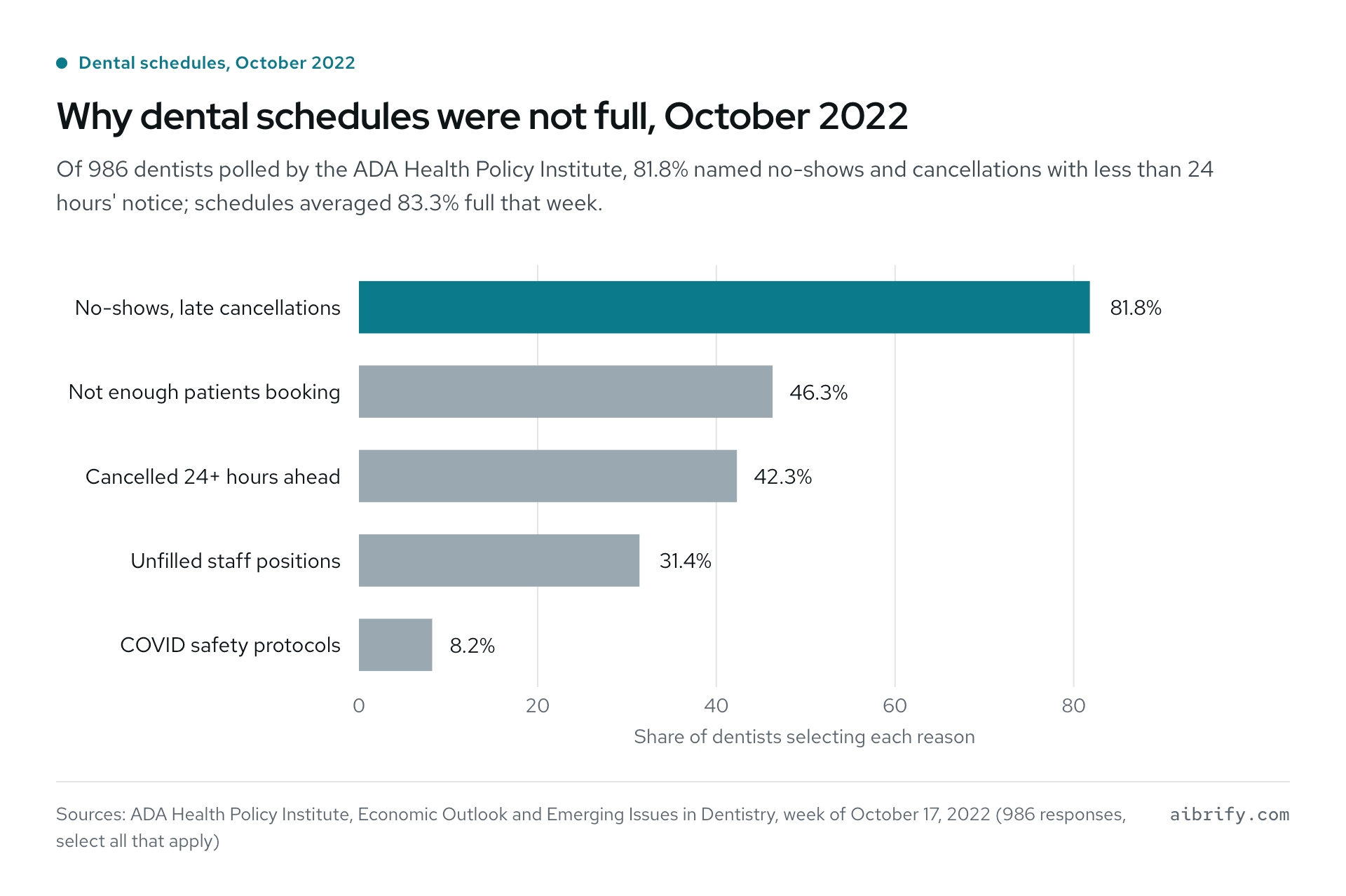
The chart's figures, from 986 dentists, follow.
| Reason the schedule was not full | Share of dentists |
|---|---|
| No-shows and cancellations with less than 24 hours' notice | 81.8% |
| Not enough patients making appointments | 46.3% |
| Cancellations made 24 or more hours ahead | 42.3% |
| Trouble filling vacant staff positions | 31.4% |
| COVID safety protocols | 8.2% |
Medical offices feel the same pressure. In an MGMA Stat poll on August 11, 2026, 32% of medical groups reported higher no-show rates than in 2025, from 190 responses. Another 58% said about the same, and 10% said lower.
Across 105 studies in every specialty, a 2018 review in Health Policy put the average no-show rate near 23%. The two most commonly reported determinants were a long lead time between booking and visit, and a prior no-show.
Run the payback with your own numbers: last month's no-shows, times the production those visits carried, times twelve. If four hygiene visits a week are lost at $150 each, that is $31,200 a year. A $100 reminder automation repays itself on the first visit it saves.
Do Automated Reminders Actually Cut No-Shows?
Yes, with evidence from randomized trials. A Cochrane review of eight randomized trials with 6,615 participants found attendance of 67.8% with no reminder. With a text reminder it was 78.6%, and with a phone call 80.3%.
Texts raised attendance by a relative 14% (risk ratio 1.14, 95% confidence interval 1.03 to 1.26). Texts and calls performed about the same (risk ratio 0.99), and texts cost less.
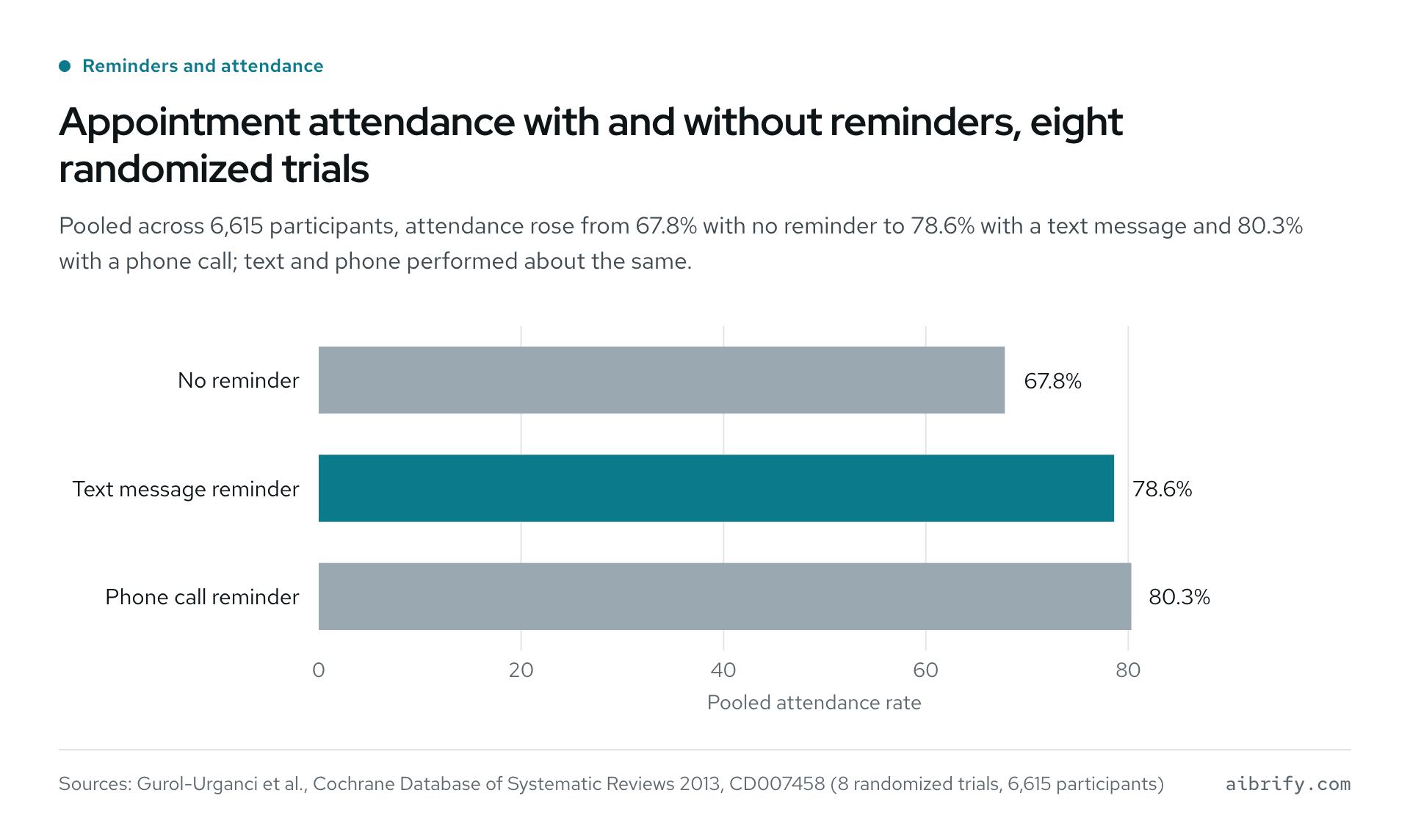
The chart's three figures, by reminder type, follow.
| Reminder type | Pooled attendance |
|---|---|
| No reminder | 67.8% |
| Text message reminder | 78.6% |
| Phone call reminder | 80.3% |
In a randomized study of 206 patients in four dental departments in India, 79.2% of texted patients arrived on time. Without a reminder the figure was 35.5%; the texts went out 24 hours ahead and on the day.
A private orthodontic office let patients choose their channel across 1,193 appointments, with a 2.43% no-show rate. Text came in at 1.90%, email at 2.68% and phone at 3.49%, with no statistically significant difference. The channel the patient chose worked, so ask for the preference at intake.
MGMA's guidance on timing: confirmations should ideally happen 48 business hours before the visit. A common second touch is an automated call the day before. A $100 text-reminder automation follows that pattern: a confirm-by-reply text two business days out, and a shorter one that morning.
What May a Reminder Text or Email Say Under HIPAA?
Only what the patient needs to confirm the visit. Providers may leave reminders on an answering machine, HHS says, but should limit the content, for example to name, number and appointment details. A text follows the same logic: practice name, date, time and how to confirm or change.
HHS permits providers to email patients with reasonable safeguards, such as checking the address first and limiting what an unencrypted message says. The same page says a provider should accommodate a patient who asks for reminders by email instead of a postcard.
The FCC's rules add the texting layer. Under 47 CFR 64.1200, autodialed texts to a cell phone normally require the recipient's prior express consent. A health-care exemption covers texts to the mobile number the patient supplied, for appointment confirmations and reminders, wellness checkups and similar purposes.
The message may carry no telemarketing, advertising, billing or debt-collection content. It runs 160 characters or less, limited to one a day and three a week. Every message offers an easy opt-out such as replying STOP, honored right away, and the patient is never charged.
A compliant reminder looks like this:
Maple Street Dental: your appointment is Tue Oct 14 at 2:00 pm. Reply C to confirm or R to reschedule. Reply STOP to end texts.
| Fits in a reminder | Leave it out |
|---|---|
| Practice name, date, time, location | The procedure or the reason for the visit |
| How to confirm, reschedule or cancel | Diagnosis, test results, medications |
| What to bring, arrival time | Balances, insurance details, payment requests |
| STOP instruction | Promotions, offers, anything that reads as marketing |
What Counts as PHI, and Which Vendors Need a Business Associate Agreement?
Protected health information is individually identifiable health information held or sent by a covered entity or its business associate, whether electronic, paper or oral. A patient's name beside an appointment date at a dental office qualifies. An outside company that stores or handles it for the practice is a business associate and needs a written contract first.
HHS lists claims processing, billing, data analysis and practice management among the activities that make a vendor a business associate. A janitorial service or an electrician whose work never involves PHI is not one. Nor is a pure conduit like the postal service, but a vendor that accesses PHI regularly to perform a service is no conduit.
Cloud hosting gets no pass either. HHS says a cloud provider that stores only encrypted data and holds no decryption key is still a business associate. Count every party that touches a reminder automation:
- The scheduling tool or spreadsheet that holds the appointment list.
- The texting or email provider that sends the message.
- The hosting account where the automation runs.
- The company that builds it, if it sees real patient records during setup or support.
Each party either signs a business associate agreement or never sees PHI. The builder can take the second route: build and test on made-up records, since HHS puts no restrictions on de-identified data. Ask every vendor for the agreement in writing before the first real record moves, Aibrify included.
Ownership decides who holds those agreements. An Aibrify client owns the code, the repository and the accounts from delivery, so the texting and hosting accounts sit in the practice's name. The practice signs with those providers directly; hosting with Aibrify is optional at $10 to $30 a month.
If a vendor loses data, the Breach Notification Rule requires notice to affected individuals and to HHS no later than 60 days after discovery. Breaches affecting more than 500 residents of a state also require notice to the media, and business associates must notify the covered entity.
How Can a Practice Ask for Reviews Without Disclosing Patient Information?
Send the same short request to every patient after every visit, link to the Google profile, and say nothing about the visit. The $100 review-request automation reads the day's completed visits from the schedule export and sends one message that evening. It carries no health information: a thank-you, the practice name and the link.
Google's policy comes first. Merchants may not discourage negative reviews or selectively solicit positive ones, and may not offer payment, discounts or free services for a review. So the automation sends to everyone, not only to patients who scored the visit well in a private survey, and offers nothing in return.
HIPAA comes second, and the enforcement record is specific to dentistry. New Vision Dental in California paid $23,000 to HHS's Office for Civil Rights over patient information disclosed in replies to online reviews. Elite Dental Associates in Dallas paid $10,000 in 2019 for social media disclosures of patients' protected health information.
Confirming that someone was a patient is already a disclosure. A review request is also outside the FCC's health-care exemption, so it needs the patient's texting consent, collected at intake with the STOP instruction.
| The review automation does | The review automation never does |
|---|---|
| Sends one request per completed visit | Filters by satisfaction score first |
| Links to the public Google profile | Mentions treatment, cost or insurance |
| Includes the opt-out instruction | Offers a discount or gift for a review |
| Logs who was asked and when | Replies to reviews on the practice's behalf |
Replies stay with a person, under one rule: thank the reviewer, confirm nothing, invite them to call the office.
What Does an Intake Form to PDF Replace?
The clipboard. A $300 tool with a page of its own lets a patient answer the same questions on a phone before the visit, sign, and send. The PDF lands in the folder or record system the practice already uses; what a $300 tool looks like shows how the page is scoped.
In May 2025 the median receptionist earned $38,010 a year, or $18.27 an hour, and 42% of receptionists work in health care and social assistance. Medical secretaries and administrative assistants had a median wage of $45,930, and every retyped form is paid at those rates.
The form is also where the other automations get their permissions:
- Preferred reminder channel: text, email or call, and which number.
- Consent to receive review requests by text.
- Any confidential-communication request, such as a different number or address.
- Signature and date, captured on the page and printed into the PDF.
Because the form page and its storage hold PHI, the hosting account needs the agreement described above. The practice owns that account from day one.
How Do Recall Reminders Work for Hygiene Visits and Annual Checkups?
A recall reminder is one automation on the ladder, so it costs $100. It reads a due list from a spreadsheet or calendar export and sends a text or email at the interval the practice sets. The message says it is time to schedule, with a booking link or a request to call, and nothing clinical.
The recall list is long. Per CDC FastStats, 66.7% of adults had a dental exam or cleaning in the past year, which leaves one adult in three who did not. Those patients already know the practice.
Recall texts fit the FCC exemption when they stay within its purposes, such as wellness checkups, and its limits on length and frequency. A whitening promotion does not fit, so it stays out.
| Automation | Trigger | What it sends | What it replaces | Fixed price |
|---|---|---|---|---|
| No-show reminders | Appointment two business days out, and the morning of | Text asking for a reply to confirm | Confirmation calls | $100, or $300 with its own booking page |
| Intake form to PDF | Booking confirmed | Link to the form; PDF to the practice's storage | Clipboard and retyping | $300 |
| Review request | Visit marked complete | One thank-you text with the Google link | Asking at checkout | $100 |
| Recall reminder | Patient due by interval | Text or email with a booking link | Postcards and call lists | $100 |
What Should the Phone Do While the Front Desk Is With a Patient?
Get answered, within narrow limits. Aibrify Desk is an AI receptionist at $179 a month with 400 minutes included, $0.30 for each extra minute, setup included, month to month. The practice keeps its number and forwards calls.
Desk speaks English, Mandarin and Spanish, not Cantonese. Every call opens by stating that the caller is talking to an AI assistant and is being transcribed; no audio is kept. It books into its own calendar, answers common questions from the practice's material, takes messages and transfers to a person when unsure.
A summary of each call arrives by email or Slack, in English or Chinese. The pages for dental offices and medical offices show the setup, and the clinic missed-calls guide covers after-hours volume. In a clinical setting the limits matter more than the features.
| Caller asks about | Desk does |
|---|---|
| Hours, address, parking, what to bring | Answers from the practice's material |
| Booking a cleaning, checkup or consultation | Books into Desk's own calendar |
| Which insurance plans are accepted | Reads the list the practice provides; no eligibility checks |
| Pain, swelling, symptoms | Takes a message, flags it urgent, or transfers |
| Test results, x-rays, treatment plans | Never discusses them; message to the clinician |
| Prescriptions and refills | Never answers; message to the clinician |
| Balances and billing disputes | Passes to a person |
| An existing patient's record | Never discussed on the call |
A transcript with a caller's name and reason for calling is PHI like any other record. The business associate question applies to Desk as to every vendor, so ask before forwarding the line. For prices across vendors, see AI receptionist cost.
What Do Dental and Medical Patient-Communication Platforms Cost in 2026?
As of October 2026, Weave's plans start at $199 a month; the page names Pro, Elite and Ultimate tiers without pricing them. Weave lists reminders, reviews, digital forms, two-way texting, missed-call texting, payments and phones.
Solutionreach shows no price, so it is price on request. Its page lists four plans, monthly text allotments of 1,750 to 4,500, and yearly contract options. NexHealth is also price on request, billed monthly or yearly up front, with no cancellation fees and 90 days' notice on annual plans.
| Option | Price | Term | What you get |
|---|---|---|---|
| Weave | From $199 a month (as of October 2026) | Not stated | Reminders, reviews, forms, texting, payments, phones |
| Solutionreach | Price on request | Yearly contract options | Reminders, recall, reviews, intake, two-way texting |
| NexHealth | Price on request | Monthly, or yearly paid up front | Online booking, reminders, forms, payments |
| Aibrify automations | $100 to $300 each, one time | None; 90 days of free fixes | One specific job each, code owned by the practice |
A platform bundles messaging, payments and phone lines, and an office wanting all of it may prefer one. An office that wants three or four specific jobs done, and wants to own the result, pays $100 to $300 per job once. The four automations above total $600, before optional hosting.
What Does Aibrify Charge for Dental and Medical Office Automation?
Aibrify is a software company in Los Angeles that builds automations and software for small businesses at fixed prices, quoted in writing before work starts. The ladder for a dental or medical office has four steps.
- $100, one automation. Text reminders, a review request, a recall reminder: a message that goes out when something happens. Usually ships in two to three days. More examples are in automations for $100.
- $300, one tool with its own page. The intake form to PDF, or reminders that come with their own booking page. About a week.
- $1,000, an application with logins. A portal or a tracker that talks to the practice's other tools. Two to three weeks.
- $5,000 and up, a system. Several roles and integrations, scoped together first.
Every job comes with a written scope and a fixed price, and the practice checks the work on a phone as it comes together. Anything broken in the delivered scope is fixed free for 90 days. After that, changes are quoted at the same prices or covered by a Care plan.
Care is $49 a month for one hour of changes, with a reply within two business days. The $149 plan covers four hours, with a reply the next business day. Automations work with the tools a practice already uses: they read a spreadsheet, form, calendar or email and send texts, emails or WeChat messages.
To start, answer the four questions at aibrify.com/start, or send a text, an email or a WeChat message. The reply comes within one business hour, with no sales call and no meeting required. The automation page lists everything on offer, and the 20-workflow guide covers other industries.
Frequently Asked Questions
Is a text message appointment reminder allowed under HIPAA?
Yes: HHS guidance lets a provider remind patients by phone, mail, voicemail or email when the message holds only what identifies the visit. A text with the practice name, date and time, and nothing about procedure, diagnosis or insurance, sits inside that guidance. A patient's reasonable request for another channel has to be honored.
Does the company that builds a reminder automation need a business associate agreement?
Only when that company creates, receives, stores or transmits patient data for the practice. A builder working from invented test records, who then hands over code the practice runs inside accounts it owns, can stay clear of PHI altogether. The texting provider and hosting account that process real records do need the agreement, signed by the practice.
How far ahead should an appointment reminder be sent?
MGMA suggests sending the confirmation request 48 business hours ahead, followed by a second message the day before the visit. Trials pooled by Cochrane showed 78.6% attendance with text reminders versus 67.8% with none. FCC rules allow at most three health-care texts a week and one per day, so a two-day and same-morning pair stays inside the limit.
Can a dental office ask every patient for a Google review?
Yes, and asking everyone is the correct approach, because Google forbids soliciting reviews selectively from happy customers or trading payment, discounts or gifts for them. A request that goes to each patient after each visit, with no health information in the text, satisfies Google and HIPAA alike. Responses to reviews must never acknowledge that the writer was a patient.
What should a practice never write when replying to an online review?
Anything identifying the reviewer as a patient, or describing a visit, a treatment, a bill or an insurance plan. HHS collected $23,000 from New Vision Dental and $10,000 from Elite Dental Associates after staff answered reviews with patient details. A safe response thanks the writer, acknowledges nothing specific and offers a phone conversation with the office.
How much does automation for a dental or medical office cost?
Aibrify charges $100 for a single automation such as text reminders, review requests or recall notices. The intake-form-to-PDF tool is $300 and a login-protected application is $1,000, each fixed in writing with free repairs for 90 days. Weave's platform starts at $199 monthly as of October 2026.
Can an AI receptionist answer clinical questions for a medical office?
Not in Aibrify Desk's setup: it answers hours, directions and booking questions, writes appointments to a calendar of its own and takes messages. Symptoms, results, prescriptions and treatment plans go to a clinician by message or transfer. Each call begins by disclosing the AI assistant and the transcription, and no audio is stored.
What is the difference between a reminder automation and a patient communication platform?
Weave, Solutionreach and NexHealth bundle reminders with texting, payments, forms and sometimes phones, under a subscription near $199 a month or quoted privately. A reminder automation performs one task for a one-time $100 and lives in accounts the practice controls. Hosting is optional, for $10 to $30 monthly.