How Much Do Automated Appointment Reminders Cut No-Shows?
Automated appointment reminders cut no-shows by about a quarter to a third in controlled studies. In a randomized trial at a pediatric clinic, adding a text to the usual voice reminder cut no-shows to 23.5%. The voice-only group missed 38.1% of visits.
Larger samples agree. Across 21 pooled studies, the no-show rate was 15% with text notifications and 21% without. A review of 29 studies found a weighted mean 34% relative drop in non-attendance when reminders were used.
A Cochrane review of eight randomized trials with 6,615 participants put attendance at 78.6% with text reminders and 67.8% without. Almost all of this evidence comes from clinics, because hospitals publish their numbers and salons do not.
The mechanism is the same for a hair appointment or a furnace tune-up. A reminder arrives a day or two out, and a reply can free the slot in time to refill it.
This guide covers the evidence, the channel choice, timing, consent rules and 2026 prices. It ends with a $100 reminder automation built on the calendar a small business already keeps.
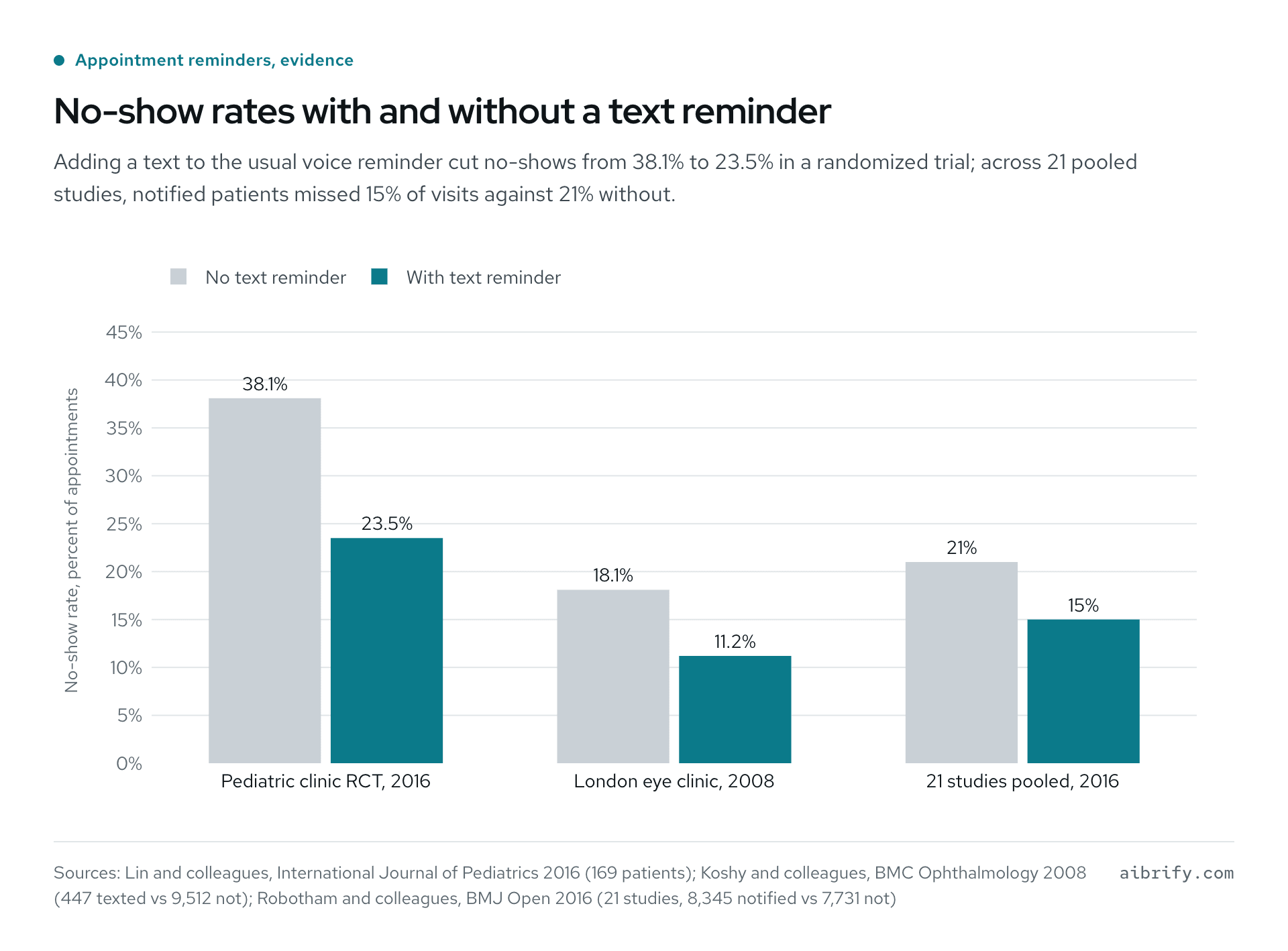
The chart compares no-show rates across the three studies below.
| Study | Design and size | No-show without text | No-show with text |
|---|---|---|---|
| Lin and colleagues, 2016 | Randomized trial, 169 patients, inner-city pediatric clinic | 38.1% (voice reminder only) | 23.5% (voice plus text) |
| Koshy and colleagues, 2008 | Observational, 447 texted vs 9,512 not, London eye clinic | 18.1% | 11.2% |
| Robotham and colleagues, 2016 | Meta-analysis, 21 studies, 8,345 notified vs 7,731 not | 21% | 15% |
What Does a Missed Appointment Cost a Salon, Clinic or Contractor?
A missed appointment costs the price of the service plus a slot nobody else could book. Zenoti's benchmark data for North American beauty businesses puts the median ticket at $77 in salons, $114 in full-service salons and $216 in medical spas. A study of ten clinics in one Veterans Affairs system put the average cost of a no-show at $196 in 2008.
The mean no-show rate across those ten clinics was 18.8%. Gastroenterology ran at 25.7% while audiology ran at 12.6%.
Rates differ a lot by business type. The Zenoti table shows 1% for full-service salons and most spas, but 4% for barbershops, nail studios and medical spas.
| Business type (Zenoti 2026 benchmark, North America) | No-show rate | Median ticket |
|---|---|---|
| Full-service salons | 1% | $114 |
| Salons | 2% | $77 |
| Barbershops | 4% | $34 |
| Nail studios | 4% | $73 |
| Waxing centers | 1% | $34 |
| Membership spas | 1% | $144 |
| Non-membership spas | 1% | $103 |
| Medical spas | 4% | $216 |
Contractors have no published benchmark of this kind, so the calendar is the source. A no-show on a service call still costs the drive, the blocked window and often a second trip.
A worked example with the figures above; put your own numbers in place of these.
- A nail studio with 60 appointments a week, a 4% no-show rate and a $73 ticket loses about $175 a week. Over a year that is roughly $9,100.
- A clinic at the study's 18.8% rate and $196 per no-show loses about $37 for every appointment on the book.
- Multiply last month's missed visits by your average ticket; that figure is the budget a reminder system has to beat.
Text, Call or Email: Which Reminder Channel Works Best?
Text and phone reminders work about equally well, and a text costs far less to send. The Cochrane review found text reminders had a similar effect to phone calls, a risk ratio of 0.99 across three trials with 2,509 participants. In the two trials that tracked spending, the cost per text per attendance was 55% and 65% lower than for phone calls.
Two findings cut the other way. In the BMJ Open meta-analysis, voice reminders came out slightly ahead of texts on attendance in a secondary analysis of six studies. The no-show rates there were 13% for voice and 15% for text, a gap that was not statistically significant.
A 2011 review in the Journal of Telemedicine and Telecare found manual phone calls by staff cut non-attendance by 39%, against 29% for automated reminders. Staff calls win on judgment and on rebooking during the conversation. They cost staff time and stop when the desk closes.
The reviews above measured texts and calls, not email. Treat email as the place for the confirmation, the intake form and the receipt, not as the reminder that keeps the chair full.
| Channel | Evidence | Cost to send one reminder | How the customer replies | Watch out for |
|---|---|---|---|---|
| Text message | Strongest: randomized trials and three meta-analyses above | About 1.2 to 1.3 cents at Twilio's US list price: $0.0083 a segment plus a carrier fee of $0.0035 to $0.005 | Replies C to confirm or R to reschedule | Consent, STOP wording and number registration |
| Automated voice call | Similar to text in the Cochrane review, slightly ahead in one meta-analysis | $0.014 a minute outbound at Twilio's US price | Key press to confirm, voicemail if unanswered | Sounds like a robocall; same consent rules |
| Staff phone call | Largest reductions in the 2011 review | Several minutes of staff time | Conversation, rebooks on the spot | Stops when the desk closes |
| Not measured in the reviews above | Fractions of a cent | Link to confirm or cancel | Easy to miss on the day |
Which channel fits which business
- Salons and nail studios: text, with the reply updating the book. When a booking comes by phone or walk-in, the mobile number has to be captured right then.
- Clinics and dental offices: text first, with a voice call for patients who ask for one. Under the FCC's health-care exemption, a provider texting without separate consent is capped at one message daily and three per week for each patient. After-hours calls are a separate problem, covered in clinic missed calls after hours.
- Contractors and HVAC: a text the day before with the arrival window. Then an "on my way" text when the tech leaves the previous job. Nobody waits at home for a window they forgot.
When Should Appointment Reminders Go Out?
Send one reminder 24 to 48 hours before the appointment, and a second one two hours before when the slot is hard to refill. The exact lead time matters less than most owners expect. A meta-analysis of 18 reports found no significant difference between texts sent 24, 48 or 72-plus hours ahead.
The 2011 review likewise saw no difference between the day before and the week before. What does matter is the number of touches. In the BMJ Open meta-analysis, multiple notifications raised attendance by 25 percentage points, against 6 points for a single notification.
The trials themselves used short lead times.
- One day before at the London eye clinic, or four days when the visit was booked further ahead.
- Within three days in the pediatric trial.
- Five days before in two UK hospital trials on message wording.
Wording matters as much as timing. In two UK hospital trials with 10,111 and 9,848 patients, one text stated what a missed slot costs the health service. It cut did-not-attend rates from 11.1% to 8.4%.
Vaguer wording about cost did worse at 9.9%, and an "empathy" message worse still at 10.7%. The authors estimated 5,800 fewer missed appointments a year at that one hospital trust.
"The evidence is overwhelming that reminders have a positive effect on non-attendance rates." Hasvold and Wootton, Journal of Telemedicine and Telecare, 2011.
The schedule below fits the evidence and the consent limits.
| Business | At booking | 24 to 48 hours before | Day of | After a no-show |
|---|---|---|---|---|
| Salon or nail studio | Confirmation with date, time, stylist and cancellation policy | Reminder with reply C to confirm, R to reschedule | 2-hour text on busy days | Text with a rebooking link |
| Clinic or dental office | Confirmation plus intake form link | Reminder, with a voice call for patients who prefer it | None, to stay within one message a day | Recall text after staff review |
| Contractor or HVAC | Confirmation with arrival window and prep steps | Reminder asking whether someone will be home | On-my-way text when the tech leaves the previous job | Reschedule text offering two windows |
What Consent Rules Apply to Reminder Texts?
Reminder texts sent by software to a cell phone need the customer's prior express consent, a way to opt out and a registered sending number. The FCC rule at 47 CFR 64.1200 covers calls made with an automatic dialing system or a prerecorded voice. To a cellular number, those calls need prior express consent, outside emergencies.
The same section covers messages sent "whether by voice call or text message" and sets limits for health-care providers. A HIPAA covered entity may deliver health-care messages under an exemption, but only one message a day and three a week per patient. Voice calls under the exemption are kept to about one minute, and texts must tell the patient they can opt out by replying STOP.
Carriers add a second layer on top of the law. Twilio's A2P 10DLC guide is clear on who registers. Anyone sending SMS from an application over a 10-digit local number to US recipients must register a brand and a campaign.
The campaign describes the opt-in, the opt-out, the help wording and the purpose of the messages. Unregistered traffic pays extra carrier fees and gets filtered more. Registered traffic gets lower filtering and higher throughput.
At the front desk, the rules come down to six habits.
- Ask for the mobile number and permission at booking, on the form, on the phone or at the counter. Record when and how you got it.
- Put the business name in every message and tell people they can reply STOP.
- Honor an opt-out at once and keep the list; a number that opted out never gets another reminder.
- Keep reminders transactional: date, time, place and how to change it. Promotions fall under the stricter telemarketing rules, so keep them out of the reminder stream.
- A daily message and three per week is the ceiling for health-care providers, and a sensible one for everyone else.
- Treat this section as a summary of the rule text, not legal advice; a lawyer or a compliance service can review your templates.
What Do Appointment Reminder Tools Cost in 2026?
Reminder tools cost $0 to $240 a month as of October 2026, built into a booking tool or sold as a standalone service. Square Appointments lists appointment reminders on its free plan, and Vagaro bundles unlimited reminders at $30 a month for one calendar. GoReminders, a standalone service, starts at $30 a month for 15 appointments.
| Tool (prices seen October 2026) | Monthly price | Reminders | Notes |
|---|---|---|---|
| Square Appointments | Free $0, Plus $49, Premium $149, each per location | Appointment reminders listed on the free tier | Plus adds a cancellation policy with no-show fees charged to the card on file; in-person processing 2.5% + 15¢ on Plus |
| Vagaro | $30 for one bookable calendar ($23.99 for the first six months), $10 per extra calendar up to seven | Unlimited notifications and appointment reminders | 1,000 free emails a month |
| GoReminders | Starter $30 (15 appointments, one reminder each), Business $60 (75 appointments, three reminders each), Premium $240 | Text and email on every plan; two-way messaging on Business and Premium | $25, $50 and $200 when paid yearly; extra blocks of 75 appointments cost $60 |
| SimplePractice | Starter $49, Essential $79, Plus $99 (50% off for the first three months) | Plan comparison on the vendor's site | Group plans priced per practitioner |
| Jobber | Core $49, Connect $139, Grow $199 for one user | Automated client reminders from Connect up; two-way SMS on Grow | $29, $99 and $149 a month when billed annually |
| Weave | From $199; plan prices on request | Appointment reminders, text confirmations, 1,500 to 15,000 bulk texts a month by plan | Pro, Elite and Ultimate plans |
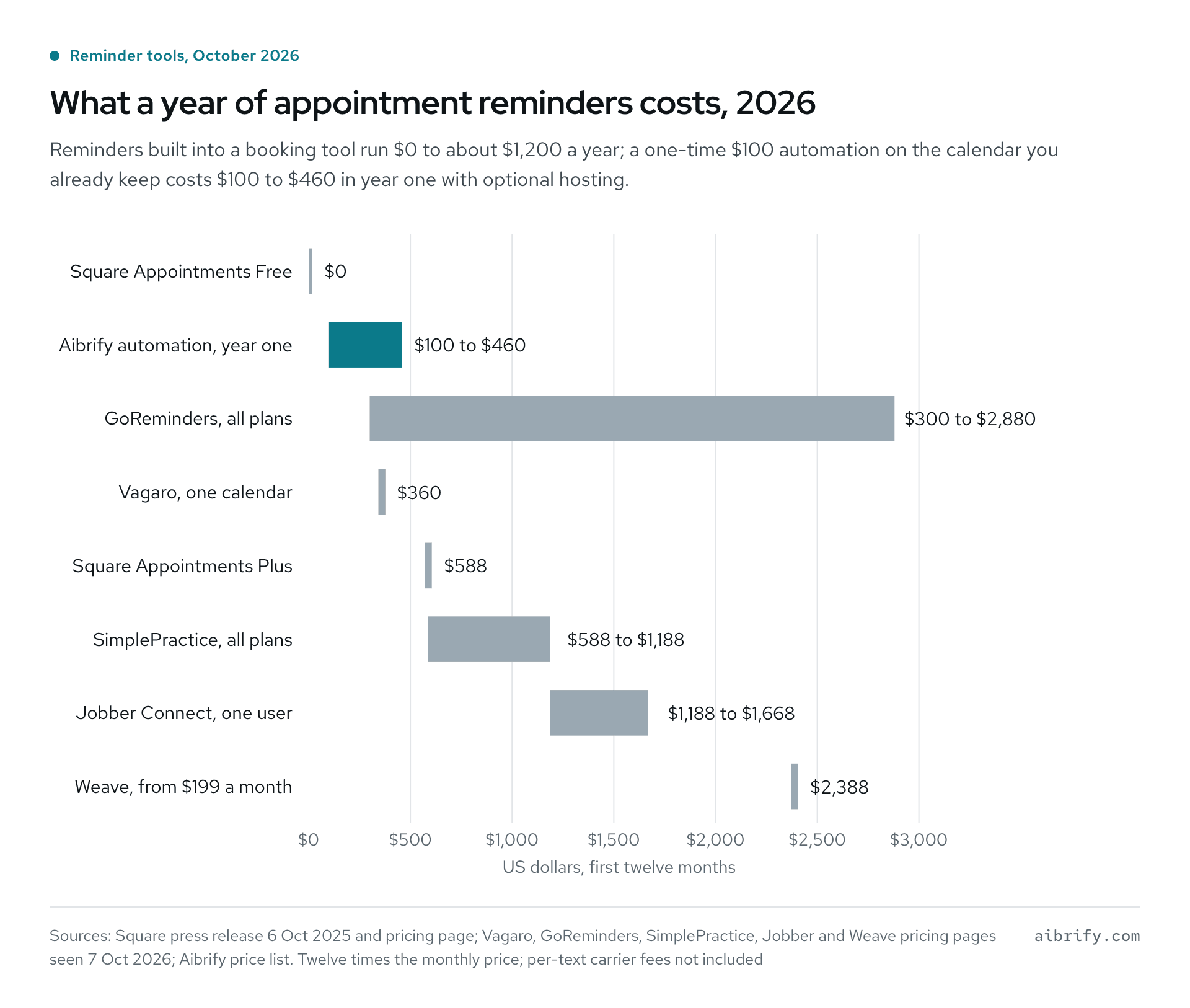
The chart shows twelve months of each option at the prices above.
| Option | Year-one cost | How it is calculated |
|---|---|---|
| Square Appointments Free | $0 | Reminders on the free tier; card processing fees apply |
| Aibrify text reminder automation | $100 to $460 | $100 once, plus optional hosting at $10 to $30 a month |
| GoReminders, all plans | $300 to $2,880 | $25 to $240 a month |
| Vagaro, one calendar | $360 | $30 a month |
| Square Appointments Plus | $588 | $49 a month per location |
| SimplePractice, all plans | $588 to $1,188 | $49 to $99 a month |
| Jobber Connect, one user | $1,188 to $1,668 | $99 billed annually to $139 month to month |
| Weave | From $2,388 | From $199 a month; plan prices on request |
For a custom build, the messages bill separately at wholesale. At Twilio's list price, one 160-character segment costs $0.0083 plus a carrier fee of $0.0035 to $0.005.
A one-segment reminder therefore runs about 1.2 to 1.3 cents. A business sending 400 reminder texts a month pays about $5 for the messages themselves.
How Do You Set Up Automated Appointment Reminders?
Setting up automated reminders takes seven steps. The first two decide whether the rest works: one calendar as the source of truth, and the mobile number captured at booking.
- 1. Pick the system of record. The booking tool's calendar, a shared online calendar or the spreadsheet the front desk already keeps. The reminder reads from it, so nobody retypes appointments.
- 2. Capture the number and the permission. When bookings arrive by phone, whoever answers asks for the cell number every time. The answer goes into the record.
- 3. Write the templates. Business name, service, date and time, address or arrival window, "reply C to confirm, R to reschedule", and STOP wording. One 160-character segment where possible.
- 4. Set the schedule. Confirmation at booking, a reminder 24 to 48 hours out, and an optional same-day text for slots that are hard to refill.
- 5. Decide what a reply does. C marks the slot confirmed; R or a cancellation texts the owner, frees the slot and sends a rebooking link.
- 6. Register the sending number. Brand and campaign registration under A2P 10DLC before the first message goes out.
- 7. Measure. No-show rate before and after, reply rate, and how many freed slots were refilled. If the rate does not move, change the wording before the timing.
Three routes get there.
- Built in: if your booking tool already sends reminders, turn them on and fix the wording. Most of the tools in the table above do.
- Standalone: a service like GoReminders when your calendar has no reminders of its own and you are fine keeping appointments in a second place.
- Custom: an automation on the calendar or spreadsheet you already use, when the built-in option cannot do what you want. Examples: a WeChat message, a custom reply flow, a deposit request, or a schedule that lives in a spreadsheet.
What Does Aibrify Charge for Appointment Reminders?
Aibrify, a software company in Los Angeles, builds a text reminder automation for a fixed $100. A booking page with reminders is a fixed $300.
Both prices are quoted in writing before work starts, and both carry 90 days of free fixes for anything broken in the delivered scope. The full ladder is on the automation page.
| Option | Fixed price | Typical time | What it does |
|---|---|---|---|
| Text reminders on your current calendar or spreadsheet | $100 | 2 to 3 days | Reads the appointments you already keep, sends the confirmation and the reminder, routes replies to you |
| Booking page with reminders | $300 | About a week | Customers pick a slot on a page of your own, which captures the mobile number and consent; reminders go out on schedule |
| Application with logins | $1,000 | 2 to 3 weeks | A membership and package tracker, or a portal where clients manage their own bookings |
The $100 version is the example first project Aibrify lists for clinics, dental offices and salons. It integrates with the tools you already use: it reads your calendar, your booking export or a spreadsheet, and sends texts, emails or WeChat messages. You check the work on your phone as it comes together.
From delivery you own the code, the repository and the accounts. The per-text fee bills to the messaging account in your name, around a cent a message at the list prices above. Hosting with Aibrify is optional at $10 to $30 a month, or take the code anywhere.
After the 90 days, changes are quoted at the same fixed prices, or a Care plan covers them. Care costs $49 a month for one hour of changes with a reply within two business days. The $149 plan gives four hours and a reply the next business day.
When the appointment itself comes in by phone, Aibrify Desk answers the call and books it into Desk's own calendar. It captures the caller's mobile number, which is the number the reminder goes to. Desk is $179 a month with 400 minutes included and $0.30 a minute after, setup included, month to month.
Desk speaks English, Mandarin and Spanish, and opens every call by saying it is an AI assistant. Calls are transcribed with no audio kept, and a summary of each call arrives by email or Slack. There are pages for salons, dental offices and HVAC companies.
To start, answer the four questions at aibrify.com/start, or send a text, an email or a WeChat message. Aibrify replies within one business hour. There are no sales calls and no meetings required.
Related reading on this site.
- What a $100 automation looks like and what a $300 tool looks like.
- Who owns the code when a software company builds it.
- Industry guides: dental and medical offices, HVAC and contractors, salons on the phone, missed call text back.
Frequently Asked Questions (FAQ)
Do automated appointment reminders reduce no-shows?
Yes: one randomized pediatric-clinic trial cut no-shows from 38.1% to 23.5% by adding a text to the standard voice call. In a 21-study meta-analysis, notified patients missed 15% of appointments and the rest missed 21%. A review of 29 studies found a 34% average relative reduction in non-attendance.
Are text or phone call reminders better for appointments?
About the same, at very different prices. A Cochrane review found text reminders matched phone calls on attendance (risk ratio 0.99), with texts 55% to 65% cheaper per attendance. One later meta-analysis gave voice a slight edge, and calls made by staff cut non-attendance the most, at the price of staff time.
How far in advance should an appointment reminder text be sent?
Send the main reminder 24 to 48 hours ahead. A meta-analysis of 18 reports saw no significant gap between 24-, 48- and 72-plus-hour lead times, while multiple reminders beat a single one. For slots that are hard to refill, add a short same-day text two hours before.
Do I need permission to send appointment reminder texts?
Yes: under 47 CFR 64.1200, software-sent texts and prerecorded calls to a cell phone require the recipient's prior express consent. Messages are expected to say how to opt out, typically by replying STOP. Providers using the HIPAA exemption get one message per day, three per week, and the sending number must be registered under A2P 10DLC.
How much does an automated appointment reminder service cost?
At October 2026 prices, built-in reminders range from $0 on Square Appointments' free plan to $30 a month at Vagaro for one calendar. Standalone GoReminders runs $30 to $240 a month, Jobber includes reminders from its $139 Connect plan, and Weave starts at $199. A one-time $100 automation on your existing calendar is the fixed-price alternative.
What is a normal no-show rate for a salon or clinic?
Zenoti's 2026 beauty benchmark shows 1% to 2% no-shows at salons and spas, and 4% at nail studios, barbershops and medical spas. Medical clinics run far higher. A Veterans Affairs study of ten clinics found a mean rate of 18.8%, from 12.6% in audiology to 25.7% in gastroenterology.
Can a reminder text let the customer confirm or reschedule by replying?
Yes: a reminder can ask the customer to reply C to confirm or R to reschedule. The reply can update the calendar, notify the owner and send a rebooking link. Replies are also what make a reminder pay off: a slot freed a day early can be refilled, while a silent no-show cannot.
What does Aibrify charge for appointment reminders?
Aibrify, a software company in Los Angeles, charges a fixed $100 for a text reminder automation on an existing calendar or spreadsheet. A booking page with reminders is $300, and an application with logins is $1,000. Every job comes with a written scope, 90 days of free fixes and ownership of the code; Care plans are $49 or $149 a month.