


How Do You Follow Up Every Real Estate Lead Without Losing Any?
Real estate lead follow-up works when the inquiry is answered within minutes, logged in one place, and followed up by software, not by memory. The odds of reaching a web lead drop 100 times between a five-minute and a thirty-minute response, according to the MIT and InsideSales study. In a WAV Group audit of 384 listings across 11 states, 48 percent of buyer inquiries never got a reply at all.
The leads that leak are not the ones an agent forgets. They are the call that rings during a showing, the sign-in sheet never typed up, and the valuation request that waits until Sunday night. Each is a small task that software can do the moment it happens.
Two figures set the stakes. In the 2025 NAR Profile of Home Buyers and Sellers, 88 percent of buyers purchased through an agent and the typical search ran 10 weeks. Every unanswered call in those ten weeks is a call some other agent can answer.
Aibrify, a software studio in Los Angeles, builds that follow-up in fixed-price pieces. An automated receptionist answers buyer and seller calls in English and Mandarin and texts the agent a summary with the caller's name, number and request, for $149 a month with setup included. A listing-to-posts automation costs $100, an open-house sign-in with follow-up $300, and a home valuation request page $300; the real estate examples list all four.
This guide covers how fast a lead goes cold, where leads leak, what a month of follow-up costs, and when automation is the wrong purchase.
How Fast Does a Real Estate Lead Go Cold?
A lead goes cold within the first half hour. The MIT and InsideSales study covered six companies, more than 15,000 web leads and more than 100,000 call attempts over three years.
Its headline finding: the odds of contacting a lead if called in 5 minutes versus 30 minutes drop 100 times. The odds of qualifying the lead drop 21 times over the same gap. The study was built on web leads across industries, not real estate alone, and it dates from 2007.
The study is old; the 2013 real estate audit below measured response times in hours, not minutes. Picture a buyer who fills in a form: still on the listing page when the first call arrives, and somewhere else an hour later.
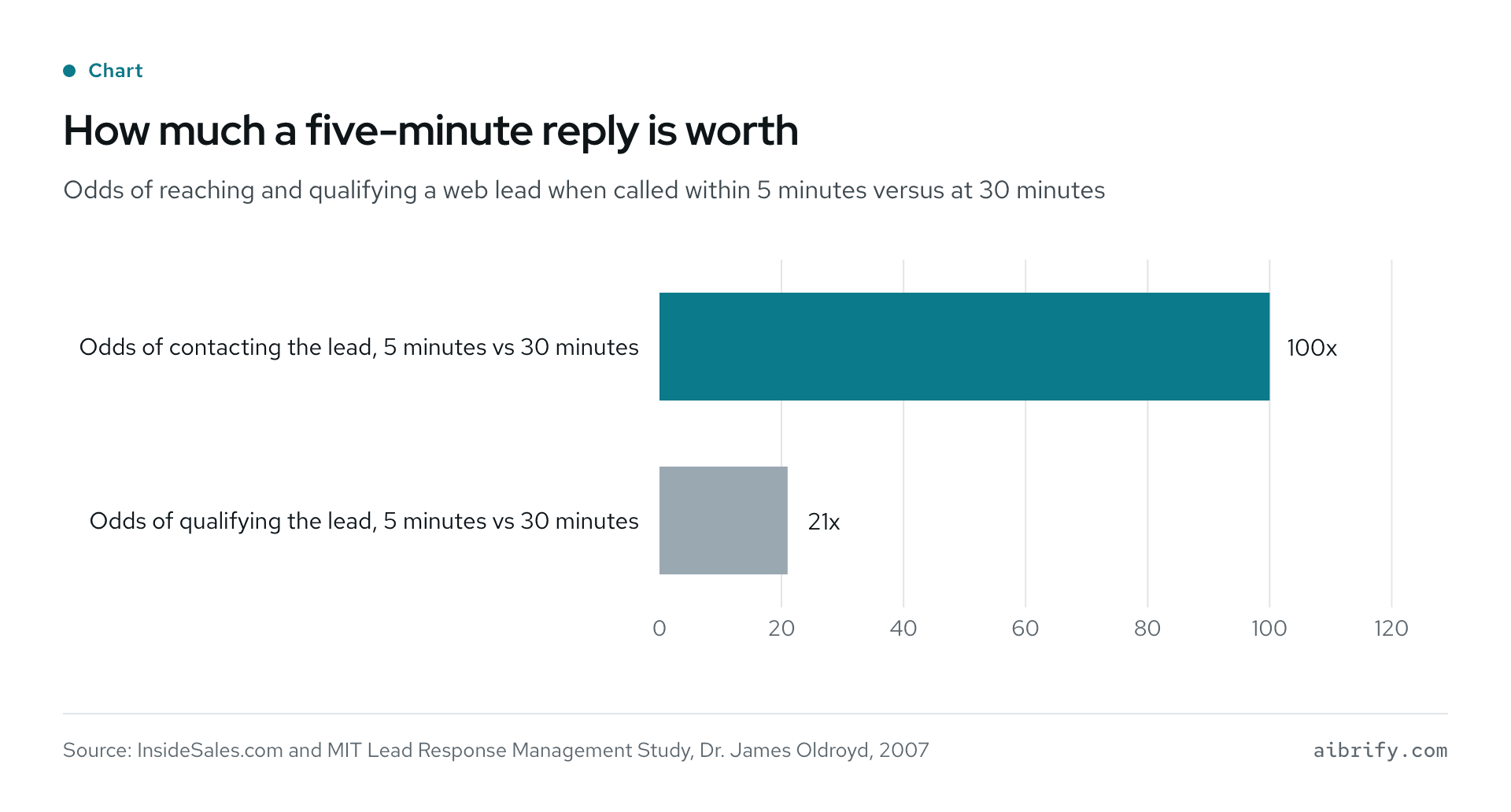
The chart shows the two multipliers from the study. The table restates them.
| Outcome | Called within 5 minutes vs at 30 minutes | Source |
|---|---|---|
| Odds of contacting the lead | 100 times higher | MIT and InsideSales, 2007 |
| Odds of qualifying the lead | 21 times higher | MIT and InsideSales, 2007 |
Real estate does worse than the cross-industry average. In Harvard Business Review's audit of 2,241 US companies, 23 percent never answered a web lead; in real estate, WAV Group found 48 percent.
WAV Group's 2013 audit sent inquiries on a random sample of 384 broker listings across 11 states and measured what came back. Forty-eight percent of buyer inquiries were never responded to, and the average response time was 917 minutes, or 15.29 hours.
The agents who did reply made an average of 1.5 call-back attempts and 2.07 email attempts after the first contact. In that sample, the whole follow-up sequence was one and a half calls and two emails, starting fifteen hours late.
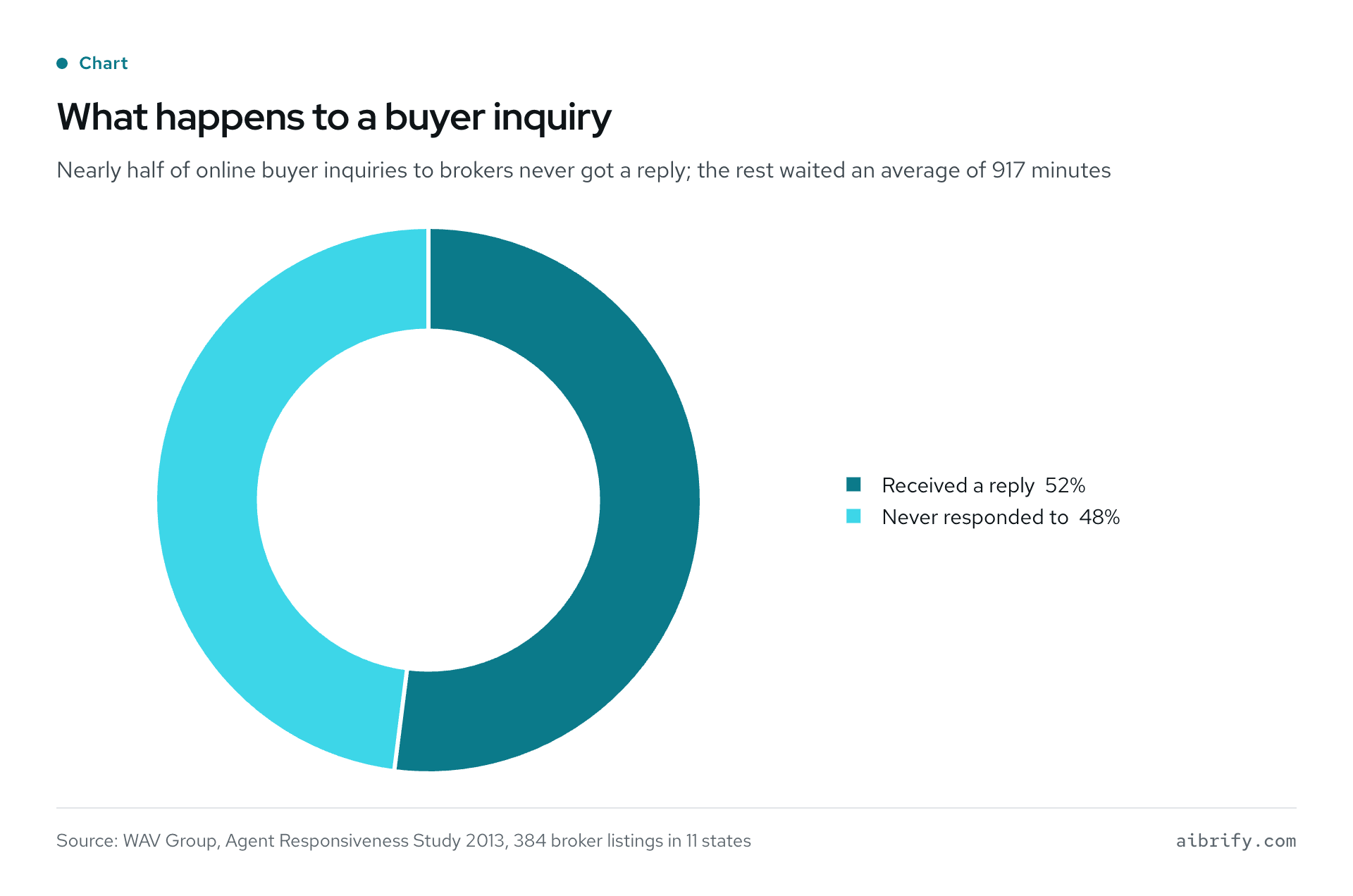
The donut shows the share of buyer inquiries that got any reply in the WAV Group audit. The table lists the audit's figures.
| Measure | Figure |
|---|---|
| Buyer inquiries that received a reply | 52% |
| Buyer inquiries never responded to | 48% |
| Average response time | 917 minutes (15.29 hours) |
| Average call-back attempts after first contact | 1.5 |
| Average email attempts | 2.07 |
| Sample | 384 broker listings, 11 states |
Where Do Real Estate Leads Come From, and Where Do They Leak?
Leads arrive by phone, by web form, at open houses, and from listing posts, and each channel leaks at a different point. The phone leaks during showings, the sign-in sheet leaks on the drive home, and the web form leaks in the inbox.
Sellers choose the same way: 91 percent sold with an agent in the same NAR profile. A buyer's calls and forms during the 10-week search can reach any agent who answers.
| Lead source | Where it leaks | What fixes it | Aibrify price |
|---|---|---|---|
| Phone call during a showing | Voicemail; the caller dials the next agent | A receptionist that answers, texts the agent a summary with the caller's name, number and request, and transfers when the caller wants the agent | $149 a month, setup included |
| Open-house visitor | A paper sign-in sheet that is never typed up | A sign-in page on a phone or tablet that sends the thank-you text and lists every visitor | $300 |
| "What is my home worth?" | A form reply written on Sunday night | A valuation request page that confirms receipt at once and hands the agent the address and contact | $300 |
| New listing | A post the agent forgets to write | An automation that turns the listing into Just Listed and Open House posts | $100 |
Chinese-speaking buyers add a language leak. NAR's 2026 international report counted $45.3 billion in foreign purchases of US existing homes, 67,100 properties, from April 2025 to March 2026.
Buyers from China were 11 percent of those purchases and the largest source of dollar volume, at $7.6 billion. Their average purchase price was roughly $1 million, and California took 19 percent of all foreign buyers. An agent in Arcadia or Irvine whose line is answered only in English has no way to take a call that arrives in Chinese.
The bilingual receptionist guide gives the Chinese-speaking population by county.
What Does a Month of Follow-Up Cost on Each Option?
A month of follow-up costs $49 to $108 for a CRM seat and $175 to $900 for a live answering or receptionist service. An in-house assistant is about $4,530. The Aibrify receptionist costs $149 a month, and the fixed-price tools are one-time purchases.
A CRM seat. Follow Up Boss charges $69 a month per user on its Grow plan, plus $39 a user to add calling. Its Pro plan is $499 a month for 10 users. Wise Agent charges $49 a month for up to five team members, or $69 with social posting.
A CRM stores and reminds; it does not answer the phone. The first touch still depends on a person seeing the notification.
A live answering or receptionist service. OnceHub's September 2026 pricing guide puts live answering services at $175 to $700 a month at small-business volume. Human virtual receptionists run $137 to $325 at entry level and $400 to $900 at realistic call volume. The operator takes a message or books a showing, and the lead reaches the agent as a note.
An in-house assistant. OnceHub puts a full-time in-house receptionist at approximately $54,400 a year once benefits and payroll taxes are counted, about $4,530 a month. One person covers one shift.
The Aibrify pieces. The receptionist is $149 a month with 400 minutes, then $0.30 a minute, with setup included. The three tools are one-time prices: $100 for listing posts and $300 each for the sign-in and the valuation page. Hosting is optional at $10 to $30 a month, and the agent owns the code.
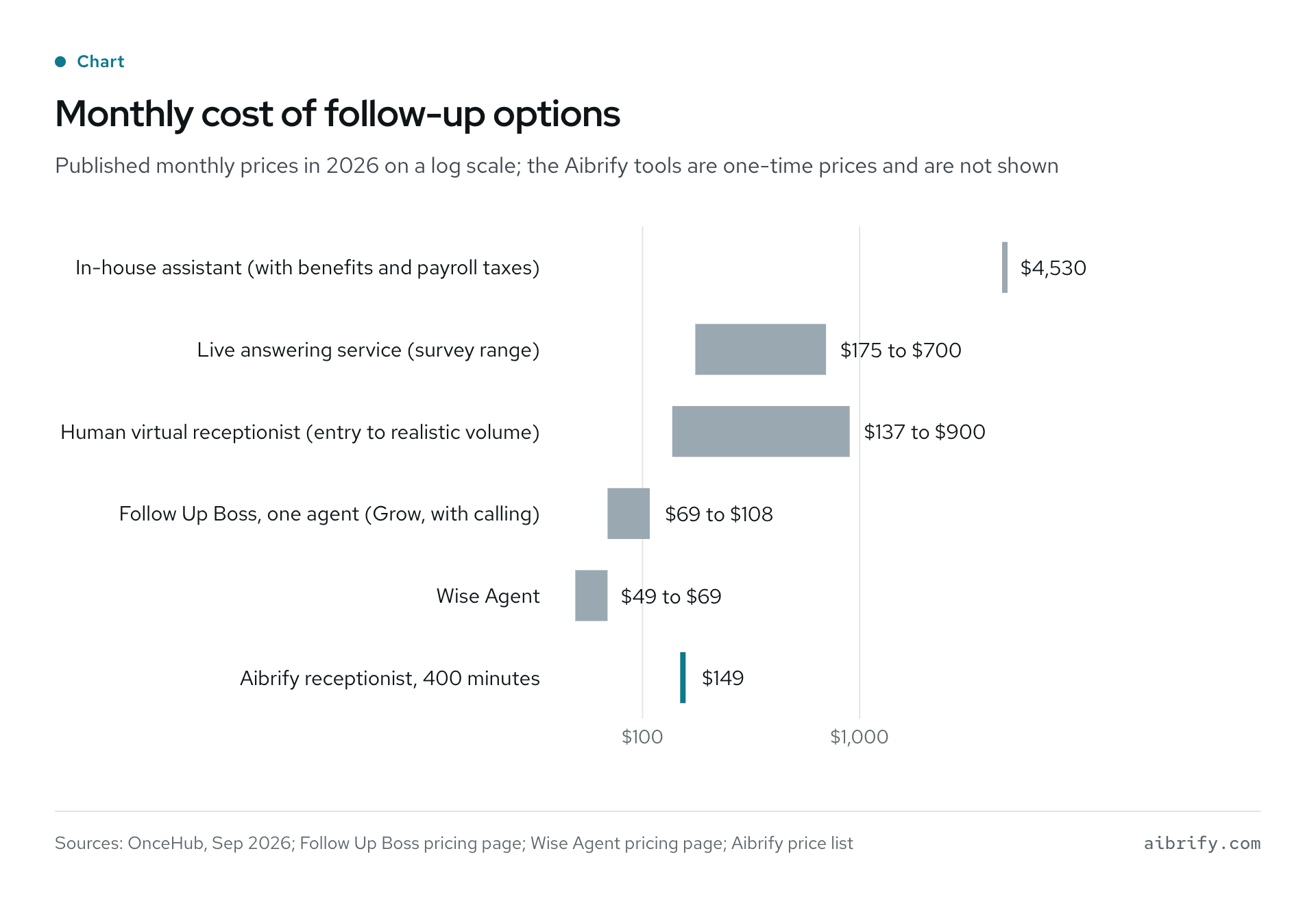
The chart compares the monthly figures on a log scale. The table adds what each price buys.
| Option | Monthly cost | What it does with a new lead | Source |
|---|---|---|---|
| In-house assistant | About $4,530 with benefits and payroll taxes | Answers on shift, logs, follows up | OnceHub, Sep 2026 |
| Live answering service | $175–$700 | Takes a message | OnceHub, Sep 2026 |
| Human virtual receptionist | $137–$325 entry; $400–$900 realistic volume | Takes a message, may book a showing | OnceHub, Sep 2026 |
| Follow Up Boss, one agent | $69; $108 with calling | Stores, reminds, dials | Follow Up Boss pricing page |
| Wise Agent | $49–$69 | Stores, reminds | Wise Agent pricing page |
| Aibrify receptionist | $149 with 400 minutes; setup included | Answers in English and Mandarin, transfers, texts a summary | Aibrify price list |
| Aibrify tools | $0 a month; $100–$300 one-time; hosting optional at $10–$30 | Sign-in, valuation page, listing posts | Aibrify price list |
How Does Aibrify's Real Estate Lead Follow-Up Stack Work?
The stack is four pieces that each do one job, bought separately at fixed prices, and the agent keeps the code. An agent can begin with a single tool and add the rest later.
The receptionist. $149 a month with 400 minutes, setup included. It answers buyer and seller calls day and night in English or Mandarin and texts the agent a summary with the caller's name, number and request.
A caller who wants the agent is transferred; a caller who wants a showing is booked from the agent's rules. A monthly report counts calls answered, after-hours calls caught and bookings taken. The same receptionist is offered to clinics and restaurants.
Every call opens with a notice that the line is automated and recorded. California's Penal Code section 632 makes recording a confidential communication without every party's consent an offense, with fines of up to $2,500 per violation.
Listing to posts. $100, usually delivered in two to three days. The agent enters the listing once, and the automation produces the Just Listed and Open House posts for the agent to publish.
Open-house sign-in with follow-up. $300, about a week. Visitors sign in on a phone or tablet at the door. Each one gets a thank-you text with the listing, and the agent gets the full list with notes before leaving the driveway.
Home valuation request page. $300, about a week. A homeowner enters the address and contact details and gets an immediate confirmation, and the agent receives the request by text. The seller lead is logged the moment it arrives, not when the inbox is checked.
Every piece follows the same four steps: the agent sends a brief by text or email and gets a written scope with a fixed price. The agent then reviews the build on a phone and takes over the code at hand-over. Details are on the price list and in the cost guide.
| Piece | Price | Delivery | What it stores | What it sends |
|---|---|---|---|---|
| Receptionist | $149 a month, 400 minutes, setup included | About a week | Every call: name, number, request, outcome | Text summary per call; monthly report |
| Listing to posts | $100 | 2–3 days | The listing details | Just Listed and Open House posts |
| Open-house sign-in with follow-up | $300 | About a week | Visitor names, contacts, notes | Thank-you text to each visitor; visitor list to the agent |
| Home valuation request page | $300 | About a week | Address and contact details | Confirmation to the owner; request to the agent |
The whole stack costs $2,488 in the first year: $700 of one-time tools and 12 months at $149, with no setup fee. Optional hosting adds $120 to $360. For comparison, one Follow Up Boss seat with calling is $1,296 a year and a human virtual receptionist at realistic volume is $4,800 to $10,800.
The two do different jobs. The CRM keeps the pipeline; the stack above answers the phone and files the lead before anyone opens the CRM.
When Is Follow-Up Automation the Wrong Choice?
Follow-up automation is a poor buy under four conditions. There are too few leads, a CRM with routing already exists, the agent will not call back, or most callers need the agent at once.
Too few leads. An agent with three inquiries a month does not need software to remember three names. A phone, a notebook, and a rule to reply within five minutes can do the job without any tool. The math changes when the calls arrive during showings and after 6 in the evening.
A team on a CRM already. A brokerage running Follow Up Boss Pro at $499 a month for 10 users has routing, dialing, and reminders. Adding a second system splits the lead record in two, so the question to settle in the written scope is where the receptionist's summaries go.
The agent will not call back. Software makes the first touch and files the lead. The second call, the showing, and the negotiation are the agent's, and no tool fixes a lead that is logged and ignored. The WAV Group audit found 1.5 call-back attempts on average; the number that matters is the agent's own.
Calls that need the agent at once. A buyer ready to write an offer wants the agent, not a receptionist. The transfer rule handles it: the receptionist hands the call over the moment the caller asks. If most calls are that call, the receptionist is a relay, and the agent's own phone may serve as well.
The comparison of receptionists and answering services covers the same trade-offs for other businesses.
Frequently Asked Questions (FAQ)
What is real estate lead follow-up automation?
Real estate lead follow-up automation is software that answers, logs and replies to inquiries as they arrive, so no lead waits for a free agent. Aibrify builds it in pieces: a receptionist at $149 a month, a $300 open-house sign-in, a $300 valuation request page, and $100 listing posts. Each piece is a fixed price, and the agent keeps the code.
How fast should a real estate agent respond to a lead?
Within five minutes: the MIT and InsideSales study found the odds of contacting a web lead drop 100 times between 5 and 30 minutes. Qualifying odds fall 21 times over the same gap. Real estate averages 917 minutes, per WAV Group's audit of 384 broker listings, which is why the first touch is worth automating.
What percentage of real estate leads never get a response?
Forty-eight percent, in WAV Group's 2013 audit of 384 listings in 11 states. Replies took 917 minutes on average, or 15.29 hours, and the agents who replied averaged 1.5 call-backs and 2.07 emails. Fifteen hours is long enough for a buyer to fill in the next agent's form.
How much does a real estate CRM cost?
Follow Up Boss charges $69 a month per user, plus $39 per user for calling; its Pro plan is $499 a month for 10 users. Wise Agent charges $49 a month for a team of up to five, or $69 with social posting. Neither plan picks up a ringing phone.
Can a virtual receptionist answer buyer and seller calls in Chinese?
Yes. The Aibrify receptionist answers in the language the caller uses, English or Mandarin, on the agent's existing number, and texts the agent a summary with the caller's name, number and request either way. In NAR's 2026 report, buyers from China led foreign dollar volume at $7.6 billion, and California took 19 percent of foreign buyers.
What does the $300 open-house sign-in do?
Visitors sign in on a phone or tablet at the door instead of a paper sheet. Each visitor receives a thank-you text with the listing, and the agent leaves the house with the full list and notes. It is one focused tool with its own page, delivered in about a week; the code belongs to the agent.
Does the receptionist replace a CRM?
No: the receptionist answers the phone and texts the agent a summary; a CRM stores the pipeline and schedules the next call. An agent with a CRM keeps it, and the written scope settles where the summaries go. An agent without one keeps the texted summaries as the record of every call.
Is it legal to record buyer calls in California?
Yes, if everyone on the call consents. California Penal Code section 632 requires all parties' consent before a confidential communication is recorded, with a fine of up to $2,500 per violation. The Aibrify receptionist states at the start of each call that it is automated and recorded; other states have their own rules.
What Should You Do Next?
Two numbers from last month settle whether any of this is needed. Count the calls that went to voicemail during showings, then the open-house sign-in sheets that never became a follow-up. If both are zero, the notebook is working.
If they are not, text or email Aibrify which piece should come first; the written scope and the fixed price arrive before any work starts. The receptionist is $149 a month with setup included, a tool is $100 to $300 one-time, and the agent keeps the code. The real estate examples show all four pieces; start a project sends the brief.


