What Can an Independent Restaurant Automate, and What Does It Cost?
An independent restaurant can automate its menu updates, reservation texts, waitlist texts, catering orders, review requests and phone for $100 to $1,000 per piece. At Aibrify, a software company in Los Angeles that builds automations for small businesses, a QR menu with daily specials is $100.
Texts that confirm a booking and call a waiting party are $300, and a catering order form that collects a deposit is $1,000. Each price is fixed in writing before work starts, and the restaurant owns what was built.
The reservation platforms most owners compare them with charge $129 to $499 a month, and one adds $1 to $1.50 for each seated diner. The phone is the exception: an AI receptionist is a monthly service, and Aibrify's is $179 a month.
Why Are Independent Restaurants Automating in 2026?
Because costs rose faster than traffic. In the National Restaurant Association's 2026 report, 42 percent of operators said their restaurant was not profitable in 2025.
Another 60 percent reported softer customer traffic, and more than 9 in 10 named food, labor, insurance, energy and swipe fees as significant challenges. Labor is the sharpest line.
In the full report, 96% of fullservice and 94% of limited-service operators called labor costs a significant challenge in 2025. Among operators who hired in 2025, about half are recruiting for front-of-house roles right now. Across all operators, 47% have openings they call difficult to fill.
Those roles cover the hours that are hardest to staff. The Bureau of Labor Statistics puts the median wage for food and beverage serving workers at $15.24 an hour in May 2025. Shifts "often include early mornings, late evenings, weekends, and holidays," and the occupation covers 5,143,000 jobs.
The industry itself is still growing. The Association forecasts $1.55 trillion in sales for 2026, a real gain of 1.3%, with employment reaching 15.8 million. The pressure is on margins, not demand.
Operators know where this leads. Eight in 10 say technology provides a competitive advantage, and 6 in 10 plan 2026 investments that improve the customer's experience. Only 12% consider their restaurant leading edge, 60% call themselves mainstream, and 28% say they are lagging.
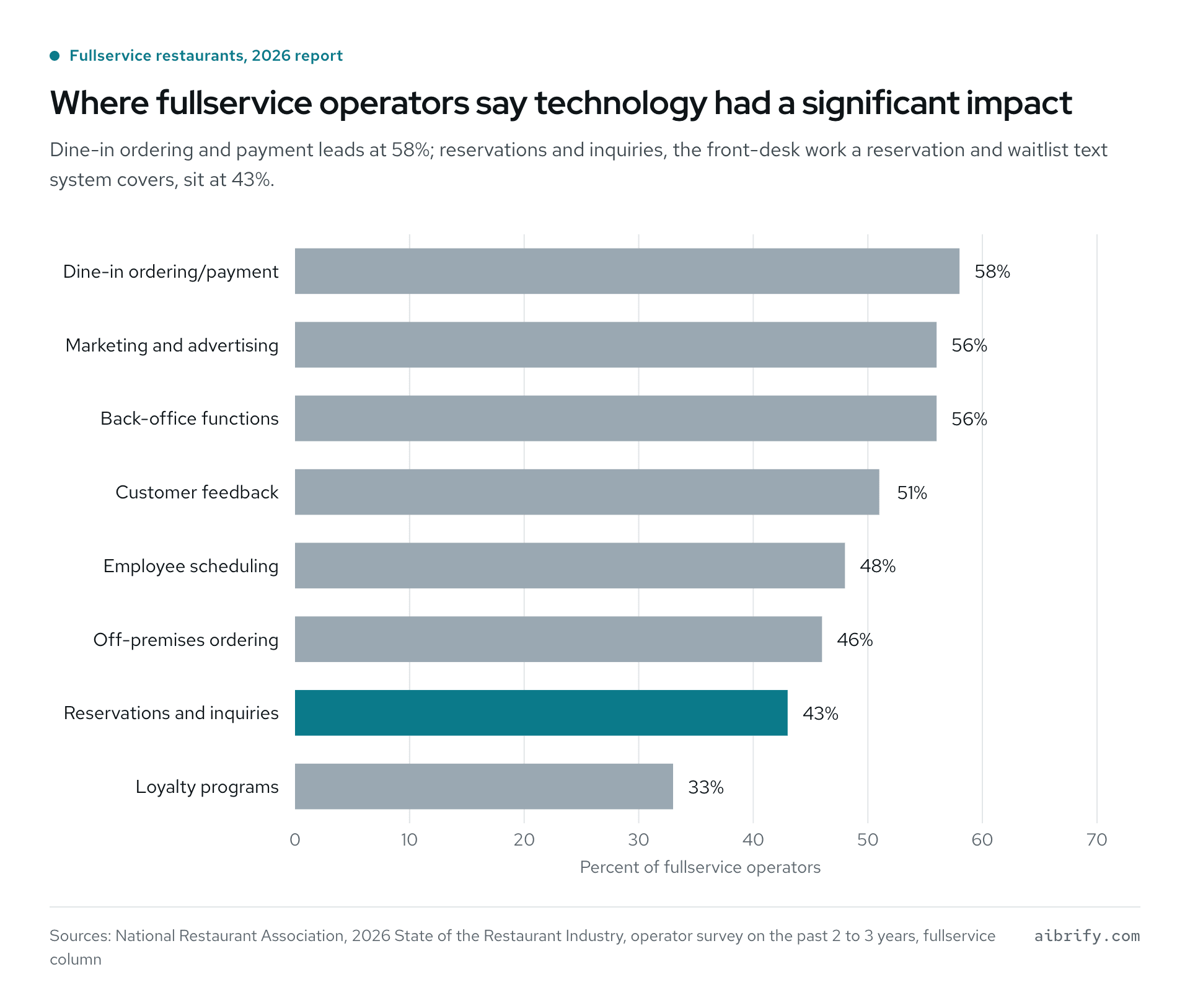
The chart shows the fullservice column of the same report.
| Area | Fullservice operators reporting a significant impact | Limited-service operators |
|---|---|---|
| Dine-in ordering and payment | 58% | 67% |
| Marketing and advertising | 56% | 64% |
| Back-office functions | 56% | 53% |
| Customer feedback | 51% | 62% |
| Employee scheduling | 48% | 50% |
| Off-premises ordering and payment | 46% | 65% |
| Reservations and inquiries | 43% | 8% |
| Loyalty programs | 33% | 60% |
One more number matters for anyone worried about staff. Only 6% of operators reported that technology investments led to the permanent elimination of jobs. The tools below take the repetitive part of a job, not the job.
Which Restaurant Tasks Should Be Automated First?
Start with the task that interrupts service most often. For most independents that is the phone during the rush, the waitlist, the specials that change daily, and the catering quote in an inbox. Each has a trigger, a message that goes out, and a person who no longer has to remember it.
| Task | Trigger | What happens | What it replaces | Fixed price |
|---|---|---|---|---|
| Daily specials on a QR menu | You type the specials on your phone | The menu page updates at once | Reprinting inserts, a chalkboard photo | $100 |
| Review request after a visit | A visit ends, from your sign-in sheet or receipt list | A text or email with your review link goes out the next morning | Asking at the table and hoping | $100 |
| Daily sales summary | Your point-of-sale export lands in a folder or inbox | A one-page report emails itself every morning | Logging in to three tools | $100 |
| Reservation and waitlist texts | A guest books or joins the list | Confirmation, a reminder, and a "your table is ready" text | Shouting names, phone tag | $300 |
| Catering order form with deposit | A client fills in the form | Deposit collected, confirmation sent, prep sheet made | Email threads and lost deposits | $1,000 |
| The phone during the rush | A call comes in | An AI receptionist answers, books, takes a message | Voicemail | $179 a month |
The $100 pieces usually ship in 2 to 3 days. A $300 tool takes about a week, and the $1,000 application tier takes up to three weeks. Earlier posts show what $100 buys and what a $300 tool looks like.
Diners are ready for the parts that touch them. In the Association's consumer survey, 70% would order and pay on a restaurant's website and 74% in a smartphone app. Another 67% would use a tablet at the table.
The caution is on hospitality. Only 41% of consumers say technology improves it and 38% say it detracts, while 65% of operators see a positive effect. So automate the confirmations, reminders, reports and forms that happen away from the table, and keep the greeting, the recommendation and the apology human.
How Do Reservation and Waitlist Texts Work, and What Do the Platforms Charge?
A reservation text system does three things: it confirms the booking, it reminds the guest, and it tells a waiting party the table is ready. The big platforms run between $129 and $499 monthly for that and for their diner networks. A $300 build is paid once and runs on an account you own.
The mechanics are plain. A guest books on a page on your site, or the host types in a walk-in party. The system sends a confirmation with the time and party size, then a reminder at the hour you choose.
When the table is ready, the host taps once and the guest gets a text. The reminder asks for a reply, and the reply is the point. A guest who cancels by text at 3 pm frees a table you can still fill.
Running costs are small. As of October 2026, Twilio lists $0.0083 per 160-character text segment and $1.15 a month for a local number, plus carrier fees. At that rate, 3,000 texts a month come to about $25, billed to the messaging account the restaurant holds.
The platforms' own pages show the following, checked on October 7, 2026.
| Reservation and waitlist option | Monthly price | Cover fees | Notes |
|---|---|---|---|
| Yelp Guest Manager | $129 to $349 | None | "Pay $0 for up to 60 days"; lists tables on Yelp, Reserve with Google, Apple Maps and ChatGPT |
| OpenTable, as listed in Yelp's comparison table | $149 to $499 | $1 to $1.50 per network cover | OpenTable's own pricing page did not load for us on October 7, 2026 |
| Resy Platform or Essential | $289 | None | Essential is "Powered by Tock" and carries a 3% fee on prepayments |
| Resy Platform 360 or Premium | $459 | None | Premium is "Powered by Tock" and carries a 2% fee on prepayments |
| SevenRooms | Price on request | Not stated | The page offers a demo, not a price list |
| Aibrify reservation and waitlist texts | $300, paid once | None | Optional hosting $10 to $30 a month; message fees on your own account |
The comparison has to be fair in both directions. A platform brings diners who search inside its app or on the maps it feeds, and that network is what the fee buys. A $300 build brings no new diners; it serves the ones who already found you, with no cover fee and no plan.
So the question is where your bookings come from. If network bookings fill Friday, keep the platform and add texts only for walk-ins. If most guests call or walk in, texts you own cost about one month of a platform plan, once.
The dining room is still where fullservice money is made. In the Association's report, 93% of fullservice operators said on-premises was the more successful side of the business in 2025. The same report found 43% of fullservice operators saying technology had a significant impact on reservations and inquiries, against 8% of limited-service operators.
What Does a $100 QR Menu With Daily Specials Do?
It gives you one web page with your menu and today's specials, edited from your phone. Guests reach it from a QR code on the table or a link on your profiles, with no app to install. The build is $100 and usually ships within three days.
The page does three jobs. It shows the full menu with prices you can change in a minute, and a specials block you type each morning. It can also show a second language, which matters when half the dining room reads Chinese or Spanish; put that in the brief.
What the $100 page does not do is take orders or payments. A form that takes orders and deposits is the $1,000 tier, as in the catering example below, because it holds money and needs staff logins. Most independents start with the menu page and add ordering once they know the volume.
How Should a Catering Order Form With a Deposit Work?
It takes the menu choices, the date, the headcount and a deposit in one pass. Then it confirms by text or email and prints a prep sheet for the kitchen. At Aibrify that is a $1,000 application with logins, built over 2 to 3 weeks.
Off-premises food is where the growth went. In May 2026 comments to the Federal Trade Commission, the Association wrote that "3 in 4 of every order at a restaurant is consumed off-premises". Technomic figures in the Association's 2026 report put off-premises at 35.4% of fullservice customer traffic in 2025, up from 12.1% in 2019.
Commissions are where the growth leaks. In the Association's May 2026 survey of 830 operators with third-party delivery, two in three put the average platform fee between 15% and 29.9%. Almost half of fullservice operators (47%) and 43% of limited-service operators said they make no profit on those orders.
A catering order placed on your own form carries no platform commission, only your card processor's fee. Suppose that fee is 3%: on a $900 office lunch it is $27, against $225 at a 25% commission, a gap of $198. Run your own numbers, and the form pays for itself within a few orders.
A working catering form includes:
- Packages with per-person prices and a minimum headcount, so the quote is done when the client finishes the form.
- Date, time, pickup or delivery address, and a cutoff that blocks dates you cannot staff.
- A deposit at the percentage you set, charged through your own payment account.
- A confirmation to the client, a reminder two days before, and a prep sheet to the kitchen.
- The event on your calendar, and a login for the manager who adjusts orders.
That is the application tier: money changes hands and several people log in. It integrates with the tools you already use: your calendar, your payment account, your email. Nothing moves to a new system.
What About Restaurant Marketing Automation: Reviews, Specials and Repeat Guests?
The two marketing automations with a measurable effect are a review request after each visit and a specials text to guests who opted in. Both are $100 pieces at Aibrify, and both depend on consent collected at the host stand or on the menu page.
Reviews first. BrightLocal's 2026 survey of 1,002 US adults found that 97% of consumers read online reviews. In the same survey, 83% of people asked to leave a review went on to leave one, and 89% expect owners to respond.
Being asked is most of the work, and the asking is what gets skipped on a busy night. The automation is one message, sent the morning after a visit, with a direct link to your review page. Everyone gets the same link, and a line inviting a reply brings complaints to you by text instead of in public.
Specials second. Guests who leave a mobile number for specials get a text when the board changes, with stop instructions in every message. Text only the people who asked for it, and keep the list in your own account.
The Association's numbers explain why operators start here. Attracting new customers was a significant challenge for 72% of fullservice and 78% of limited-service operators in 2025.
Marketing and advertising is among the top areas where operators say technology made a significant difference. Already 17% of operators use AI tools in marketing, their most common AI use.
Who Answers the Phone During the Rush?
An AI receptionist can. Aibrify Desk answers in English, Mandarin and Spanish, books reservations into its own calendar, and answers common questions from your material. It takes messages and transfers the call to a person when it is unsure.
It costs $179 a month with 400 minutes included, then $0.30 per extra minute, setup included, month to month. You keep your number and forward calls to Desk. Every call opens by saying it is an AI assistant, and the call is transcribed with no audio kept.
After each call you get a summary by email or Slack, in Chinese or English. The manager sees the 7 pm party of twelve without listening to anything.
Two limits to know before you compare. Cantonese is not supported, and phone ordering for restaurants is coming soon, so today Desk takes a reservation or a message, not an order. Desk for restaurants lists what it answers, and the AI receptionist for restaurants guide walks through a dinner-rush call.
Diners are cautious with machines that pretend. In the Association's survey, 62% of consumers would order from a live person on a video screen, but only 39% from an AI persona. A receptionist that says what it is, sticks to your facts, and hands off when unsure sits on the right side of that line.
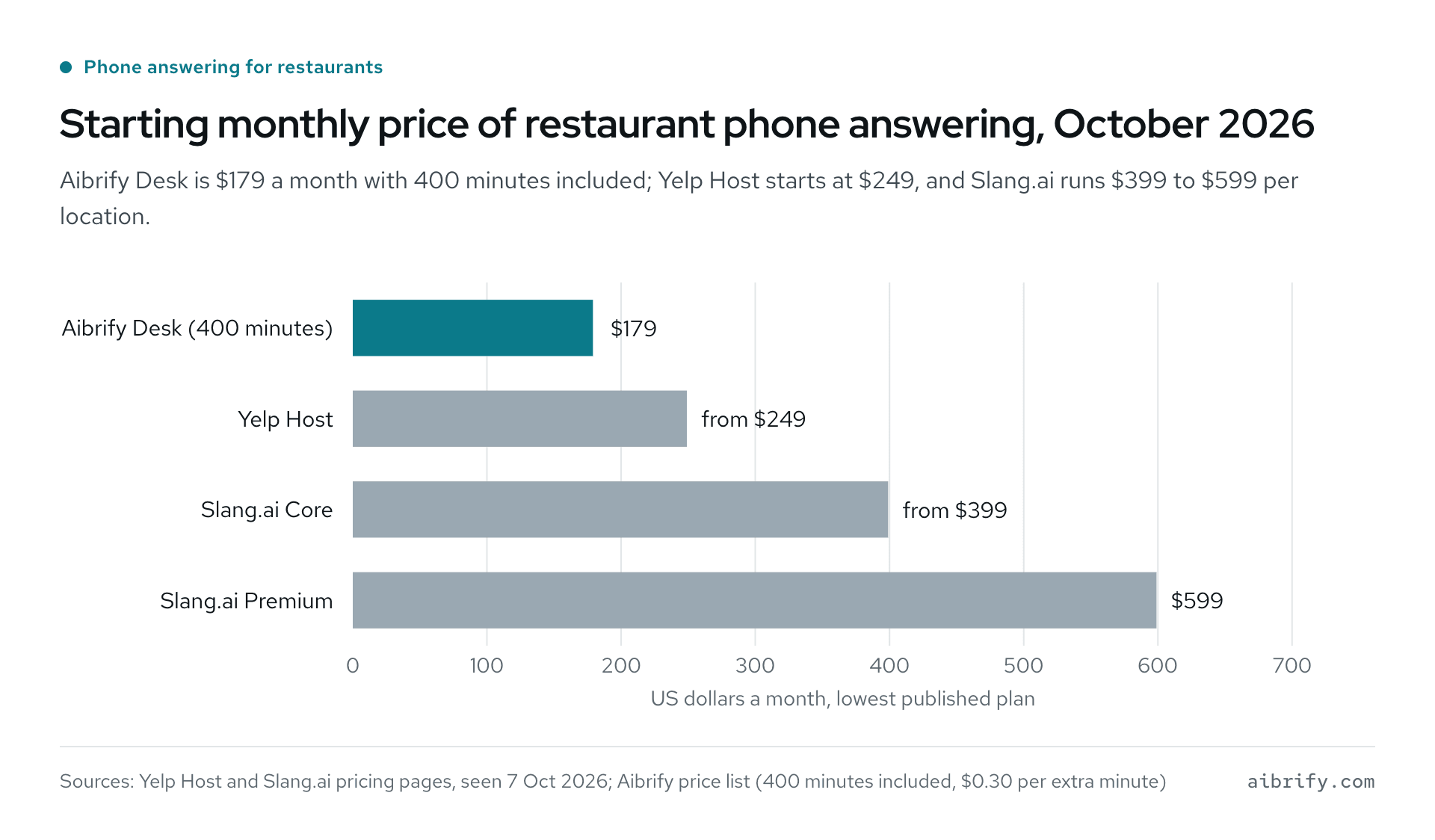
The chart shows published prices as of October 2026.
| Phone answering service | Monthly price | What the page states |
|---|---|---|
| Aibrify Desk | $179, 400 minutes included, $0.30 per extra minute | English, Mandarin, Spanish; books into its own calendar; phone ordering coming soon |
| Yelp Host | "pricing starts at $249 per month" after a free trial of up to 30 days | "speaks nearly any language with automatic detection"; takes phone orders and texts a payment link |
| Slang.ai Core | "Starting at $399 per location" | Reservation management, bilingual support |
| Slang.ai Premium | $599 per location | Adds 97 languages; Enterprise is custom pricing |
For a Mandarin-speaking dining room, the language list matters more than the price. The Chinese restaurants page shows how a bilingual front desk is set up, and the restaurants page covers other cuisines. Cantonese callers are the honest gap: Desk does not take them.
What Does Aibrify Charge for Restaurant Automation?
Aibrify quotes a fixed price in writing before any work starts; the whole ladder is on the automation page. Most restaurant software is a subscription instead. Square's point-of-sale plans run $0, $49 or $149 per location a month, reservation platforms $129 to $499, and phone answering $179 to $599.
- $100, one automation. The QR menu with the day's specials, the review request after a visit, the sales summary that emails itself. Usually two or three days.
- $300, one tool with its own page. The texts for reservations and the waitlist, or a request page for private events. About a week.
- $1,000, an application with logins. The catering order form with a deposit, talking to your calendar and payment account. Two to three weeks.
- $5,000 and up, a system. Several locations, several roles, integrations and a plan for growth. Scoped together first.
Every job comes with a written scope, a fixed price, and the chance to check the work on your phone as it comes together. From delivery you own the code, the repository and the accounts, as who owns the code explains. Hosting with Aibrify is optional at $10 to $30 a month, or take it anywhere.
Anything broken in the delivered scope is fixed free for 90 days. After that, changes are quoted at the same fixed prices, or a Care plan covers them.
Care is $49 a month for 1 hour of changes, with a reply in 2 business days. The $149 plan gives 4 hours a month and a reply the next business day. The fixed-price guide explains how a scope is written so the price holds.
To start, answer the four questions in the brief, or send a text, an email or a WeChat message. You get a reply within 1 business hour, with no sales calls and no meetings required. If writing a brief feels hard, how to write a software brief has a template that fits on a napkin.
Frequently Asked Questions (FAQ)
What is restaurant automation?
Restaurant automation is software that performs a repeated task when something happens, without a person doing it by hand. A menu page updates when the owner types specials, a text confirms a booking, a form takes a catering deposit, a receptionist answers the phone. Each piece needs a trigger, an action and a message to a person.
How much does restaurant automation cost for an independent restaurant?
At Aibrify in Los Angeles, one automation costs $100, a tool with a page of its own $300, and an application with user logins $1,000. The restaurant pays once and keeps the code. Reservation platforms charge $129 to $499 each month instead, and an AI receptionist for the phone runs $179 monthly, 400 minutes included.
What do restaurant reservation platforms charge in 2026?
In October 2026, Yelp Guest Manager lists $129 to $349 a month and Resy $289 or $459, both without cover fees. Yelp's comparison table puts OpenTable at $149 to $499 monthly plus $1 to $1.50 per network cover. SevenRooms publishes no prices and offers a demo instead.
Can an AI receptionist take phone orders for a restaurant?
Aibrify Desk books reservations, answers questions, takes messages and hands calls to a person; phone ordering is coming soon, and it takes no orders today. Yelp Host states that it takes phone orders and texts a payment link, with pricing from $249 a month. Ask any vendor to show an order placed on a live call.
Do I need OpenTable or Resy if I have my own reservation texts?
Only if the platform's network sends you diners; OpenTable, Resy and Yelp list your tables where people search, and the fee pays for that reach. Texts built for $300 confirm, remind and seat guests who found you already, without cover fees. A restaurant filled by calls and walk-ins can skip the platform.
How much does a catering order form with a deposit cost?
At Aibrify a catering form that takes a deposit is $1,000, the application-with-logins tier, and is usually ready within three weeks. It holds packages priced per person, date and headcount, a deposit taken on your own payment account, and a confirmation and reminder for the client. The kitchen gets a prep sheet, and the price is quoted in writing up front.
Is a QR code menu enough, or does a restaurant need online ordering?
A $100 QR menu lets the owner change prices and specials from a phone, with nothing to reprint, and suits most dining rooms. Taking orders and payments is a larger build, since money and staff logins are involved. Add ordering when the volume of requests shows it is worth $1,000.
Who owns a restaurant automation after it is built?
The restaurant does: at Aibrify the code, repository and accounts transfer to the owner on delivery, with hosting optional from $10 to $30 monthly. Defects inside the delivered scope are repaired at no charge for 90 days. Later work is priced at the same fixed rates, or covered by a Care plan at $49 or $149 a month.