

Should You Build Custom Software or Buy Off-the-Shelf?
Buy off-the-shelf software when a packaged tool covers about 80 percent of the job and the missing 20 percent is not critical. Build custom software when the workflow is yours alone, when needed integrations do not exist, or when per-seat fees outgrow a one-time build. Zylo puts the rule at about 80 percent: buy and extend when a product covers that much and the rest can be customized.
Custom vs off-the-shelf software is not a rivalry in most businesses. Accounting, payroll and email get bought; the one workflow that makes the business different gets built. The open question is where that line falls, and what a build costs on the far side of it.
Aibrify is a software studio in Los Angeles that builds the custom side at a fixed price. One automation costs $100, a focused tool $300, an application with logins $1,000, and a system starts at $5,000. Every job gets a written scope and a fixed price before work starts, and the client owns the code.
This guide gives a decision table, verified subscription prices and a three-year comparison, then the cases where building is the wrong call.
When Is Off-the-Shelf Software the Right Choice?
Off-the-shelf software is the right choice when the job is common and speed matters more than fit. LaunchPad Lab lists accounting, CRM, payroll, time tracking, internal messaging and ticketing as jobs a vendor has already solved. Its February 2026 guide calls a packaged tool right "when the job is common" and getting it done fast is the point.
Three advantages come with a packaged product. Syberry names a lower initial cost, quick deployment with minimal configuration, and updates and bug fixes handled by the vendor. The business starts with a working product and leaves updates and fixes to the vendor.
The same guide lists the trade. Customization is minimal, so the business adjusts its process to the software. Integrations may not fit, and the roadmap belongs to the vendor, not the customer.
Four signals say buy:
- The job is one of the common six: accounting, CRM, payroll, time tracking, messaging, ticketing.
- A packaged tool covers 80 percent of the job without workarounds.
- The process changes often, so a vendor's updates are a feature rather than a cost.
- Nobody outside the business ever sees the tool, so fit does not affect sales.
Aibrify's own scoping follows the same rule. A written scope lists the tools a task touches and builds around them rather than replacing them; the services list shows what gets built.
When Does Custom Software Make Sense?
Custom software makes sense in three cases: the workflow is the business, the integrations are missing, or the subscription math has turned. Each case has a test an owner can run in an afternoon.
The workflow is the business. LaunchPad Lab has a name for the alternative: the workaround tax. Teams that are "exporting data, pasting it into spreadsheets, re-entering it into multiple fields" are already paying for a custom build, in staff hours. A contractor who quotes on site or a wholesaler with tiered prices runs a process no packaged tool matches.
The integrations are missing. Syberry warns that packaged tools "may not integrate smoothly with other platforms," and a person fills the gap. When the booking page cannot see the calendar, someone retypes every booking into it. That person is the integration, and the cost is their time plus the errors.
The subscription math has turned. Per-seat prices are set per person per month, and they rise. Vertice's SaaS Inflation Index recorded 16.4 percent software price inflation in June 2026, which the index compares with a US CPI of 4.2 percent. A one-time build is paid once, and hosting runs $10 to $30 a month for the whole tool rather than per seat.
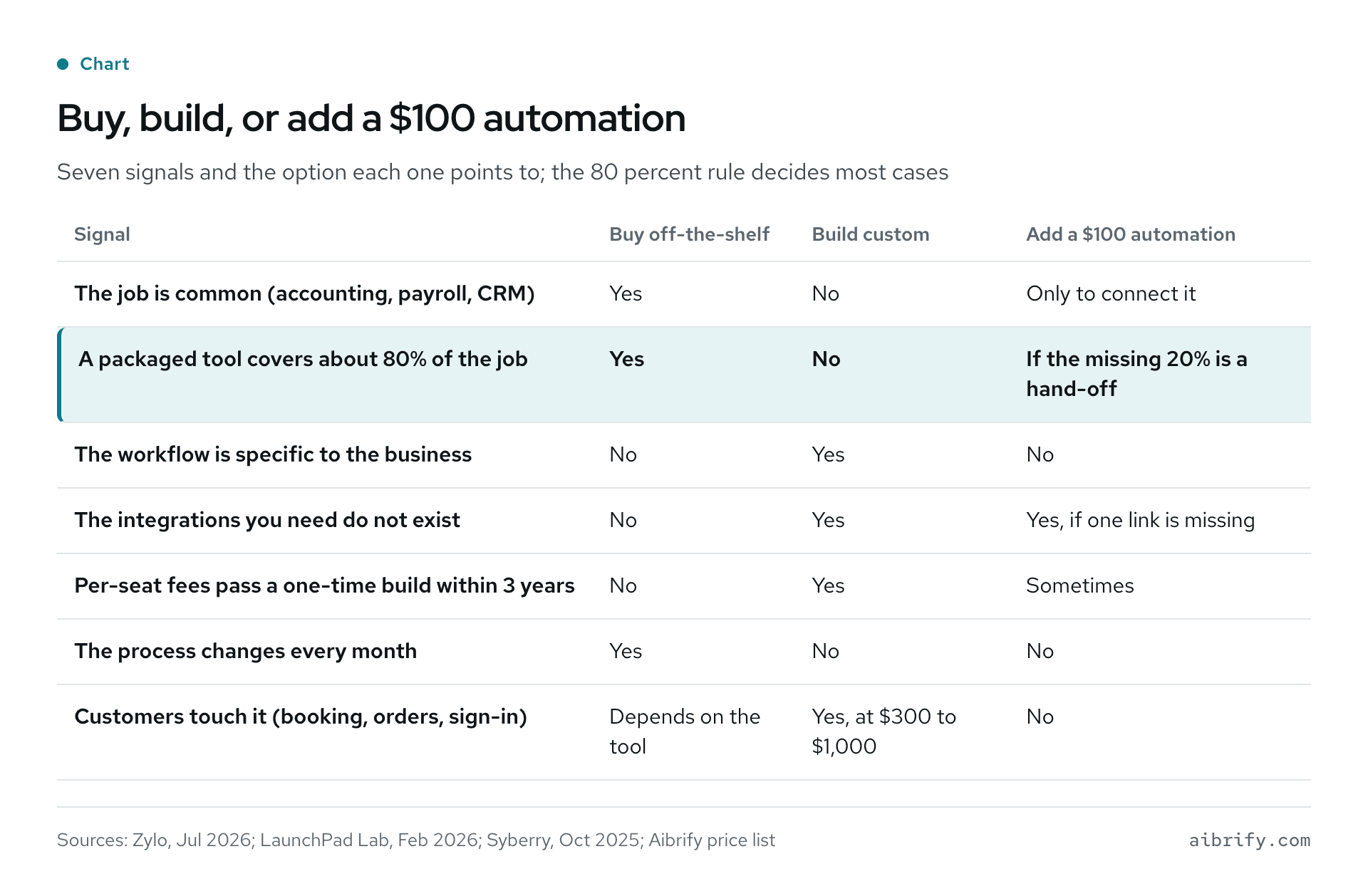
The table scores seven signals against the three options. The rows below repeat the same content as text.
| Signal | Buy off-the-shelf | Build custom | Add a $100 automation |
|---|---|---|---|
| The job is common (accounting, payroll, CRM) | Yes | No | Only to connect it |
| A packaged tool covers about 80% of the job | Yes | No | If the missing 20% is a hand-off |
| The workflow is specific to the business | No | Yes | No |
| The integrations you need do not exist | No | Yes | Yes, if one link is missing |
| Per-seat fees pass a one-time build within 3 years | No | Yes | Sometimes |
| The process changes every month | Yes | No | No |
| Customers touch it (booking, orders, sign-in) | Depends on the tool | Yes, at $300 to $1,000 | No |
What Does a Fixed-Price Build Include?
A fixed-price build includes a written scope, a delivery date, fixes for anything broken in that scope, and the code itself. Aibrify publishes four tiers, and each maps to a kind of deliverable.
An automation is $100 and usually takes two to three days; a tool with its own page is $300 and about a week. An application with logins is $1,000 over two to three weeks, and a system with several roles starts at $5,000 and is scoped together first.
Two terms separate a build from a subscription. The client owns the code and can take it anywhere; hosting with Aibrify is optional at $10 to $30 a month. Changes after delivery are quoted separately, so the price stays fixed rather than drifting.
The full ladder, with what each tier buys, is in the custom software cost guide. The current prices are on the price list.
What Does Per-Seat Pricing Cost Over Three Years?
Per-seat subscriptions for five people cost $2,880 to $5,940 over three years at September 2026 list prices. A one-time build for the same workflow costs $1,380 to $2,080 including hosting. The comparison only holds when the business needs one workflow rather than the vendor's whole feature set.
What do the subscriptions charge per seat?
Three vendors publish per-seat prices on their pricing pages, fetched in September 2026.
- Calendly charges $10 a seat a month on Standard and $16 a seat a month on Teams, billed annually. Enterprise starts at $15,000 a year with a 50-seat minimum.
- HubSpot Sales Hub lists Starter at $20 a seat a month on monthly billing, with a limited-time offer for new customers from $7. Professional is $90 a seat a month on annual billing plus a one-time $1,500 onboarding fee. Enterprise starts at $150 a seat, with a $3,500 onboarding fee on top.
- Jobber Core is $49 a month for one user, with each additional user at $29 a month. Connect is $139 and Grow is $199 a month before extra users.
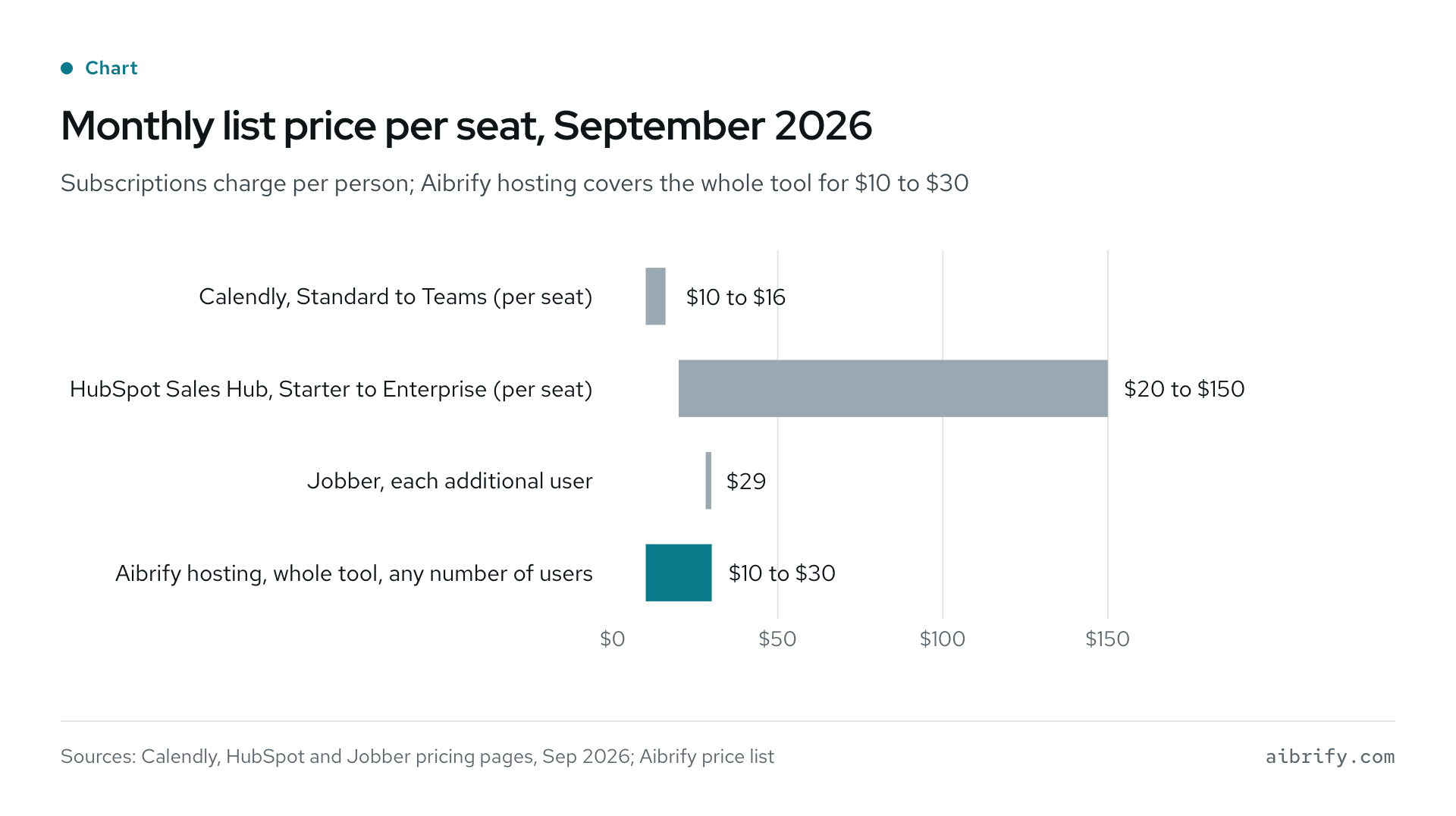
The chart shows each vendor's per-seat monthly range next to Aibrify's hosting fee, which covers every user. The table lists the same figures.
| Option | Monthly price | Charged per | Source |
|---|---|---|---|
| Calendly, Standard to Teams | $10–$16 | Seat | Calendly pricing page, Sep 2026 |
| HubSpot Sales Hub, Starter to Enterprise | $20–$150 | Seat, plus onboarding fees from $1,500 | HubSpot pricing page, Sep 2026 |
| Jobber, each additional user | $29 | User, on top of the plan | Jobber pricing page, Sep 2026 |
| Aibrify hosting for a delivered tool | $10–$30 | Whole tool, any number of users | Aibrify price list |
What does a five-person team pay over 36 months?
Take a team of five and hold list prices flat for three years. If Vertice's index holds, list prices will not stay flat, which makes the subscription side of this comparison the conservative one.
- Scheduling. Calendly Teams at $16 a seat on annual billing, times five seats times 36 months, is $2,880. A $300 booking page with a deposit, plus $30 a month hosting, is $1,380.
- Customer tracking. HubSpot Sales Hub Starter at $20 a seat on monthly billing, times five seats times 36 months, is $3,600. A $1,000 application with logins, plus $30 a month hosting, is $2,080.
- Field quoting. Jobber Core at $49 a month plus four extra users at $29 is $165 a month, or $5,940 over 36 months. A $1,000 estimate builder with a materials list, plus hosting, is $2,080.
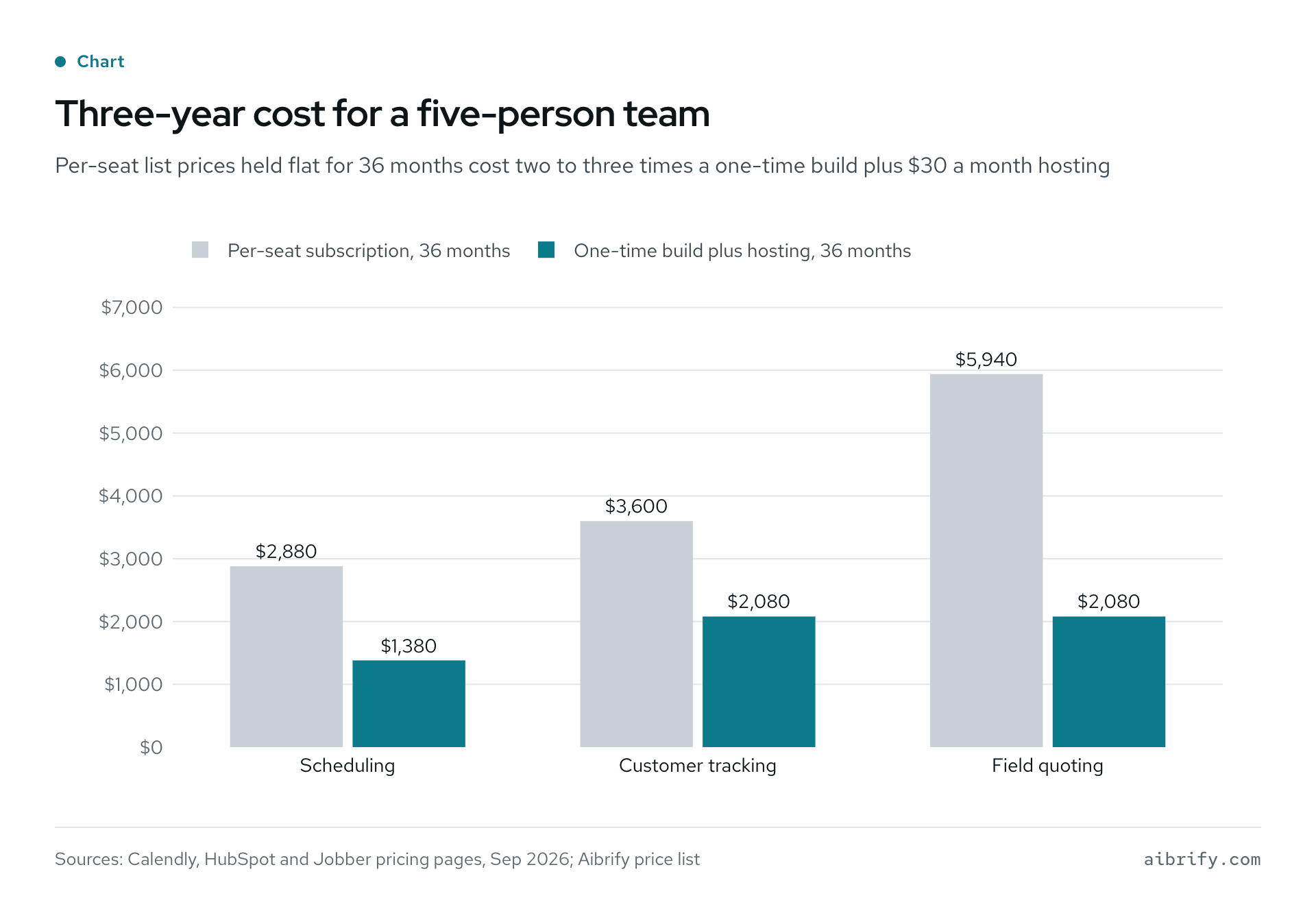
The chart compares the 36-month totals for each pair. The table shows the arithmetic.
| Workflow for five people | Per-seat subscription, 36 months | One-time build plus hosting, 36 months | Basis |
|---|---|---|---|
| Scheduling | $2,880 | $1,380 | Calendly Teams $16 (annual billing) × 5 × 36; $300 tool + $30 × 36 |
| Customer tracking | $3,600 | $2,080 | HubSpot Starter $20 (monthly billing) × 5 × 36; $1,000 app + $30 × 36 |
| Field quoting | $5,940 | $2,080 | Jobber Core $49 (monthly) + 4 × $29, × 36; $1,000 app + $30 × 36 |
Three caveats keep the comparison honest:
- The subscription includes support, updates and every feature the vendor ships. The build includes fixes for anything broken in the delivered scope; changes after delivery are quoted separately.
- Jobber's plans bundle more than quoting, so a business that uses the rest of the bundle is buying more than one workflow.
- A $300 tool does exactly one thing, which is the point of the price.
When Is a $100 Automation Enough?
A $100 automation is enough when the packaged tools are fine and the gap between them is a hand-off someone does by hand. Retyping, reminding and reporting are the three jobs it takes over. Aibrify delivers one in two to three days, and it runs on the tools the business already pays for.
The test is the workaround tax in reverse. If the pain is "someone copies this every week," the fix is a $100 automation that moves the data, not a new application. LaunchPad Lab's symptoms, exporting, pasting and re-entering, describe exactly the work an automation removes.
Seven examples at this tier come from the industry examples on the homepage.
| Business | $100 automation | What it replaces |
|---|---|---|
| Retail and wholesale | Low-stock alerts from the existing spreadsheet | Someone scanning the sheet on Monday |
| Clinics and med spas | Review request sent after each visit | A front-desk reminder that never happens |
| Accountants and insurance | Deadline reminders to clients | A calendar only the owner sees |
| Real estate agents | Listing turned into Just Listed and Open House posts | Retyping the listing three times |
| Restaurants | QR menu with daily specials | Reprinting the specials sheet |
| Contractors | Before and after project gallery | Photos stuck on a phone |
| Salons and nails | No-show reminders | A missed slot nobody filled |
The ladder above $100 follows the same logic. When the customer has to touch the result, a booking page or a quote sheet, the job is a $300 tool. When several people need logins and roles, it is a $1,000 application.
The guide to spreadsheet plus automation versus a custom app walks through that ladder step by step. The list of twelve $100 automations gives more examples by industry.
One more option costs nothing. Every month Aibrify builds one requested tool for free on the wish wall, and everyone can use it.
When Is Custom Software the Wrong Choice?
Custom software is the wrong choice in four cases, and each one has a cheaper answer. The gap is harmless, the process is still changing, the job is regulated commodity work, or the plan is an agency-scale rebuild.
The gap is harmless. Zylo's rule cuts both ways. If a packaged tool covers 80 percent and the missing 20 percent never touches revenue, customers or compliance, the license is the cheaper answer.
The process changes monthly. Custom software freezes a process in code. A business still working out how it takes orders gets more from a vendor's updates than from code that needs re-quoting monthly.
The job is regulated commodity work. Payroll tax tables, bookkeeping rules and card processing change on someone else's schedule. Syberry's point that vendors handle "regular updates, bug fixes, and support" is strongest here, and no $1,000 build competes with it.
The plan is an agency-scale rebuild. The cost guide's agency benchmark puts the average custom project at $132,480 and 13 months. For a business of five, rebuilding a CRM at that scale when a $20 seat exists fails the tests above. The job is common and the gap is harmless, and the fixed-price ladder exists so the unit stays one task, not one platform.
How Do You Decide in Five Minutes?
Five questions settle most build-or-buy decisions, and the answers double as a usable brief.
- Is the job common? If a vendor sells it to every business on the street, buy it.
- Does a packaged tool cover 80 percent without workarounds? If yes, and the remaining 20 percent is harmless, buy and stop.
- What is the gap? A hand-off between tools is a $100 automation. A page customers use is a $300 tool. Logins and roles are a $1,000 application.
- What do the seats cost? Multiply the seat price by people and by 36 months, then compare with a one-time price plus hosting.
- Who owns the result? With a subscription, the vendor owns the platform and the roadmap. With an Aibrify build, the code belongs to the client and moves with them; the ownership guide covers hosting and handover.
The answers become the brief. Aibrify replies to a text or an email within one business hour. A five-minute brief becomes a written scope with a fixed price, and work starts only after the client agrees.
The client reviews the result on a phone, and the code is handed over at the end. The price list lists the four steps and the current prices, and the brief-writing guide shows what to send.
Frequently Asked Questions (FAQ)
What is the difference between custom software and off-the-shelf software?
Off-the-shelf software is a finished product sold to many businesses under a license, usually priced per seat per month. Custom software is built for one business, to its own workflow, and the business can own the code. Off-the-shelf wins on speed and price for common jobs; custom wins when the workflow is specific or the integrations are missing.
When should a business buy off-the-shelf software instead of building?
A business buys off-the-shelf when a packaged product handles roughly 80 percent of the need and the rest never touches revenue, customers or compliance. Accounting, CRM, payroll, time tracking, messaging and ticketing are the usual cases, per LaunchPad Lab. Vendor updates and support come with the license, which matters for work that changes often.
What is the 80 percent rule for build versus buy?
The 80 percent rule says to buy a packaged product when it covers 80 percent of the need, then customize or automate the rest. Zylo calls that approach buy and extend. The rule fails when the missing 20 percent is what customers see or what makes money; then the gap is worth a build.
Is custom software more expensive than a subscription?
Over three years, a single-workflow build is the cheaper option: five HubSpot Sales Hub Starter seats cost $3,600 over 36 months at list price. A $1,000 application with logins plus $30 a month hosting costs $2,080 over the same period. Custom software costs more when the business uses the whole feature set of the subscription or needs an agency-scale platform.
How much does custom software cost compared with off-the-shelf tools?
Aibrify's fixed prices are $100 for an automation, $300 for a tool, $1,000 for an application with logins and $5,000+ for a system. Off-the-shelf tools verified in September 2026 charge $10 to $150 a seat a month, and some add onboarding fees of $1,500 or more. Agency-built applications average $132,480, per Keyhole Software.
Can a $100 automation replace a software subscription?
Sometimes, when the subscription was bought for one hand-off. A $100 automation moves data between tools, sends reminders or emails a report on schedule, and runs on the tools the business already has. A product customers log into is a different job; that is a $300 tool or a $1,000 application.
Who owns custom software after it is built?
The client owns the code in an Aibrify engagement and can move it to any developer or host. Hosting with Aibrify is optional, $10 to $30 a month covering every user, with no per-seat charge. A subscription never transfers ownership; the vendor keeps the platform, the roadmap and the price list.
Can custom software and off-the-shelf tools work together?
Yes, and that is the usual outcome: the packaged tools stay for accounting, email and payments, and a custom piece fills the gap between them. The gap piece is a $100 automation that files entries, a $300 page customers use, or a $1,000 application with logins. The written scope names which existing tools the build connects to.
What Should You Do Next?
List the tools the business pays for by the seat, and write down the one workflow none of them handles without retyping. If a packaged tool covers 80 percent and the gap is harmless, keep the subscription. If the gap is a hand-off, a page or a login, it has a fixed price.
Text or email Aibrify that workflow and the tools it touches. Aibrify replies within one business hour, and a written scope with a fixed price follows before any work starts.
A first build can be as small as a $100 automation, priced at two to three days, or a $300 tool at about a week. The client owns the code either way. See the current prices or start a project.


