


What Does a Bilingual AI Receptionist Do for a Chinese-Owned Business?
A bilingual receptionist answers the phone in the language the caller uses, English or Mandarin, on one number; an AI receptionist, sometimes called a virtual receptionist, does it around the clock. It takes the order or the booking, texts the owner a summary, and transfers to a person when it is unsure.
About 3.7 million people in the US speak Chinese at home, according to the 2024 American Community Survey, table B16001, as served by Census Reporter. Half of them, 1.9 million, speak English less than "very well". A business whose phone is answered only in English can use that share as a first estimate of the Chinese-speaking callers it cannot serve.
Aibrify, a software studio in Los Angeles that works in English and Chinese, builds and runs an AI receptionist for exactly this case. It answers day and night in the caller's language, English or Mandarin, and texts the owner a summary of each call, or the order, in Chinese or English. The business keeps its own number: calls forward to the receptionist when the line is busy or after hours. The plan is $149 a month with 400 minutes and setup included, live in about a week; details are on the receptionist page.
This guide covers how many customers call in Chinese, what bilingual coverage costs, how a two-language call works, and when not to buy one.
How Many Customers Call in Chinese?
Chinese is spoken at home by 3,734,956 people aged five and over in the US, per the 2024 American Community Survey. Of those, 1,895,001 speak English less than "very well", the Census Bureau's threshold for limited English proficiency. The share varies by county, from 42 percent to 72 percent in the six counties below.
California has 1,334,399 Chinese speakers and New York 646,302; the two states hold more than half of the national total. By metro area, New York leads with 721,530, Los Angeles has 494,179, and San Francisco 394,037. In Los Angeles County alone, 383,333 people speak Chinese at home and 219,662 of them, 57 percent, speak English less than "very well".
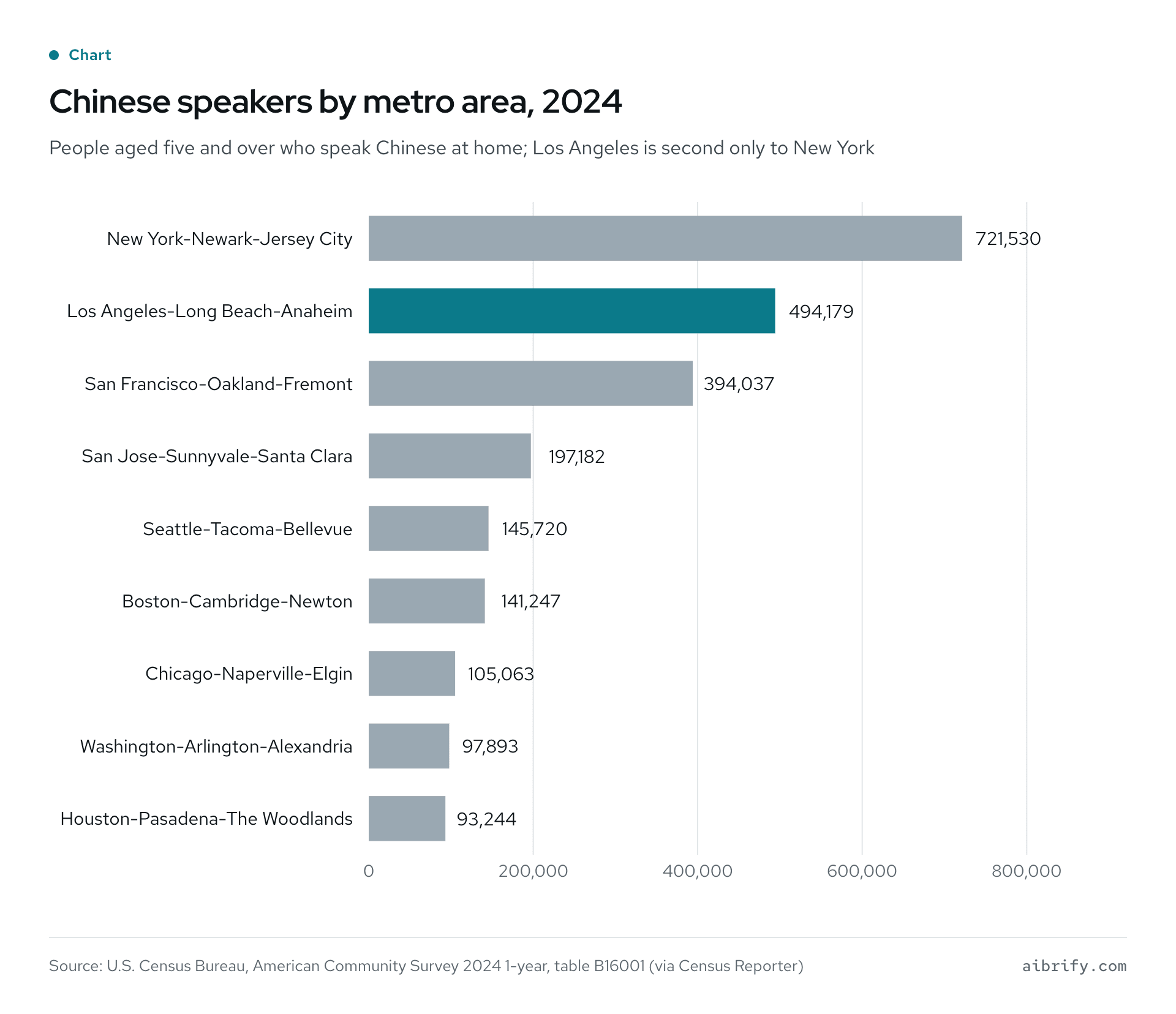
The chart ranks the nine largest metro areas by Chinese speakers in 2024. The table adds how many in each speak English less than "very well".
| Metro area | Chinese speakers, 2024 | Speak English less than "very well" |
|---|---|---|
| New York-Newark-Jersey City | 721,530 | 435,540 |
| Los Angeles-Long Beach-Anaheim | 494,179 | 269,689 |
| San Francisco-Oakland-Fremont | 394,037 | 203,825 |
| San Jose-Sunnyvale-Santa Clara | 197,182 | 82,727 |
| Seattle-Tacoma-Bellevue | 145,720 | 61,107 |
| Boston-Cambridge-Newton | 141,247 | 65,568 |
| Chicago-Naperville-Elgin | 105,063 | 52,265 |
| Washington-Arlington-Alexandria | 97,893 | 38,549 |
| Houston-Pasadena-The Woodlands | 93,244 | 46,632 |
The English-ability split matters more than the headcount. In Queens, 151,896 of 225,137 Chinese speakers, two thirds, speak English less than "very well"; Santa Clara County's share is 42 percent.
A business in Queens is therefore likelier to answer Chinese-first calls than one in Santa Clara County, if its callers match the county. The headcount says how many customers speak Chinese; the split says how many need it.
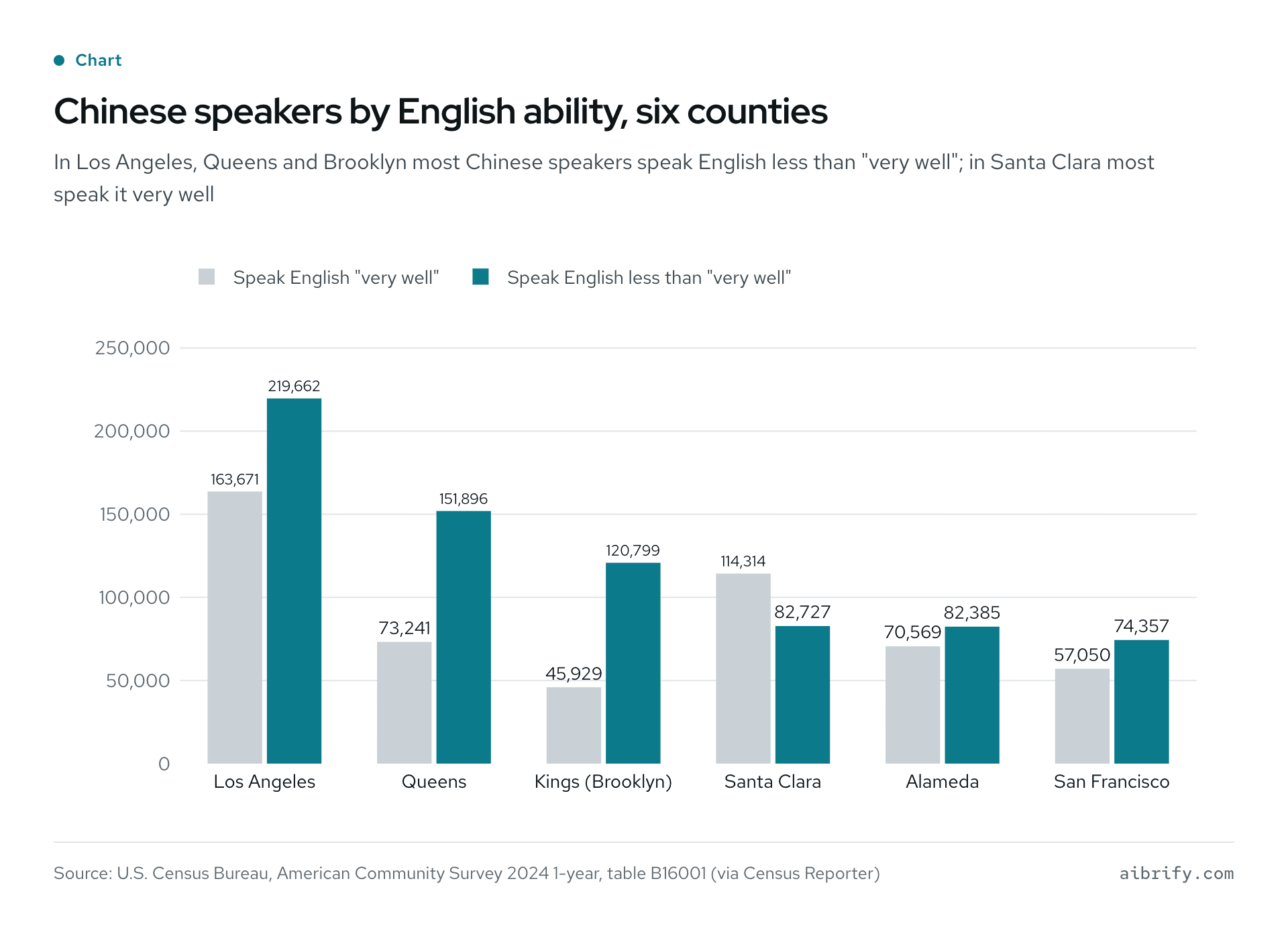
The chart splits Chinese speakers in six counties by English ability. The table gives the counts.
| County | Speak English "very well" | Speak English less than "very well" | Share less than "very well" |
|---|---|---|---|
| Los Angeles, CA | 163,671 | 219,662 | 57% |
| Queens, NY | 73,241 | 151,896 | 67% |
| Kings (Brooklyn), NY | 45,929 | 120,799 | 72% |
| Santa Clara, CA | 114,314 | 82,727 | 42% |
| Alameda, CA | 70,569 | 82,385 | 54% |
| San Francisco, CA | 57,050 | 74,357 | 57% |
The Census Bureau's Annual Business Survey counted 650,680 Asian-owned employer businesses in 2022, with 144,141 of them, 22.2 percent, in accommodation and food services. The survey does not break out Chinese-owned firms, and it counts sectors rather than restaurants. That sector is the one that contains restaurants, and a restaurant's phone is its order line.
What Does Bilingual Phone Coverage Cost?
An in-house receptionist costs $3,168 a month at the median wage before any bilingual premium; California's state differential adds $100. A live answering service runs $175 to $700 and an AI receptionist $25 to $300. Chinese is the hard part: the bilingual plans on the pricing pages checked below mean English and Spanish.
Hire a bilingual receptionist. The median receptionist earned $38,010 a year, or $18.27 an hour, in May 2025, per the Bureau of Labor Statistics. OnceHub puts the cost at about $54,400 a year once benefits and payroll taxes are counted.
Bilingual skill carries a premium. California pays state employees a bilingual differential of $100 a month, or $0.58 an hour, when a second language fills 10 percent of their time. And one person, however skilled, covers one shift.
Subscribe to a live answering service. Live answering services run $175 to $700 a month at small-business volume, per OnceHub's September 2026 pricing guide. AnswerConnect sells bilingual plans at $350, $395 and $575 a month, with $1.85 to $2.50 per extra minute.
Its bilingual page describes receptionists fluent in English and Spanish. Of the three pricing pages checked for this guide, AnswerConnect, PATLive and Ruby, none lists Mandarin or Cantonese. A Chinese-speaking caller on those plans is answered in English.
Use an AI receptionist. AI receptionists run $25 to $300 a month in the same guide. Language support varies by product. The test is simple: call the line in Mandarin and see whether the answer comes back in Mandarin.
The Aibrify AI receptionist. English and Mandarin are both included in the $149 monthly plan, on one number, with no per-language fee. The plan covers 400 minutes and extra minutes cost $0.30. Setup is included.
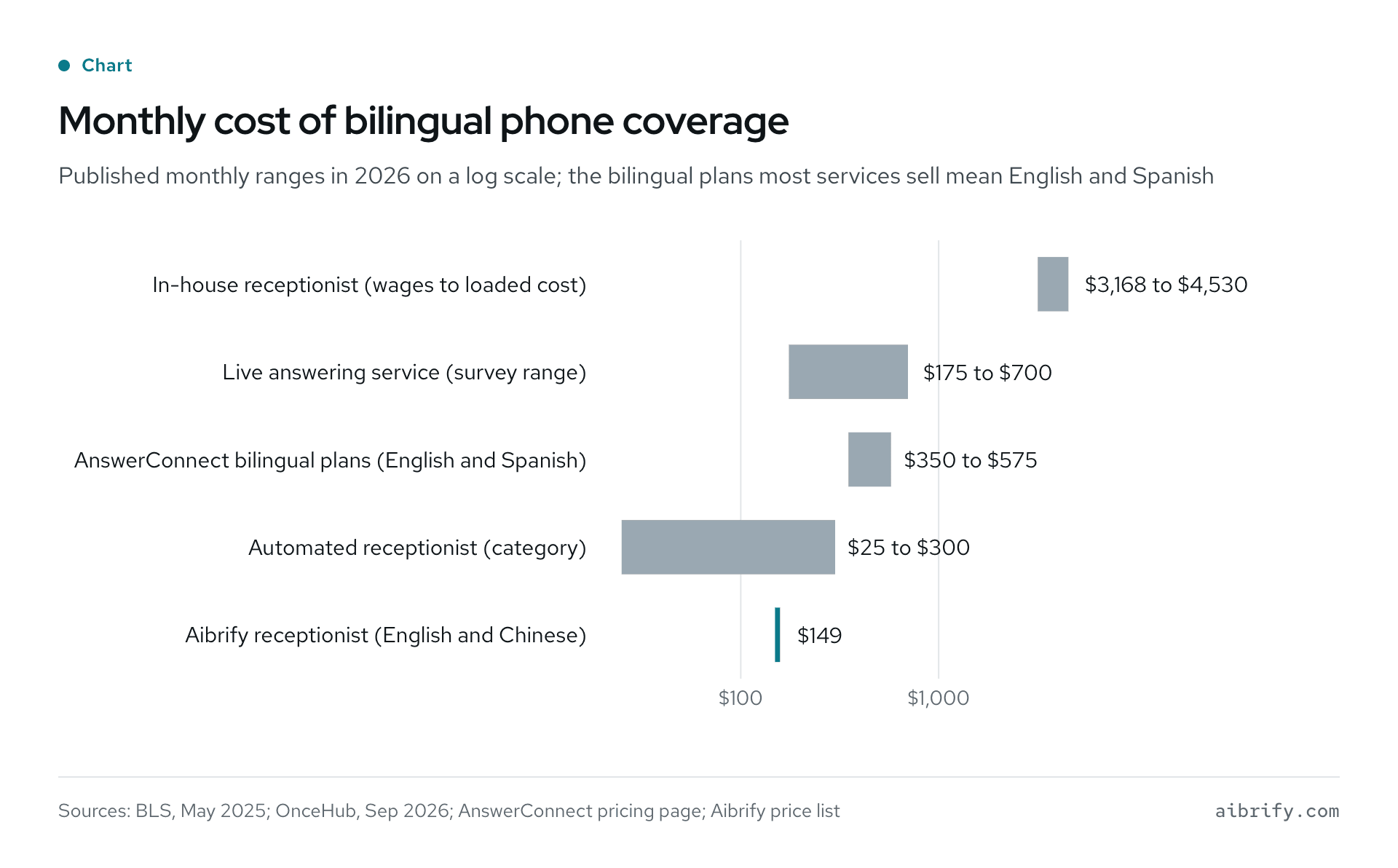
The chart shows each option's monthly range on a log scale. The table lists the sources and which languages the price includes.
| Option | Monthly cost | Languages included | Source |
|---|---|---|---|
| In-house receptionist | $3,168 in wages; about $4,530 with benefits and payroll taxes | Whatever the hire speaks; $100 a month state differential as a benchmark | BLS, May 2025; OnceHub, Sep 2026; CalHR |
| Live answering service, guide range | $175–$700 | Varies by provider | OnceHub, Sep 2026 |
| AnswerConnect bilingual plans | $350–$575; $1.85–$2.50 a minute over | English and Spanish | AnswerConnect pricing page |
| AI receptionist, category | $25–$300 | Varies by product | OnceHub, Sep 2026 |
| Aibrify AI receptionist | $149 with 400 minutes; setup included; $0.30 a minute over | English and Mandarin | Aibrify price list |
The comparison of AI receptionists and answering services covers the three paid categories in detail.
How Does a Call Work in Two Languages?
The call starts with a short notice, continues in the caller's language, and ends with a text summary the owner can read. Every step follows a rule the owner set during setup.
- Notice. The receptionist opens by stating that it is automated and that the call is recorded. A caller can ask for a person at any point.
- Language. The receptionist continues in the language the caller uses, English or Mandarin, on the same number. Cantonese is not supported yet.
- Task. It takes the order from the owner's menu, books from the owner's calendar rules, or answers hours, directions and prices from the owner's list.
- Summary. Name, number, request and outcome go into a text summary of the call, sent to the owner in Chinese or English.
- Transfer. A complaint, a negotiation, or a question the list does not answer goes to the number the owner chose, with the summary attached.
- Report. Once a month the owner receives a report of the calls it answered.
| Step | What the caller hears | What the owner gets |
|---|---|---|
| Notice | That the line is automated and recorded | A notice written for California's consent and disclosure rules |
| Language | A reply in English or Mandarin, whichever they used | No separate Mandarin line to buy |
| Task | An order read back, a booking confirmed, or an answer from the owner's list | The order or booking by text, in Chinese or English |
| Transfer | A person, when the call leaves the rules | A text summary with the hand-off |
| Report | Nothing; the caller has hung up | A monthly report of the calls it answered |
Two California rules inform the notice. Penal Code section 632 applies directly to recorded calls. Section 17941 is written for online bots, and the receptionist follows its disclosure standard on the phone anyway.
Section 632 requires the consent of all parties before a confidential communication is recorded, with a fine of up to $2,500 per violation.
Business and Professions Code section 17941 covers bots that communicate with a person in California online to incentivize a purchase or sale. Using one to mislead a person about its artificial identity is unlawful unless the bot is disclosed. The disclosure must be "clear, conspicuous, and reasonably designed to inform".
The receptionist discloses itself at the start of every call, and businesses outside California follow their own state's rules.
Which Chinese-Owned Businesses Get the Most From It?
The receptionist is built for businesses whose customers call to order, book, or ask, and whose callers split between English and Mandarin. Four hypothetical cases show where the value lands; the prices are Aibrify's fixed list prices.
A San Gabriel Valley restaurant. Half the calls arrive in Mandarin, half in English, and the same two people cook and answer. The receptionist takes takeout orders in either language and texts each order to the owner in Chinese or English. The restaurant guide works through the numbers; a QR menu with daily specials costs $100 and reservation and waitlist texts $300.
A real estate agent in Arcadia or Flushing. Buyer and seller calls come in both languages, often during a showing. The receptionist answers, texts the agent a summary with the caller's name, number and request, and the agent calls back with the context already written down. The lead follow-up guide covers the rest; an open-house sign-in with follow-up costs $300.
A med spa or clinic in Irvine. After-hours calls are mostly bookings and hours questions. The receptionist books non-clinical appointments in either language and hands anything clinical to staff, as the clinic guide explains. Appointment reminders that cut no-shows cost $300.
A tutoring center or an accountant. Parents and clients call in Mandarin to ask about schedules, documents and deadlines. The receptionist answers from the owner's list and takes messages; parent notices by text or WeChat cost $300 and deadline reminders $100.
| Business | Calls the receptionist takes | Fixed-price add-ons |
|---|---|---|
| Restaurant | Takeout orders, reservations, hours | QR menu with specials $100; reservation and waitlist texts $300 |
| Real estate agent | Buyer and seller inquiries, showing requests | Listing to Just Listed posts $100; open-house sign-in with follow-up $300; valuation request page $300 |
| Clinic or med spa | Non-clinical bookings, hours, directions, messages | Review request after each visit $100; appointment reminders $300; intake form to PDF $300 |
| Tutoring and classes | Schedule questions, make-up requests, messages | Parent notices by text or WeChat $300; schedule and make-up booking $300 |
| Accountants and insurance | Document and deadline questions, messages | Deadline reminders $100; document intake portal $1,000 |
The full list by industry is on the homepage, and the cost guide explains the $100 to $5,000+ ladder.
When Is a Bilingual Receptionist the Wrong Choice?
A bilingual receptionist does not fit every business; four cases stand out. The callers mostly speak a third language, the calls need judgment, the customers message instead of calling, or the volume is too low.
A third language dominates. The Aibrify AI receptionist answers in English and Mandarin. A business whose callers mostly speak Vietnamese, Korean or Spanish is better served by a live service with staff in that language. AnswerConnect's bilingual plans, for instance, cover Spanish.
The calls need judgment. Contract negotiations, immigration questions, and complaints that need an apology from the owner belong to a person. Those calls go to a bilingual employee, not a script. The receptionist's job is to take the routine call and transfer the rest.
Customers message instead of calling. The receptionist answers phone calls. A business whose customers order in WeChat groups and never dial gets more from a $300 booking page or a $100 automation.
Volume is too low. A shop that gets five calls a day, all in English, does not need a second language on the line. Keep a tally of each call and its language for seven days; the sheet will show whether a second language earns its place.
Frequently Asked Questions (FAQ)
What is a bilingual AI receptionist?
A bilingual AI receptionist answers calls in two languages on one number, takes orders and bookings, texts the owner a summary of each call, and transfers when needed. Aibrify's AI receptionist answers in English and Mandarin day and night and costs $149 a month with setup included. The plan includes 400 minutes.
How many people in the US speak Chinese at home?
About 3.7 million people aged five and over spoke Chinese at home in 2024, according to the Census Bureau's American Community Survey. Of those, 1.9 million, about half, speak English less than "very well". California has 1.3 million Chinese speakers and New York 646,000.
How much does a bilingual receptionist cost?
An in-house receptionist earns a median $38,010 a year, per the Bureau of Labor Statistics, and California pays a $100 monthly differential for bilingual work. Live answering services run $175 to $700 a month, with bilingual plans at AnswerConnect from $350 to $575. Aibrify includes both languages in its $149 monthly plan.
Do answering services offer Mandarin or Cantonese?
Not on the pricing pages reviewed for this guide: AnswerConnect's bilingual plans, $350 to $575 a month, describe receptionists fluent in English and Spanish. On those plans a Chinese-speaking caller reaches an English-speaking operator. The Aibrify plan includes a second language on the same number at no extra charge. Aibrify's AI receptionist speaks English and Mandarin; Cantonese is not supported yet.
How does the receptionist know which language to use?
It replies in the language the caller uses, English or Mandarin, on the same number. The owner's menu, prices, hours and booking rules are stored once and used in both languages. Anything the receptionist is unsure about is transferred to a person, with a text summary of the call so far.
Does the receptionist have to say it is automated?
Yes: the Aibrify AI receptionist opens every call by stating that it is automated and that the call is recorded. In California, Penal Code section 632 requires all-party consent to record a confidential communication. Business and Professions Code section 17941 requires disclosing a bot used online to incentivize a commercial transaction; the receptionist applies that disclosure on the phone.
Can the owner read the call summaries in Chinese?
Yes. The call summaries are texted in Chinese or English, and Aibrify works in both languages, so the brief, the written scope and the monthly report can be in either language too. The owner chooses during setup, and support in both languages costs nothing extra; it is part of the written scope.
How long does setup take for a bilingual line?
About a week: the owner sends the menu or service list, hours, booking rules and transfer number, in either language. Aibrify writes the scope and builds the flow, and the owner test-calls in both languages until the answers are right. There is no setup fee.
What Should You Do Next?
The tally is the brief: calls a day, calls in Chinese, and calls that went unanswered. A Chinese-speaking share near the county figures above makes the case for a second language on the line. Five English calls a day does not.
Send that tally to Aibrify by text or email, in English or Chinese, with the menu or service list and the transfer number. The written scope and the fixed price come back before any work starts: $149 a month with both languages included and no setup fee. Details are on the receptionist page, and the brief goes in through start a project.


