How Does an AI Phone Answering Service Detect the Caller's Language?
An AI receptionist picks the language in one of two ways. Either the caller chooses from a short menu at the start: press 1 for English, 2 for Mandarin, 3 for Spanish. Or the system listens to the first words and answers in the same language.
The better systems also switch when a caller asks for another language part way through.
Aibrify Desk uses the first approach and adds the switch. Every call opens with a greeting: the caller has reached an AI assistant, and the call is transcribed. The language menu follows.
If the caller later asks for Spanish or Mandarin, Desk changes language and keeps going.
The business keeps its number throughout. You forward calls to Desk, every call or only the ones nobody picks up. The owner gets a summary of each call in Chinese or English; the caller's language and the owner's language are set separately.
Option A: a language menu at the start
A menu is the plain, predictable choice. The caller hears each option in its own language, presses a key, and the rest of the call runs in that language. Nothing is guessed, so a caller with an accent is never misread.
The cost is a few seconds at the top of the call. For a restaurant or clinic whose callers are used to menus, those seconds are rarely a problem. For a line where almost every caller speaks English, the menu can be shortened to a single prompt.
Option B: switching mid-call
Switching handles the cases a menu misses. A caller presses 1 for English, then hands the phone to a parent who speaks only Spanish. Or a caller starts in English and asks, "¿Habla español?" halfway through.
An AI receptionist built for this confirms the new language and continues without restarting. The appointment it was booking stays open, and the notes it took are kept. The table below sets the two methods side by side.
| Menu at the start | Mid-call switch | |
|---|---|---|
| How the language is chosen | Caller presses a key | Caller asks, or starts speaking another language |
| Risk of a wrong guess | None | Low when the caller asks; higher when detection is automatic |
| Time added to the call | A few seconds | None |
| Handles a hand-off to a relative | Only if the relative calls back | Yes |
| What Aibrify Desk does | Yes, after the opening greeting | Yes, when the caller asks |
What Happens When the Caller Switches Languages Mid-Call?
The AI receptionist confirms the switch, repeats what it has so far in the new language, and carries on. The caller does not start over, and the business does not lose the booking. On Desk, the owner's summary arrives in the owner's language no matter what the caller spoke.
Here is the usual sequence. The caller says a sentence in Spanish, or asks for Spanish directly. Desk answers in Spanish: it confirms the name it already has, restates the open request, and asks the next question.
Two limits are worth knowing. Desk speaks English, Mandarin and Spanish; Cantonese is not supported, so a Cantonese speaker is offered English or Mandarin, or a message is taken for the owner.
The owner can also list topics Desk will not answer in any language: prices, complaints, refunds, symptoms, legal advice. Those are passed to a person.
A caller who presses 1, then asks for Spanish, hears the same AI receptionist continue in Spanish. The owner later reads one summary, in Chinese or English, that says what the caller wanted and which language the call ended in.
How Many Callers Actually Need Spanish or Mandarin?
In 2024, 44.9 million US residents age 5 and over spoke Spanish at home and 3.7 million spoke Chinese (the Census counts Mandarin and Cantonese together, and Desk does not support Cantonese). That is 13.9 percent and 1.2 percent of the population age 5 and over, according to ACS 2024 1-year table C16001. In California the shares are 28.8 percent and 3.6 percent; in Los Angeles County, 37.6 percent and 4.1 percent.
The share who struggle on an English-only phone line is large. Nationally, 18.4 million Spanish speakers (41.1 percent) and 1.9 million Chinese speakers (50.7 percent) speak English less than "very well", per the same table. In Los Angeles County the figures are 1.48 million Spanish speakers (42.4 percent) and 220,000 Chinese speakers (57.3 percent).
The Census Bureau's report Language Use in the United States: 2019 (ACS-50, Table 2) gives the longer view. In 2019, 67.8 million people spoke a language other than English at home, 41.8 million of them Spanish and 3.5 million Chinese.
In the Los Angeles-Long Beach-Anaheim metro, 54.4 percent of residents spoke a non-English language at home. Spanish made up 66.2 percent of those speakers and Chinese 7.2 percent (ACS-50, Table 4).
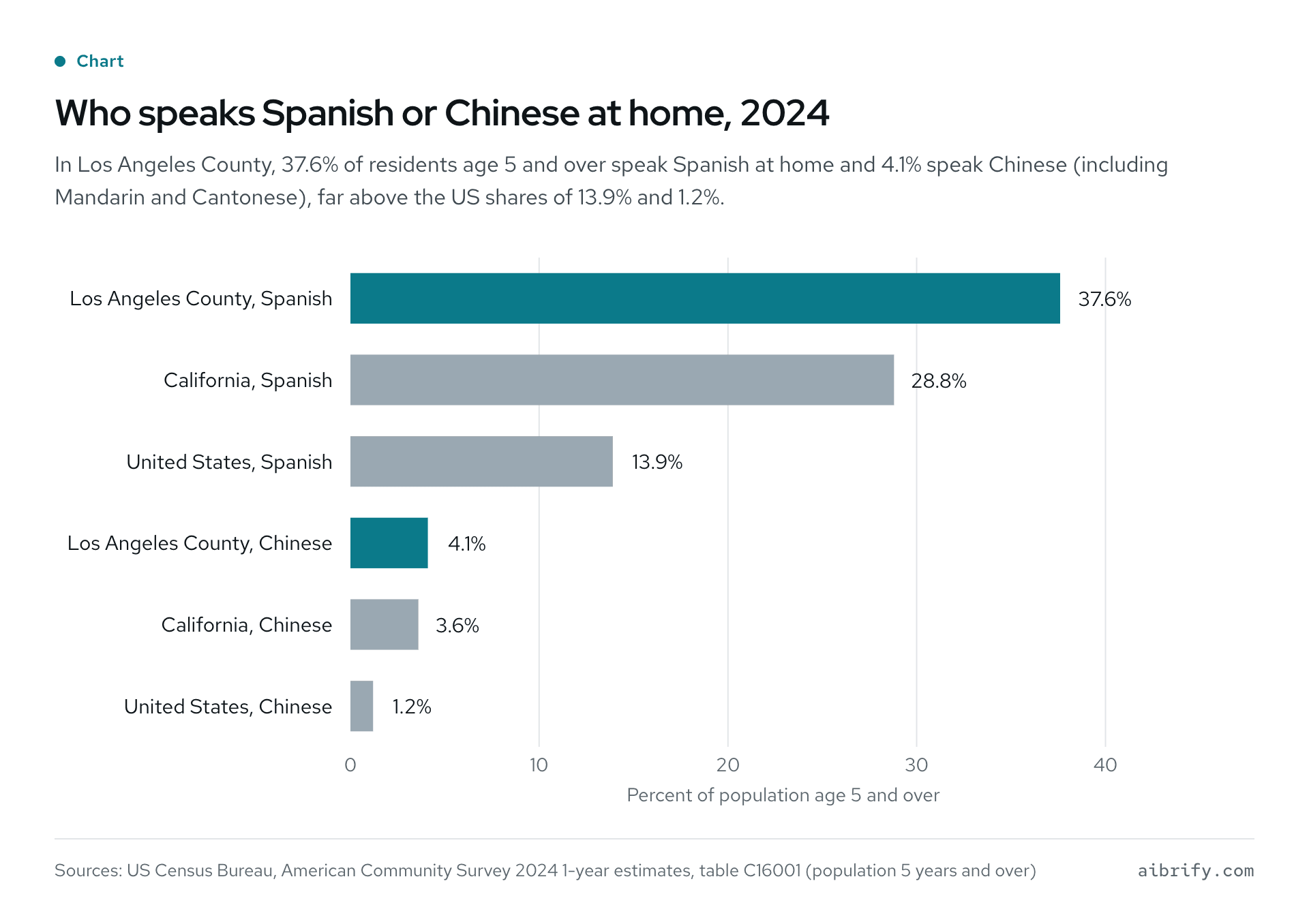
The chart shows the need varies sharply by place. A Los Angeles County business hears Spanish from more than a third of its market, and Chinese from one resident in 25.
| Area | Speak Spanish at home | Speak Chinese at home | Speak a language other than English |
|---|---|---|---|
| Los Angeles County | 37.6% (3.49 million) | 4.1% (383,000) | 55.2% |
| California | 28.8% (10.75 million) | 3.6% (1.33 million) | 45.3% |
| United States | 13.9% (44.87 million) | 1.2% (3.73 million) | 23.0% |
Source: ACS 2024 1-year, table C16001, population age 5 and over.
Call data from one vendor points the same way. NextPhone, an AI answering vendor, analyzed 1,446,980 business calls across 2,074 businesses in 2025. It reports 8.0 percent in Spanish, 89.8 percent in English and 1.7 percent in French.
That is vendor data from its own customers, not a national sample, but it means roughly 1 caller in 12.
Which Businesses Need a Bilingual AI Receptionist?
Any business whose callers include people who speak English less than "very well" needs it. In practice the five fields below ask for Spanish and Mandarin most often, and each has its own pattern of calls.
| Business | What the caller usually wants | What Desk answers | What goes to a person |
|---|---|---|---|
| Restaurants | Hours, directions, parking, a table | Hours, address, parking, bookings | Complaints, refunds |
| Clinics and dental offices | Insurance accepted, an appointment, directions | Insurance list, hours, bookings | Symptoms, prices |
| Salons | A booking, a cancellation, service list | Bookings, services, hours | Prices, complaints |
| Home services (HVAC, plumbing) | A visit, an urgent repair, service area | Bookings, service area, hours | Quotes |
| Law firms | Intake, office hours, directions | Hours, address, message taking | Legal advice, fees |
Restaurants. A Spanish-speaking caller wants to know if you are open and whether there is parking. Desk answers from the owner's material and books a table into its own calendar; phone ordering is coming soon. See the restaurant guide and Desk for restaurants.
Clinics. The first question is almost always "do you take my insurance", and the second is for an appointment. Desk reads the accepted insurance list the owner uploaded and books the visit; anything about symptoms goes to staff. Clinics that need stricter limits can go custom, as described on Desk for medical offices and in clinic missed calls after hours.
Salons. Bookings and cancellations in the client's own language, with the service list loaded from the owner's menu. Desk for salons covers the setup.
Home services. A caller with a leak wants a time, not a conversation. Desk takes the address, books a window and notifies the owner right away; quotes are passed to the owner. Desk for HVAC applies to plumbers and electricians too.
Law firms. A potential client calls after hours in Spanish. Desk takes the name, the matter in the caller's words and a callback time; it never gives legal advice. Desk for law firms explains the custom option for firms that want more material and tighter limits.
Mandarin-speaking communities have the same needs with one extra wrinkle: many older callers prefer Mandarin for the call but have children who read English. The bilingual AI receptionist guide for Chinese businesses goes into that case.
What Does a Spanish Call Sound Like?
Below is a sample call to a plumbing company, translated into English. The actual call runs in Spanish from the moment the caller presses 3; the greeting and menu are heard in each language. Names and details are invented for the example.
Receptionist: Thank you for calling Ruiz Plumbing. You have reached an AI assistant, and this call is transcribed. For English, press 1. For Mandarin, press 2. For Spanish, press 3.
The caller presses 3. From here the call is in Spanish; the text is translated.
Receptionist: Good afternoon. How can I help you?
Caller: There is water coming out from under my kitchen sink. Can someone come today?
Receptionist: I can help with that. May I have your name and the address of the property?
Caller: Marta Delgado. It is the house on Ninth Street in Santa Ana, the one with the blue gate.
Receptionist: Thank you, Ms. Delgado. The next open visit today is between 3 and 5 in the afternoon. Should I book it?
Caller: Yes. How much does the visit cost?
Receptionist: Prices are something the owner answers directly. I will send him your question with the booking, and he will call you back before the visit.
Caller: All right. Thank you.
Receptionist: You are booked for today between 3 and 5. The owner will get this message right away. Goodbye.
The owner, who reads English, gets this a minute later:
Marta Delgado, kitchen sink leak, Ninth Street in Santa Ana (blue gate). Booked today 3 to 5 pm. Asked for the price; call her back before the visit. Call in Spanish, 2 min 10 s.
A Chinese-reading owner gets the same summary in Chinese.
What Does a Mandarin Call Sound Like?
This sample is a call to a dental office. The caller presses 2, and the call runs in Mandarin; the text below is an English translation. The insurance answer comes from the list the office gave Desk.
Receptionist: Thank you for calling Bright Smile Dental. You have reached an AI assistant, and this call is transcribed. For English, press 1. For Mandarin, press 2. For Spanish, press 3.
The caller presses 2. From here the call is in Mandarin; the text is translated.
Caller: Hello. Is Delta Dental on your insurance list? I would like to book a cleaning.
Receptionist: Yes, the office accepts Delta Dental PPO. For a cleaning, the next openings are Tuesday at 10 in the morning and Thursday at 2 in the afternoon. Which one works for you?
Caller: Thursday. Also, one of my back teeth has been sore for a week. Is that serious?
Receptionist: I am not able to answer questions about symptoms. I will note it for the office, and a staff member will call you back today. May I have your name for Thursday at 2?
Caller: Chen Wei. Is there parking?
Receptionist: Thank you, Mr. Chen. There is a parking lot behind the building, entrance on the side street. You are booked for Thursday at 2 in the afternoon. Goodbye.
A caller who asks for Cantonese on this line is told, in Mandarin and English, that Cantonese is not supported. Desk then offers to continue in Mandarin or English, or to take a message for the office.
Which AI Receptionists Offer Spanish and Mandarin?
As of October 2026, every vendor in this comparison offers Spanish. Only two name Mandarin on their pages: Aibrify Desk and My AI Front Desk.
Only RingCentral and Aibrify state that the language can change mid-call. The table lists what each vendor's own page says and nothing more.
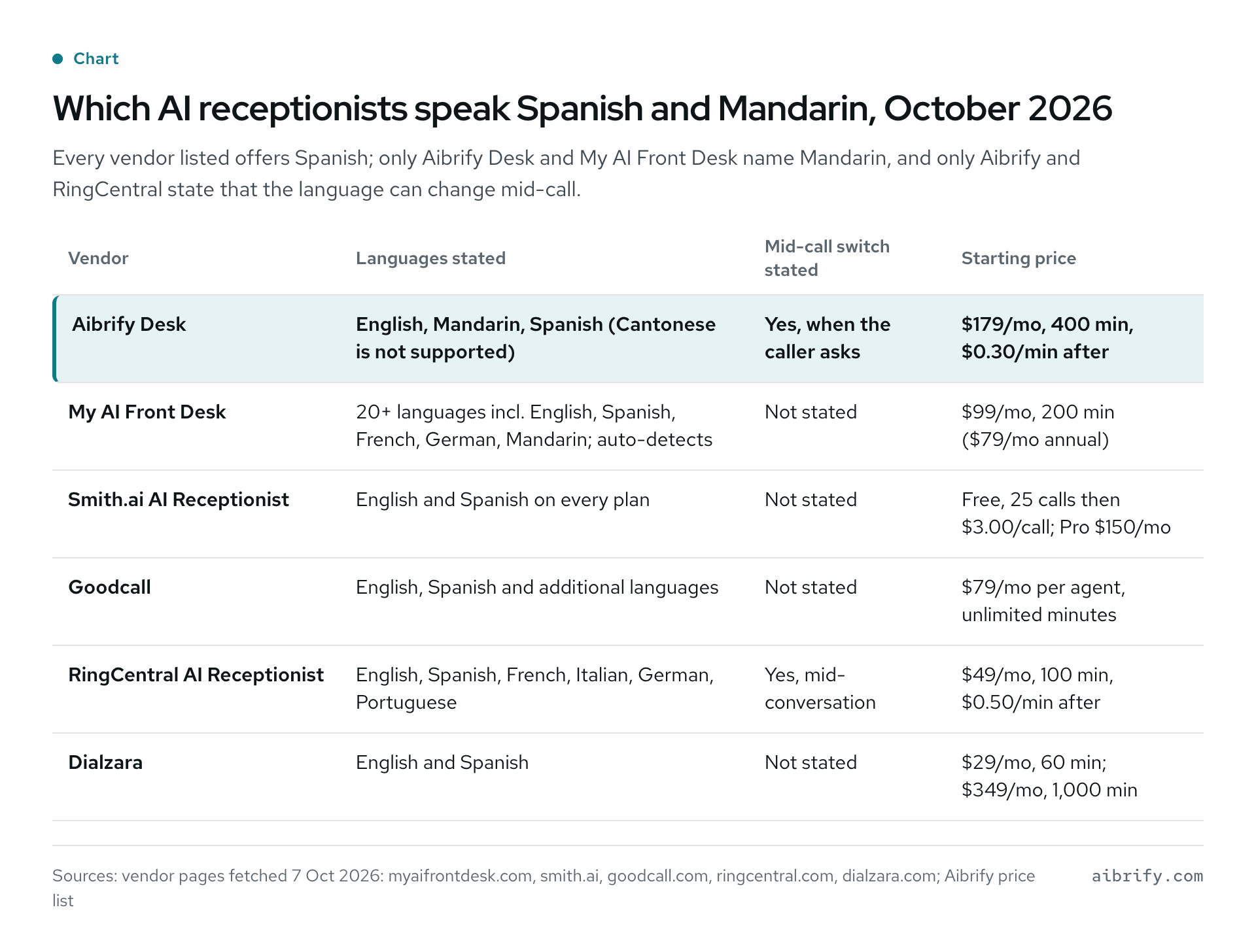
The table lists each vendor's languages, switching and starting price. Prices are as of October 2026.
| Vendor | Languages stated on the vendor's page | Mid-call switching stated? | Starting price (as of October 2026) |
|---|---|---|---|
| Aibrify Desk | English, Mandarin, Spanish; Cantonese is not supported | Yes, when the caller asks | $179 a month, 400 minutes, $0.30 a minute after |
| My AI Front Desk | "20+ languages", naming English, Spanish, French, German, Mandarin; "detects caller language automatically" | Not stated | $99 a month, 200 minutes; $79 a month billed annually |
| Smith.ai AI Receptionist | "EN + ES fluency" on every plan; Mandarin not mentioned | Not stated | Free plan, 25 calls then $3.00 a call; Pro $150 a month at $2.00 a call |
| Goodcall | "Multilingual support for English, Spanish, and additional languages"; the pricing page lists no languages | Not stated | $79 a month per agent, unlimited minutes |
| RingCentral AI Receptionist | English, Spanish, French, Italian, German, Portuguese | "Can switch languages mid-conversation" | $49 a month standalone, 100 minutes, $0.50 a minute after |
| Dialzara | "English + Spanish" | Not stated | $29 a month, 60 minutes; up to $349 a month for 1,000 minutes |
Smith.ai also sells human-staffed plans, where a Spanish line is an add-on at $1.00 per call on top of a $300-a-month plan that includes 30 calls. The broader best AI receptionist comparison covers features beyond language.
What Does Bilingual Phone Coverage Cost?
A bilingual employee is the most expensive option and an AI receptionist the cheapest, with a human-staffed Spanish line in between. The BLS Occupational Outlook Handbook puts the median receptionist wage at $38,010 a year, or $18.27 an hour, in May 2025. That is $3,168 a month before payroll tax, benefits or any bilingual premium.
Employers do pay a premium for the second language. The State of California, for example, adds a bilingual differential of $125 a month for Highway Patrol officers (CalHR Pay Differential 116, revised October 2024). Private rates vary, but the state figure is a public, dated example of what the skill is worth to an employer.
| Option | Basis | Cost per month |
|---|---|---|
| In-house receptionist, wages only | BLS median, May 2025 | $3,168 |
| Plus a bilingual differential | California state example, $125 a month | $3,293 |
| Human-staffed Spanish line (Smith.ai) | $300 plan, 30 calls, plus $1.00 a call in Spanish | $330 for 30 calls |
| AI receptionist, low end (Dialzara) | 60 minutes | $29 |
| AI receptionist, mid range (RingCentral) | 100 minutes, $0.50 a minute after | $49 |
| Aibrify Desk | 400 minutes, $0.30 a minute after, setup included | $179 |
Aibrify Desk is $179 a month with 400 minutes included and $0.30 for each extra minute. Setup is included, and the plan is month to month with no contract. The full breakdown, including overage math for busy lines, is in what an AI receptionist costs.
One cost item is easy to miss. A bilingual employee covers the phone for one shift. The three languages on Desk are on the line whenever calls are forwarded, evenings and weekends included.
How Do You Set Up Language Detection on Your Line?
Setup is a short list of decisions, and Desk's setup is included in the price. Here are the steps in order.
- 1. Pick the languages. Desk offers English, Mandarin and Spanish. Choose which ones your callers need and the order they appear in the menu.
- 2. Write the greeting. The opening states that the caller has reached an AI assistant and that the call is transcribed. Add your business name and, if you like, a one-line note such as "we are closed Mondays".
- 3. Load your material. Hours, address, parking, services and the insurance you accept, in one language. Desk answers in whichever language the caller chose.
- 4. List the topics Desk will not answer. Prices, complaints, refunds, symptoms, legal advice. Those calls are transferred to your phone, or the details are taken and you are notified right away.
- 5. Set up call forwarding. Forward every call, or only the ones nobody answers, from your existing number. Keep your number as it is.
- 6. Choose the summary language. Chinese or English, by email or Slack, plus a weekly summary on Monday and a monthly report.
- 7. Test it. Call your own line, press 2, then ask for Spanish mid-call. Then call the demo line on desk.aibrify.com to compare.
Clinics, law firms and other careful fields can ask for a custom setup. That means more material for Desk to work from and stricter limits, priced to fit. For a Spanish-first line, start at desk.aibrify.com/spanish.
Frequently Asked Questions
Can an AI receptionist detect Spanish automatically without a menu?
Some systems listen to the caller's first words and answer in the same language, which skips the menu. Aibrify Desk opens with a greeting and a language menu (English, Mandarin, Spanish) and switches when the caller asks for another language. The menu avoids wrong guesses on callers with an accent, at the cost of a few seconds.
Does Aibrify Desk speak Cantonese?
No, Cantonese is not supported; Aibrify Desk speaks English, Mandarin and Spanish. A caller who asks for Cantonese is told it is not supported, in Mandarin and English. The caller can then continue in Mandarin or English, or leave a message that reaches the owner right away.
What language does the owner receive the call summary in?
The owner chooses Chinese or English, and every summary arrives in that language no matter which language the caller used. Summaries go out by email or Slack after each call, with a weekly summary on Monday and a monthly report. Text alerts start once carrier texting registration is approved.
Can the caller switch languages in the middle of a call?
Yes: on Aibrify Desk, a caller who asks for another language part way through hears the receptionist confirm the change and carry on in it. Nothing already booked or noted is lost. RingCentral's AI Receptionist page also states that its product can switch languages mid-conversation.
How much does a bilingual AI receptionist cost compared with a bilingual employee?
The BLS median receptionist wage was $38,010 a year in May 2025, about $3,168 a month before benefits, and employers often add a bilingual premium. As of October 2026, AI receptionists with Spanish run from $29 a month (Dialzara, 60 minutes) to $179 a month. The $179 is Aibrify Desk: 400 minutes, English, Mandarin and Spanish.
Do I need a separate phone number for Spanish callers?
No, a single line carries all three languages. The business keeps its existing number and forwards calls to the AI receptionist, every call or only unanswered ones. Callers choose from the menu or ask mid-call, so printing a second number for Spanish or Mandarin speakers is unnecessary.
How many callers to a local business need a language other than English?
It depends on the area: in Los Angeles County, 37.6 percent of residents age 5 and over speak Spanish at home and 4.1 percent Chinese. The source is ACS 2024 1-year, table C16001. One AI answering vendor, NextPhone, reports 8.0 percent of 1,446,980 calls across 2,074 businesses in 2025 were in Spanish, about 1 caller in 12.
Which businesses benefit most from a multilingual AI receptionist?
Restaurants, clinics and dental offices, salons, home-service companies and law firms. Their callers often need hours, directions, insurance answers or a booking in their own language. Any business in an area where many residents speak English less than "very well" sees the same effect: fewer hang-ups and more bookings.