


Who Owns the Code When You Hire a Software Studio?
Who owns the code in custom software? The studio, by default, unless the contract transfers it in writing.
Under section 201 of the Copyright Act, copyright "vests initially in the author", and an outside studio is the author of the code it writes. Paying the invoice does not change that; a signed assignment does.
The rule surprises owners because it runs against common sense. The business paid for the work, so it feels like the business owns the result. Copyright law separates the two, and the paperwork is where the gap gets closed.
Aibrify closes it by contract: the client owns the code for every build and can take it to any developer or host. Hosting with Aibrify is optional, and the hosting section below prices it. Fixes for anything broken in the delivered scope are included, and handover includes the repository and the credentials.
This guide explains what "work made for hire" covers, what a contract has to say, and what open-source code, escrow and hosting mean for ownership. It is general information, not legal advice.
Is Custom Software a "Work Made for Hire"?
Usually not, when an outside studio writes it. The Copyright Office's Circular 30 describes two situations that produce a work made for hire, and a studio's work rarely fits either.
One is work "created by an employee as part of the employee's regular duties", in the circular's words. The other is a commissioned work of a certain type, made under "an express written agreement" between the parties. A studio is not the client's employee, so only the second route is open, and it is narrow.
The second route has four conditions. Circular 30 says a work that fails any one of them "is not a work made for hire":
- The work falls within one of nine categories listed in section 101 of the Copyright Act.
- There is a written agreement between the commissioning party and the creator.
- The agreement expressly says the work is a work made for hire.
- All parties sign it.
The nine categories are the giveaway, because business software is not among them.
| The nine categories in §101 | Where a booking page, order form or portal fits |
|---|---|
| A contribution to a collective work | No |
| A part of a motion picture or other audiovisual work | No, outside games and video |
| A translation | No |
| A supplementary work | No |
| A compilation | No, unless the deliverable is an arrangement of existing data |
| An instructional text | No |
| A test | No |
| Answer material for a test | No |
| An atlas | No |
A "work made for hire" clause on its own therefore usually transfers nothing when the developer is an outside studio. The clause is written for employees and for the nine categories; for everything else, the contract needs a different sentence.
The employee question has its own test. Circular 30 cites the Supreme Court's decision in Community for Creative Non-Violence v. Reid, which read the term "in light of agency law" rather than any state's rules.
The circular's questions ask who supplied the tools, how long the relationship lasted, and whether taxes were withheld and benefits offered. A studio with its own office, tools and other clients answers every one of those as a contractor.
What Does a Contract Need to Say for the Client to Own the Code?
It needs an assignment: a sentence transferring the copyright to the client, in a document signed by the studio. Section 204 of the Copyright Act makes the form mandatory. A transfer is "not valid unless" the conveyance "is in writing and signed by the owner of the rights conveyed", the statute says.
An email thread does not meet that bar; a signed scope with an ownership clause does. Section 201(d) allows the transfer, since ownership "may be transferred in whole or in part by any means of conveyance", including a signed assignment. The assignment belongs in the same document as the scope and the price.
Five things to look for in a studio's terms:
- An assignment, not just a license. "Assigns all right, title and interest, including copyright" transfers ownership. "Grants a license to use" does not, and a license can carry conditions and an end date.
- Timing. Ownership passes on payment for each delivery, not at the end of a multi-phase project.
- A carve-out for the studio's own tools. Studios reuse libraries and templates. The contract names which pieces stay the studio's and grants the client a perpetual license to keep using them inside the delivered software.
- A component list. Third-party and open-source pieces come with their own licenses, and the client receives the list at handover.
- Delivery. The code, the repository, the credentials and the hosting access, in the client's name.
Aibrify's written scope states that the client owns the code. It is the same document that fixes the price, so both are settled before any work starts, and the price list states the same terms. At delivery the client receives the repository, the credentials and the hosting access. Aibrify can deploy the software for the client or hand it to whichever host the client chooses. Hosting with Aibrify is optional at $10 to $30 a month.
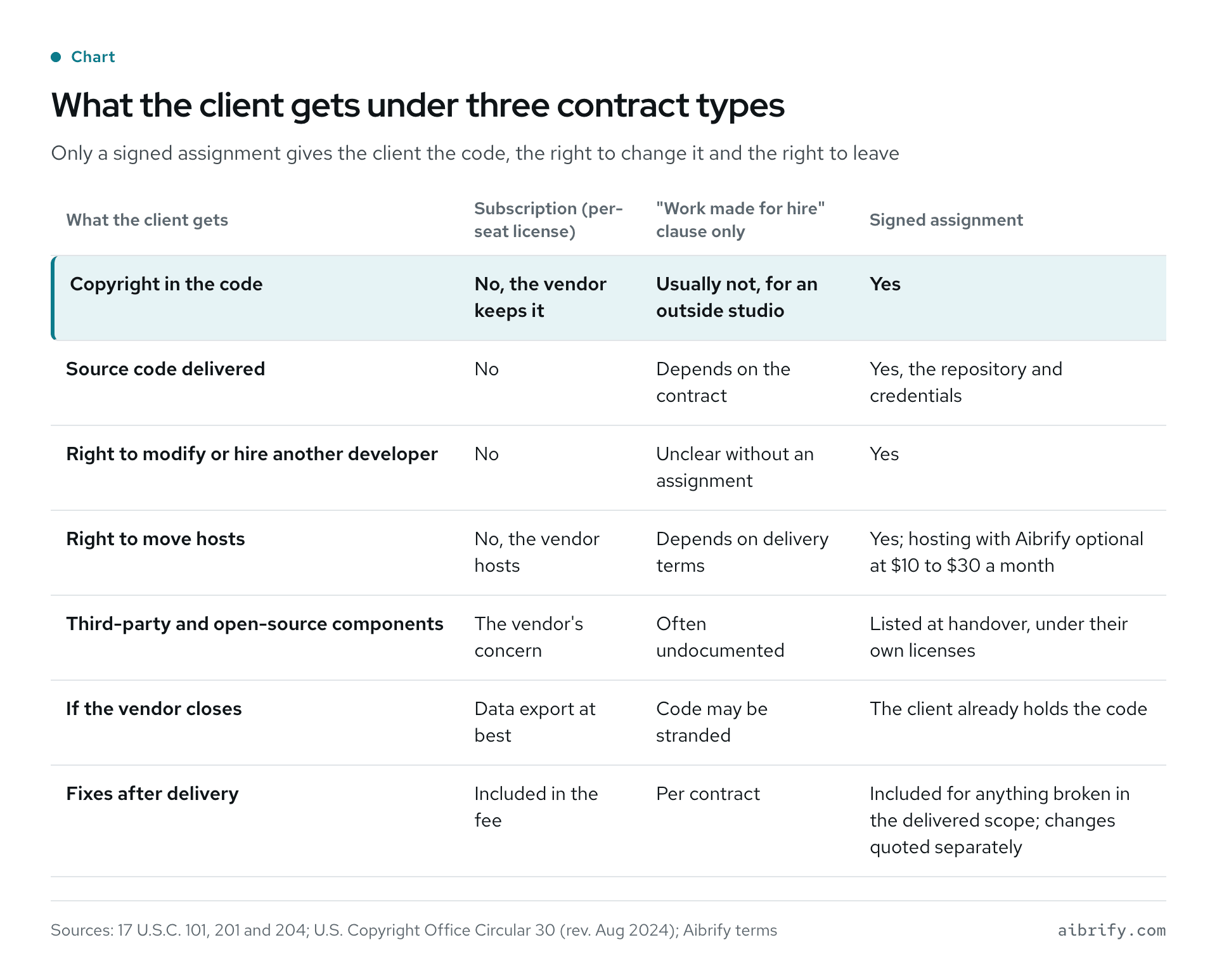
The table compares what a client can do under three kinds of agreement. The rows below repeat the same content as text.
| What the client gets | Subscription (per-seat license) | "Work made for hire" clause only | Signed assignment |
|---|---|---|---|
| Copyright in the code | No, the vendor keeps it | Usually not, for an outside studio | Yes |
| Source code delivered | No | Depends on the contract | Yes, the repository and credentials |
| Right to modify or hire another developer | No | Unclear without an assignment | Yes |
| Right to move hosts | No, the vendor hosts | Depends on delivery terms | Yes; hosting with the studio optional |
| Third-party and open-source components | The vendor's concern | Often undocumented | Listed at handover, under their own licenses |
| If the vendor closes | Data export at best | Code may be stranded | The client already holds the code |
| Fixes after delivery | Included in the fee | Per contract | Included for anything broken in the delivered scope; changes quoted separately |
What About Open-Source Code Inside Your Software?
Nobody owns it, and nobody needs to. Open source appears in 98 percent of codebases, according to Black Duck's 2026 Open Source Security and Risk Analysis of 947 codebases across 17 industries. A custom build uses libraries under their own licenses, and the client's ownership covers the code written for the client, not those libraries.
License conflicts are the part worth checking. The same report found license conflicts in 68 percent of codebases, the highest rate in its history, up from 56 percent the year before. A conflict is a component whose license terms clash with how the software is used or shared; the fix is knowing what is inside.
The report also sorted components by license status. Standard recognized licenses covered 78 percent, custom or modified licenses 11 percent, no detected license 8 percent, and dual or multiple licenses 3 percent. The 8 percent with no license is the group a handover list exists to catch.
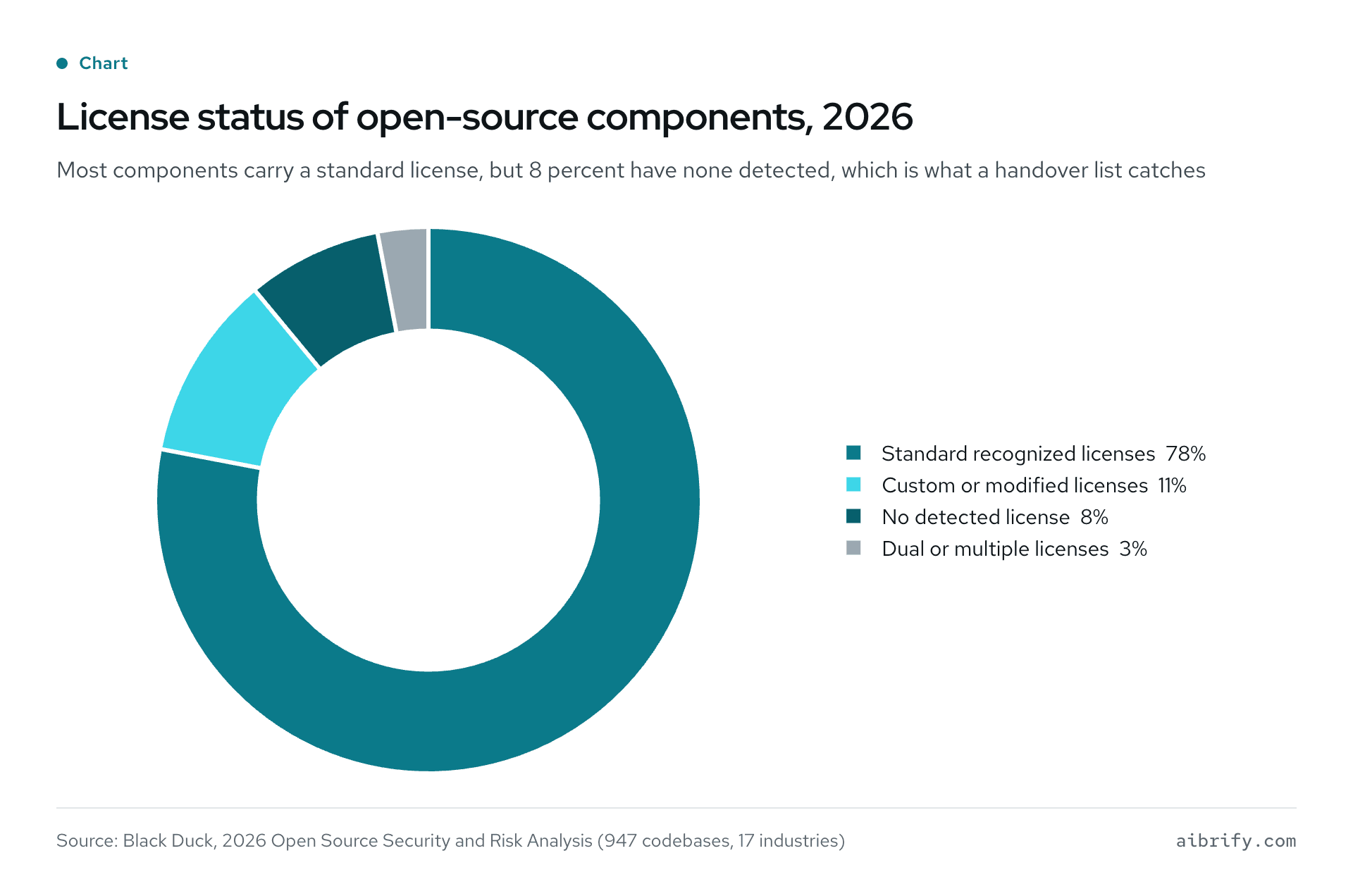
The donut shows the four license groups from the 2026 report. The table lists the same shares with the headline figures.
| Measure | Share | Basis |
|---|---|---|
| Components under standard recognized licenses | 78% | Black Duck OSSRA 2026 |
| Components under custom or modified licenses | 11% | Black Duck OSSRA 2026 |
| Components with no detected license | 8% | Black Duck OSSRA 2026 |
| Components under dual or multiple licenses | 3% | Black Duck OSSRA 2026 |
| Codebases containing open source | 98% (97% in the 2025 report) | Black Duck OSSRA 2026, 947 codebases |
| Codebases containing license conflicts | 68% (56% in the 2025 report) | Black Duck OSSRA 2026 |
For a business that runs its own tool rather than selling it, the practical effect is small, in this guide's reading of the license terms. Permissive licenses such as MIT, BSD and Apache 2.0 allow use, change and resale with attribution; copyleft licenses add conditions when software is distributed. The component list at handover makes either case checkable, which is the point.
Do You Need Source Code Escrow?
Not when the client owns and holds the code. Escrow exists for licensed software, where the vendor keeps the source and the customer wants a copy released if the vendor fails. EscrowTech charges $995 to set up a single-beneficiary agreement and $1,595 a year after that, with fees locked for three years.
That is $2,590 in the first year for a copy of something the client could simply own outright. Escrow makes sense for a subscription product the business depends on and cannot leave. For a fixed-price build with an assignment and a delivered repository, the client already has what escrow would release.
| Item | EscrowTech single-beneficiary agreement | Owned code delivered at handover |
|---|---|---|
| Setup | $995 | $0, part of the build |
| Annual fee | $1,595, locked for three years | $0 |
| Verification that the deposit is complete | From $295 for a file listing | The client runs the code |
| Release condition | Vendor failure or breach, per the agreement | None; the client already holds it |
| First-year cost | $2,590 before verification | $0 |
What Does Hosting Cost After Handover?
Hosting for a delivered tool costs $10 to $30 a month with Aibrify. A basic virtual server the client runs costs $4 to $12 a month, and agency-scale hosting runs $500 to $10,000+ a month. The number depends on who carries the operations work, not on the code.
DigitalOcean lists its basic Droplet at $4.00 a month for 512 MiB of memory and one vCPU. The next sizes are $6.00 for 1 GiB and $12.00 for 2 GiB. That price is the raw server; updates, backups and monitoring are the owner's job.
Keyhole Software's 2026 cost guide puts hosting for agency-built applications at $500 to $10,000+ a month. It also budgets annual maintenance at 15 to 25 percent of the initial development cost. Those figures fit applications with teams behind them, not a booking page.
Aibrify's hosting sits between the two: the client pays $10 to $30 a month for the whole tool, and the studio keeps it running. Because the client owns the code, moving to another host means moving the repository, not renegotiating. Included fixes do not depend on where the tool is hosted.
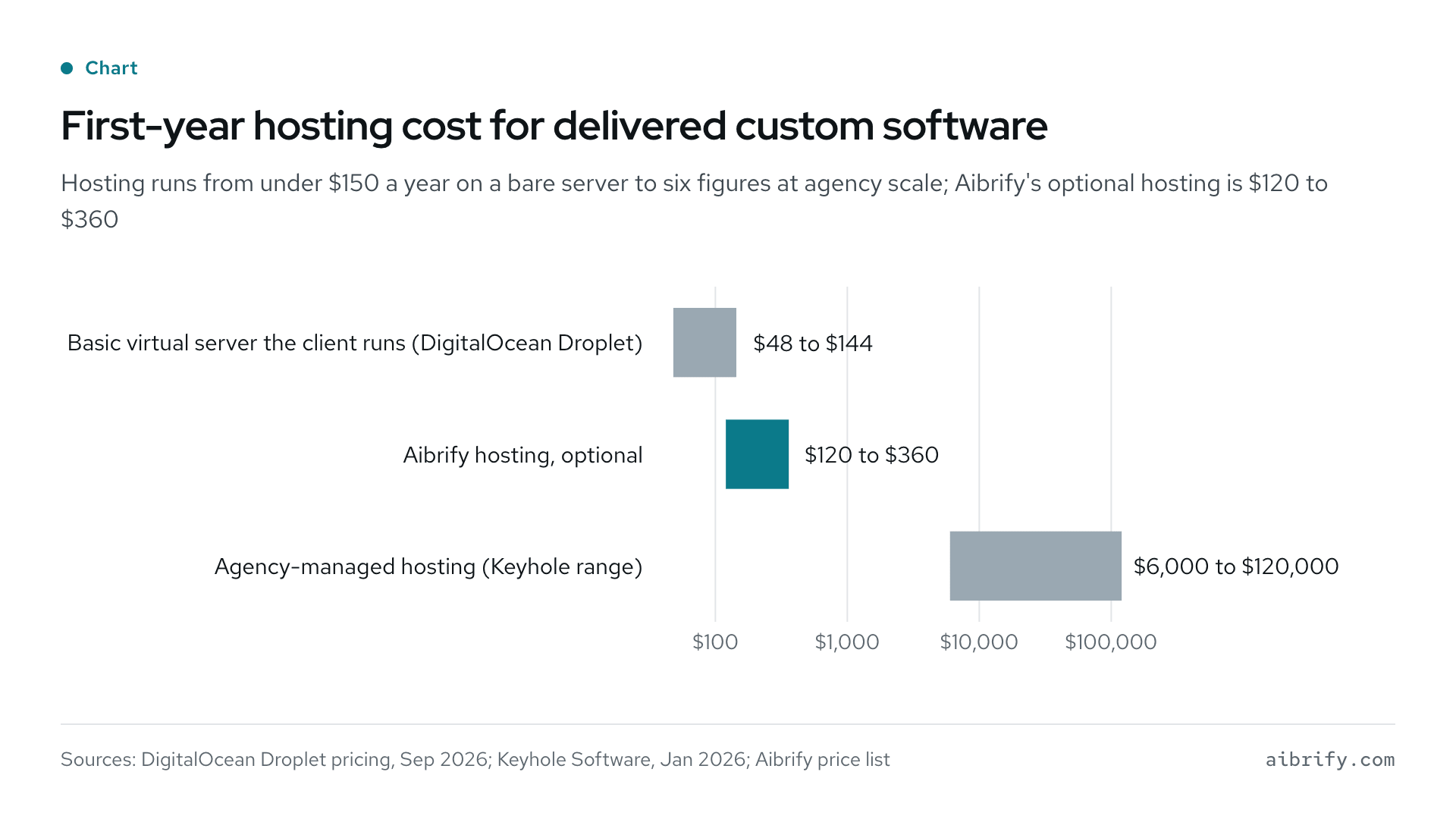
The chart compares first-year hosting costs on a logarithmic scale. The table shows the arithmetic.
| Hosting option | Monthly | First year | Who does the operations work |
|---|---|---|---|
| Basic virtual server (DigitalOcean Droplet) | $4–$12 | $48–$144 | The client |
| Aibrify hosting, optional | $10–$30 | $120–$360 | Aibrify |
| Agency-managed hosting (Keyhole range) | $500–$10,000+ | $6,000–$120,000+ | The agency |
What Does a Handover Include?
A handover should include the repository, every credential, the hosting and domain access, the component list and the written scope. Aibrify's fourth step is "ship and hand over", for every tier from a $100 automation to a $5,000+ system. It includes the repository and the credentials, and the client checks the result on a phone first.
This is what to ask any studio for at handover.
- The source code in a repository the client controls, with the studio added as a collaborator only if the client wants it.
- Credentials for every service the tool touches: hosting, database, email or text sending, payment processor, calendar.
- Domain and DNS access in the client's name.
- The list of third-party components and their licenses.
- The written scope, which doubles as the documentation of what the tool does and does not do.
- Instructions for the one or two things the owner changes routinely, such as menu items, prices or reminder text.
Two rules apply on Aibrify's side after that. Anything broken in the delivered scope is fixed at no charge. Changes are quoted separately, and because the client owns the code, another developer can make them instead.
The cost guide explains the four tiers behind those rules. The brief-writing guide shows how to describe the task so that the scope, and therefore the handover, is complete.
When Is Owning the Code the Wrong Priority?
Owning the code is the wrong priority in three cases. The job is a commodity subscription, the "code" is configuration inside someone else's platform, or nobody will maintain it.
Commodity subscriptions. Accounting, payroll and email are bought as services; the code behind them is not for sale and does not need to be. What matters there is data export. The build-or-buy guide covers when a subscription is the right call.
Configuration inside a platform. A $100 automation often lives as a rule inside a form tool or a spreadsheet. There is little code to own; what the client needs is the recipe written down and the data in a format that leaves with them. The spreadsheet guide shows where that line sits.
Ownership without a maintainer. Code the client owns still needs someone to keep it running. When nobody in the business will touch it, the practical choice is optional hosting with the studio, with the code still owned and still movable.
In every other case, this guide's advice is to ask for ownership: it is cheap to ask for and expensive to skip. One sentence in the contract decides whether the business can change developers, change hosts, or keep running if the studio disappears.
Frequently Asked Questions (FAQ)
Who owns the code in custom software by default?
The developer does. Under section 201(a) of the Copyright Act, copyright vests initially in the author, which for commissioned code is the outside studio that wrote it. The client owns the code only when the contract assigns it in a signed writing; Aibrify's written scope states the client owns the code.
Is custom software a work made for hire?
Rarely, when the developer is an outside company. A commissioned work is made for hire only if it falls within the nine section 101 categories and the parties sign an agreement saying so. Those categories cover things like translations, tests and atlases, not business software, so an assignment is the safer route.
What is the difference between work made for hire and an assignment?
A work made for hire makes the hiring party the author from the start, but only for employees or the nine statutory categories. An assignment transfers an existing copyright from the author to someone else and works for any kind of work. Under section 204 of the Copyright Act, an assignment must be in writing and signed by the owner.
Do I own the code if I paid for it?
Not automatically: payment settles the invoice, and ownership of the copyright follows the contract. Without a signed assignment, section 204 leaves the copyright with the studio, and any right to use the software is implied rather than written. That implied right is narrower than ownership and harder to prove, and a signed ownership clause removes the doubt.
Can I move my custom software to another developer or host?
Yes, when the client owns the code and has the repository and credentials. Aibrify delivers both at handover, and hosting with the studio is optional at $10 to $30 a month. A basic virtual server from DigitalOcean starts at $4.00 a month for clients who prefer to run the tool themselves.
Who owns the open-source code inside my application?
The original authors, who license it to everyone under terms such as MIT or the GPL. Black Duck's 2026 report found open source in 98 percent of codebases, so nearly every custom build includes some. The client owns the code written for the client, and the component list at handover shows which libraries are inside and under which licenses.
Do I need source code escrow?
No, not once the code has been handed over. Escrow protects customers of licensed software whose vendor keeps the source, and EscrowTech prices a single-beneficiary agreement at $995 setup plus $1,595 a year. A client with a delivered repository already has what escrow would release, at no annual fee.
What should a software handover include?
A handover should include the repository, credentials for every connected service, domain and DNS access, a component list with licenses, and the written scope. Aibrify's handover at the fourth step of every build includes the repository and the credentials, after the client has reviewed the result on a phone. Fixes within the delivered scope stay included.
What Should You Do Next?
Before signing with any studio, find the sentence that says who owns the code. Check that it is an assignment in a document both sides sign. If the sentence is missing, ask for it; if the answer is a license, ask why.
Text or email Aibrify what the tool has to do. Aibrify replies within one business hour, and a written scope with a fixed price follows before any work starts.
The scope states that the client owns the code, hosting is optional, and handover includes the repository and credentials. See the current prices or start a project.


