


How Much Does It Cost to Fix a Vibe-Coded App?
The cost to fix a vibe-coded app runs from $49 for a marketplace task to $40,000 for a full agency cleanup. AxonBuild compared the published prices in September 2026 and found the same cleanup words priced from $299 to $40,000. Aibrify prices the work in fixed steps: a $100 diagnosis within 24 hours, fixes at $100 or $300, $1,000 to stabilize and rebuilds from $5,000.
A vibe-coded app is an application built by describing features in plain language to Cursor, Lovable, Bolt or Replit, and the tool writes the code. Fixing a vibe-coded app means finding why the generated code fails, then repairing the code, the database rules or the deployment until the app works.
The spread exists because each seller prices a different unit: one task, a package of unknown size or a report. The owner wants the app working again at a price known before the work starts.
Aibrify is a software studio in Los Angeles that repairs apps built with Cursor, Lovable, Bolt, Replit, v0 and similar tools. A $100 diagnosis, delivered within 24 hours, lists every cause and quotes each fix at a fixed price; the $100 is credited to the fix. The rest of the fix and maintain ladder is $100 for a simple fix and $300 for a complex fix or a whole-app security check.
Stabilizing an app costs $1,000 and a rebuild starts at $5,000. The sections below cover what breaks, what each price includes and when a rebuild beats a fix.
Why Do Repair Quotes Range From $49 to $40,000?
Repair quotes vary with the unit being priced: one task, one named problem, a package or a report. humansfix lists fixed-price tasks from $49, adds a 10 percent service fee at checkout and gives the developer three days to deliver.
Per-problem prices sit in the middle. AxonBuild quotes vibecoding.app at $200 to $500 for a database access rule left switched off and $1,000 to $3,000 for a broken sign-in flow. The same page lists a $500 quick security check and a $1,500 audit with a written report.
Packages sit at the top: an audit plus fixes at $3,000 to $5,000 and a full cleanup package at $5,000 to $8,000. Agency ranges climb with firm size: specialist agencies $1,500 to $5,000, full-stack rescue agencies $3,000 to $8,000, enterprise security firms $8,000 to $15,000 and up.
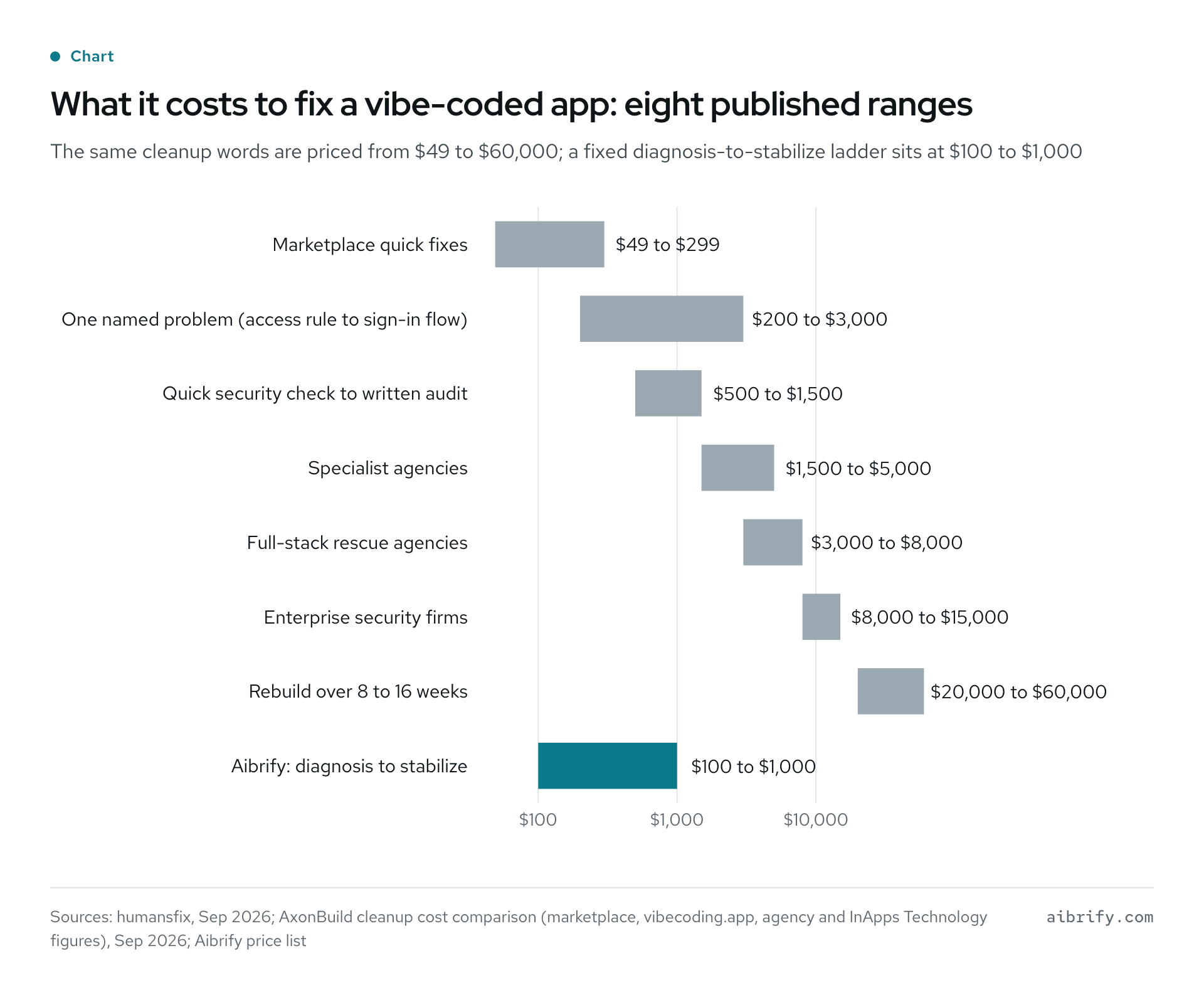
The chart places eight published ranges on a logarithmic scale. The table lists the same numbers with their sources.
| Who is quoting | What is priced | Low | High | Source |
|---|---|---|---|---|
| Marketplace quick fixes | humansfix task (plus 10% fee) to a freelance quick fix | $49 | $299 | humansfix; AxonBuild, Sep 2026 |
| vibecoding.app | One named problem, access rule to sign-in flow | $200 | $3,000 | AxonBuild, Sep 2026 |
| vibecoding.app | Quick security check to audit with report | $500 | $1,500 | AxonBuild, Sep 2026 |
| Specialist agencies | Cleanup engagement | $1,500 | $5,000 | AxonBuild, Sep 2026 |
| Full-stack rescue agencies | Cleanup engagement | $3,000 | $8,000 | AxonBuild, Sep 2026 |
| Enterprise security firms | Cleanup engagement | $8,000 | $15,000+ | AxonBuild, Sep 2026 |
| InApps Technology | Rebuild over 8 to 16 weeks | $20,000 | $60,000 | AxonBuild, Sep 2026 |
| Aibrify | Diagnosis, fix, security check, stabilize | $100 | $1,000 | Aibrify price list |
The tools keep billing while the app is broken; five subscriptions, read from the vendors' pricing pages in September 2026, are in the table.
| Tool | Plan | Monthly price | What the plan includes | Source |
|---|---|---|---|---|
| Lovable | Pro | $25, or $250 a year | 100 credits a month | Lovable subscription plans page, Sep 2026 |
| Cursor | Individual | $20 | Extended limits on the agent | Cursor pricing page, Sep 2026 |
| Bolt | Pro | $25 billed monthly | 10 million tokens a month to start | Bolt pricing page, Sep 2026 |
| Replit | Core | $20, or $18 billed annually | $20 toward the most powerful models | Replit pricing page, Sep 2026 |
| v0 | Plus | $30 a user | $30 of credits a user a month | v0 pricing docs, Sep 2026 |
Four of the five plans cost $20 to $25 a month, so one diagnosis costs four or five months of a subscription and names the cause.
What Usually Breaks in Apps Built With Cursor, Lovable, Bolt and Replit?
Published scans of generated apps keep finding the same faults: open database rules, keys in the front end, browser-only sign-in and unverified payment hooks. In September 2025, Wiz Research named four recurring misconfigurations. They were sign-in handled in the browser, keys in client-side code, database tables open to the world and internal tools published without a login.
Database rules. Supabase's row level security guide says a table in an exposed schema without RLS is readable and writable by any role with a grant. Matt Palmer's scan of 1,645 Lovable projects, published in his May 2025 statement, found 303 open endpoints across 170 projects, about 10.3 percent. The exposed data included names, phone numbers, API keys and payment details, and the cause was absent RLS configuration rather than the public key.
Secret keys in the front end. Anything placed in front-end code ships to every visitor. RedHunt Labs scanned about 130,000 published sites from 13 platforms in September 2025 and found a leaked secret on about 26,000, one in five.
Sign-in in the browser. Wiz found apps that check the password on the client without contacting any backend server, so anyone who reads the page source has the password.
Unverified payment hooks. Stripe's webhook guide warns that without signature verification an attacker could send fake events that fulfil orders or grant account access.
No limits, no backups. A leaked key becomes a bill when the provider account has no spending cap, and deleted data cannot be patched when there is no backup. Supabase's free tier leaves backups to the owner, so the diagnosis reads the backup schedule first.
AxonBuild audited 21 third-party apps built with these tools in June and July 2026 and recorded 958 confirmed findings, about 46 per app. Of those, 58 were critical, and 17 of the 21 apps had at least one critical finding.
| What breaks | How the owner notices | Aibrify price |
|---|---|---|
| Database rules off or too permissive | Data readable by anyone who edits a request | $100; $300 when data permissions need rebuilding |
| Secret key in the front end | An unexpected provider bill | $100 to move the call server-side and rotate the key |
| Sign-in checked in the browser | Protected pages open from a direct link | $300 complex fix |
| Payment webhook unverified | Orders marked paid that were never paid | $300 complex fix |
| No spending caps, no backups | A runaway bill; data gone after one bad prompt | $100 each |
What Does Aibrify Charge to Fix a Vibe-Coded App?
Aibrify charges $100 for a diagnosis, $100 or $300 for a fix, $300 for a security check, $1,000 to stabilize and from $5,000 to rebuild. Each price is fixed in writing before the work starts, and the diagnosis fee is credited to the fix.
- Diagnosis, $100, within 24 hours. The client sends the repository, or access to the hosting or tool account, and a description of what breaks. The diagnosis lists the causes and gives a fixed quote for each fix.
- Simple fix, $100, one to two days. One reproducible problem in one page, one feature or one integration.
- Complex fix, $300, two to three days. A problem that crosses systems or needs a small piece rebuilt: sign-in, payments or data permissions.
- Security check, $300, whole app, 2 days. The whole app is checked for keys exposed in the front end, missing sign-in checks or database rules and unprotected paid endpoints. Each finding gets a fixed quote, and the 12-point checklist shows what the check covers.
- Stabilize, $1,000, one to two weeks. The top five to eight problems fixed, the critical protections added, a working deployment and a handover note.
- Rebuild, from $5,000. Offered when the diagnosis says fixing costs more than rebuilding, and scoped like any custom build.
Same-day rush adds 50 percent to the $100 and $300 fixes. Two guarantees apply: the quote stands after the diagnosis, and an undelivered quoted fix costs nothing. The diagnosis fee is not refunded, and anything broken in a delivered scope is fixed free for 90 days.
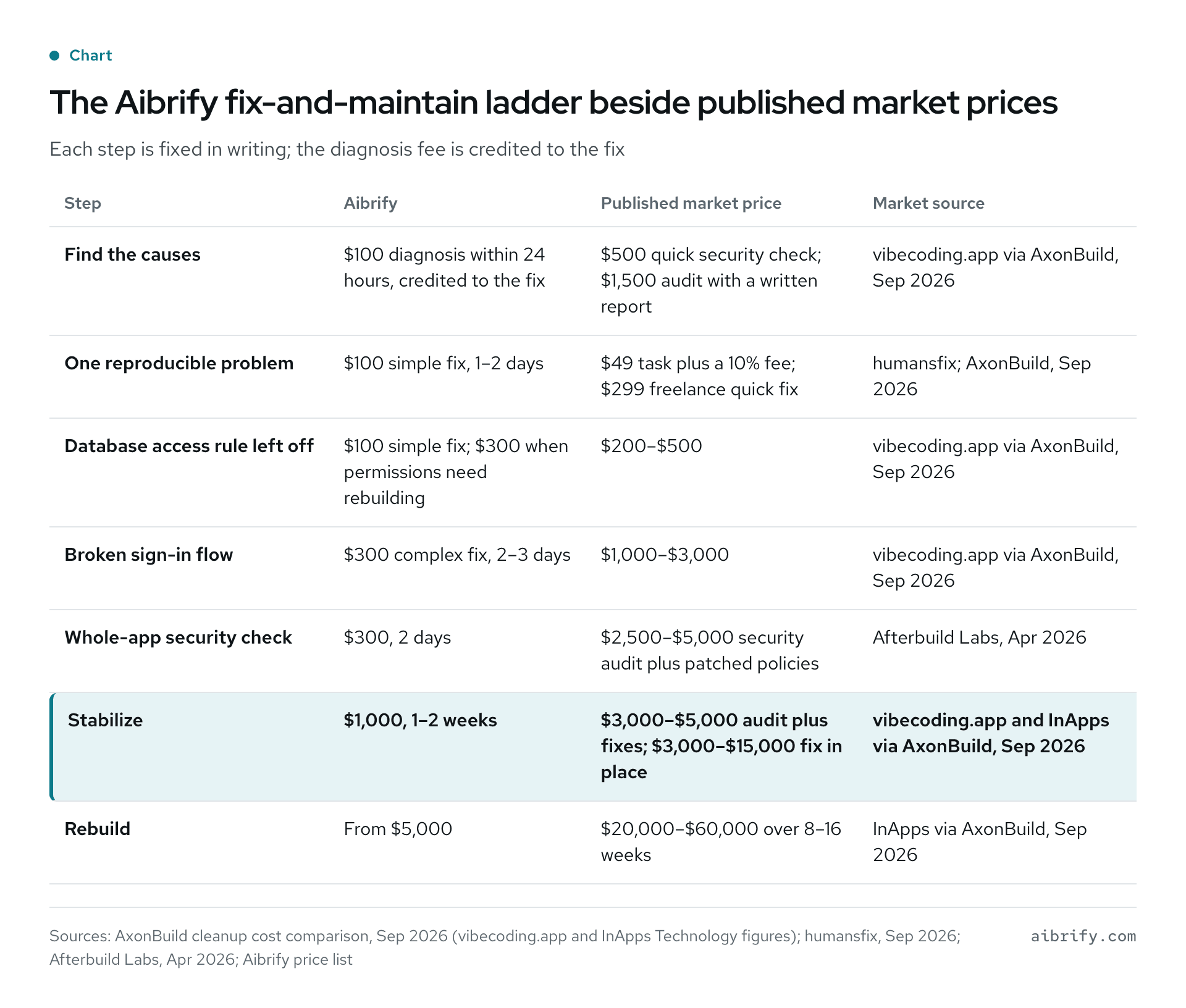
The table image compares each ladder step with the closest market price published in 2026; the rows below repeat it as text.
| Step | Aibrify | Published market price | Market source |
|---|---|---|---|
| Find the causes | $100 diagnosis within 24 hours, credited to the fix | $500 quick security check; $1,500 audit with a written report | vibecoding.app via AxonBuild, Sep 2026 |
| One reproducible problem | $100 simple fix, 1–2 days | $49 task plus a 10% fee; $299 freelance quick fix | humansfix; AxonBuild, Sep 2026 |
| Database access rule left off | $100 simple fix; $300 when permissions need rebuilding | $200–$500 | vibecoding.app via AxonBuild, Sep 2026 |
| Broken sign-in flow | $300 complex fix, 2–3 days | $1,000–$3,000 | vibecoding.app via AxonBuild, Sep 2026 |
| Whole-app security check | $300, 2 days | $2,500–$5,000 security audit plus patched policies | Afterbuild Labs, Apr 2026 |
| Stabilize | $1,000, 1–2 weeks | $3,000–$5,000 audit plus fixes; $3,000–$15,000 fix in place | vibecoding.app and InApps via AxonBuild, Sep 2026 |
| Rebuild | From $5,000 | $20,000–$60,000 over 8–16 weeks | InApps via AxonBuild, Sep 2026 |
After the fix, two care plans apply to software Aibrify built or has checked. Care is $49 a month: hosting, monitoring, backups, dependency and security updates, one change a month of up to an hour and a two-business-day response. Care Plus is $149 a month and adds four hours of changes, next-business-day response and handling of a payment or calendar provider changing its interface.
Hours do not roll over, extra work is quoted at the fixed prices and hosting alone stays $10 to $30 a month. The client owns the code throughout, as the ownership guide explains.
What Does a $100 Diagnosis Check?
A diagnosis reads the repository and the hosting setup, reproduces each reported failure and writes down the cause and a fixed price per fix. It covers eight areas whether or not the owner reported a problem there.
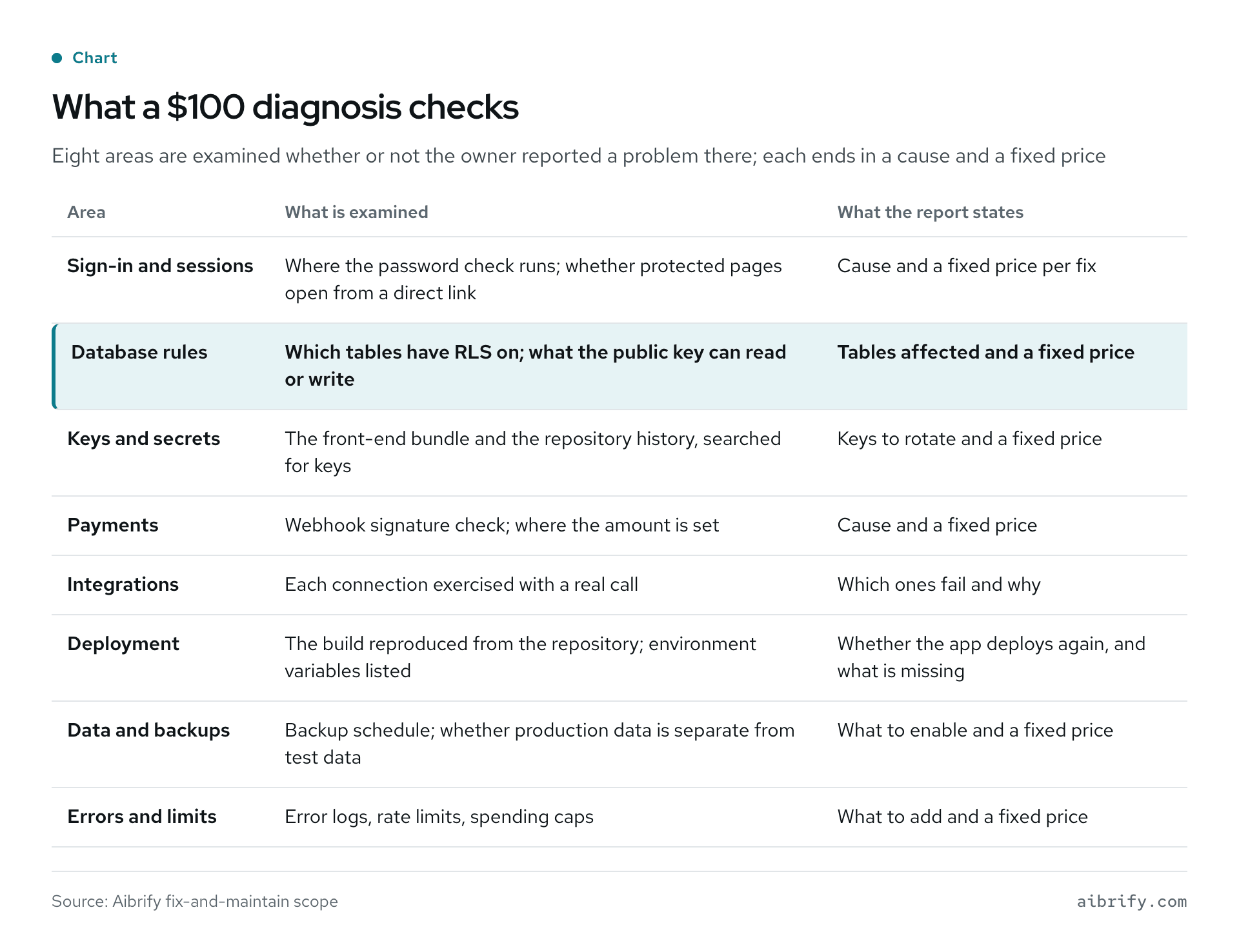
The table image lists the eight areas; the rows below repeat them as text.
| Area | What is examined | What the report states |
|---|---|---|
| Sign-in and sessions | Where the password check runs; whether protected pages open from a direct link | Cause and a fixed price per fix |
| Database rules | Which tables have RLS on; what the public key can read or write | Tables affected and a fixed price |
| Keys and secrets | The front-end bundle and the repository history, searched for keys | Keys to rotate and a fixed price |
| Payments | Webhook signature check; where the amount is set | Cause and a fixed price |
| Integrations | Each connection exercised with a real call | Which ones fail and why |
| Deployment | The build reproduced from the repository; environment variables listed | Whether the app deploys again, and what is missing |
| Data and backups | Backup schedule; whether production data is separate from test data | What to enable and a fixed price |
| Errors and limits | Error logs, rate limits, spending caps | What to add and a fixed price |
For comparison, AxonBuild lists a $1,500 audit with a written report, and Afterbuild Labs lists $2,500 to $5,000 for a security audit plus patched policies. The diagnosis is cheaper because its output is a priced list rather than a report to be re-quoted.
The input is the repository, or access to the hosting or tool account, plus one line per problem in the format the brief guide shows.
When Does a Rebuild Beat a Fix?
A rebuild beats a fix when the diagnosis prices the fixes above the cost of building the app again from a written scope. AxonBuild quotes InApps Technology at $20,000 to $60,000 over 8 to 16 weeks for a rebuild. Fixing in place on the same page runs $3,000 to $15,000 over 2 to 6 weeks.
Afterbuild Labs prices a full migration off a generation platform at $8,000 to $25,000. Aibrify rebuilds from $5,000, and only when the diagnosis says fixing costs more. The rebuild is scoped like any new project: a written scope, a fixed price and code the client owns.
Three signs point to a rebuild rather than a list of fixes.
- Sign-in, payments and data rules are all broken. Each is a $300 complex fix on its own, and together they are most of the app.
- The app has to leave the platform that generated it. Hosting, database and code move together, so the move is a build.
- Nobody can state what the app is supposed to do. A fix restores intended behaviour, and without a description of it there is nothing to restore.
The cost guide shows what a scope contains at each tier. For a one-person workflow, the answer is sometimes a spreadsheet plus a $100 automation, as the spreadsheet-or-app guide sets out.
When Is Paying to Fix a Generated App a Bad Buy?
A paid fix is a bad buy in three situations: no users yet, a billing problem, or a fix list longer than the app.
No users, no real data. A prototype with test data costs less to describe again than to repair. The brief guide turns what the app was meant to do into five questions, and a $300 tool or $1,000 application follows from the answers.
A billing problem, not a code problem. When the app works and the bill is the complaint, the answer is a plan change or a spending cap, not a repair.
The fix list is longer than the app. When the diagnosis lists more than eight problems and three of them are sign-in, payments and data rules, the rebuild path costs less. The diagnosis says so in writing.
Frequently Asked Questions (FAQ)
How much does it cost to fix a vibe-coded app?
Published prices run from $49 for a marketplace task to $40,000 for an agency cleanup, according to AxonBuild's September 2026 comparison. At Aibrify the steps are fixed: a $100 diagnosis that is credited to the fix, a $100 simple fix and a $300 complex fix. A security check is $300, stabilizing is $1,000 and a rebuild starts at $5,000.
What counts as a vibe-coded app?
A vibe-coded app is an application whose code was written by Cursor, Lovable, Bolt, Replit or v0 from plain-language prompts rather than by a developer. The owner may have a working demo but no written scope, no tests and nobody who has read the code. A repair starts with a diagnosis of that code.
What usually breaks in apps built with Lovable, Bolt, Cursor or Replit?
Four faults recur in published scans: open database rules, keys shipped to the browser, passwords checked on the client and unverified payment webhooks. Matt Palmer's 2025 scan found readable data in 170 of 1,645 Lovable projects. RedHunt Labs found a leaked secret on one in five of about 130,000 generated sites.
How long does a fix take?
A diagnosis comes back within 24 hours, a simple fix takes one to two days and a complex fix two to three days. A whole-app security check takes two days and a stabilize package one to two weeks. Same-day rush adds 50 percent to the $100 and $300 fixes.
Can the app stay on Lovable, Bolt or Replit after the fix?
Yes. A fix repairs the code and settings inside the account the owner already has, and the client owns the code afterwards. Hosting with Aibrify is optional at $10 to $30 a month, and the $49 Care plan adds monitoring, backups and updates.
Is it cheaper to rebuild a broken generated app?
A rebuild is cheaper when the priced fixes exceed the cost of a new build from a written scope. AxonBuild quotes InApps Technology at $20,000 to $60,000 for a rebuild against $3,000 to $15,000 to fix in place. Aibrify rebuilds from $5,000, and only when the $100 diagnosis shows that fixing costs more.
What does the $300 security check include?
The $300 security check covers the whole app in two days: exposed keys, missing sign-in checks, open database rules and unprotected paid endpoints. Each finding comes with a fixed quote, and an app that passes, or is fixed afterwards, qualifies for a care plan.
What happens if a quoted fix does not work?
The quote does not change after the diagnosis, and a quoted fix Aibrify cannot deliver is not paid for. The $100 diagnosis fee is not refunded. Anything broken inside a delivered scope is fixed free for 90 days, and changes outside the scope are quoted separately.
What Should You Do Next?
Write down what the app does when it fails, one line per problem. Find the repository or the login to the tool that built it; those two things are the whole input to a diagnosis.
Text or email Aibrify with the repository or account access and the list. A written diagnosis with a fixed price per fix arrives within 24 hours, and the $100 is credited to the fix. See the fix and maintain prices or start a diagnosis. For an app built with Lovable, see fixing a Lovable app.


