


What Is the Difference Between an AI Receptionist and an Answering Service?
AI receptionist vs answering service comes down to what happens after hello. An answering service takes messages and routes calls, while a virtual receptionist, human or AI, also books appointments, takes orders, answers questions, and transfers callers. Ruby draws the line at tasks: answering services stop at message-taking and basic routing, while virtual receptionists add scheduling, lead capture, and customer questions.
Price follows the task list. Answering services run $50 to $450 a month in Ruby's range, and human virtual receptionists start at $137 a month in OnceHub's 2026 survey.
Aibrify offers a third kind: an AI receptionist that answers in English and Mandarin, books, takes orders, and transfers to a person when unsure. It texts the owner a summary of every call and sends a monthly report. The plan is $149 a month with 400 minutes included and no setup fee.
This guide compares all three on tasks, price, and fit, with the numbers each option publishes.
How Do the Three Options Compare on Tasks?
The three options differ most in what happens after "hello". An answering service writes a message down, while a virtual receptionist acts on the call. An AI receptionist does the same at any hour, with software rather than a person on the line.
Live answering service. A shared pool of operators answers with the business's greeting, takes a message, and forwards it. Some route urgent calls to an on-call number. In Ruby's description, the service stops at message-taking and basic routing.
Human virtual receptionist. A named receptionist or small dedicated team learns the business, books appointments, screens leads, and handles routine questions. Ruby lists appointment scheduling, call filtering, lead capture, and payment processing among the tasks.
AI receptionist. Software answers every call, day and night, from a script and a source of truth the owner controls. The test is whether one takes orders and bookings and hands off to a person, or only records a message. OnceHub prices the category at $25 to $300 a month, with full-featured plans at $50 to $200.
The table scores each option on six tasks: full, partial or none.
| Task | Live answering service | Human virtual receptionist | AI receptionist |
|---|---|---|---|
| Take a message | Full | Full | Full |
| Book an appointment | Rarely | Full | Full, from the owner's calendar rules |
| Take an order | Rarely | Sometimes | Full, from the owner's menu or price list |
| Answer after hours | Full, at overage rates | Depends on plan | Full, same price at 2 a.m. |
| Second language | Depends on staffing | Depends on staffing | Depends on the product; Aibrify answers English and Mandarin on one line |
| Transfer to a person | Full | Full | Full, by rule |
Editorial scoring by Aibrify from the published service descriptions above; individual providers vary.
What Does Each Option Cost in 2026?
Live answering services cost $175 to $1,700 a month by call volume. Human virtual receptionists cost $137 to $900, and AI receptionists $25 to $300, before overage minutes.
OnceHub's September 2026 survey breaks human answering services into tiers. Entry level is $175 to $325 a month, 50 to 200 calls cost $325 to $700, and 200 to 500 calls cost $700 to $1,700. Overage runs $1.75 to $5.40 a minute, or $10.50 to $11.50 a call.
Nextiva's July 2026 guide reports per-minute pricing of $0.75 to $1.50 for live services. It lists AI answering service plans at $50 to $300 a month and live plans at $100 to $1,000 or more.
The in-house alternative sets the ceiling. The median receptionist earned $38,010 a year in May 2025, or $18.27 an hour, per the Bureau of Labor Statistics. Payroll taxes, benefits, and the hours nobody is at the desk come on top.
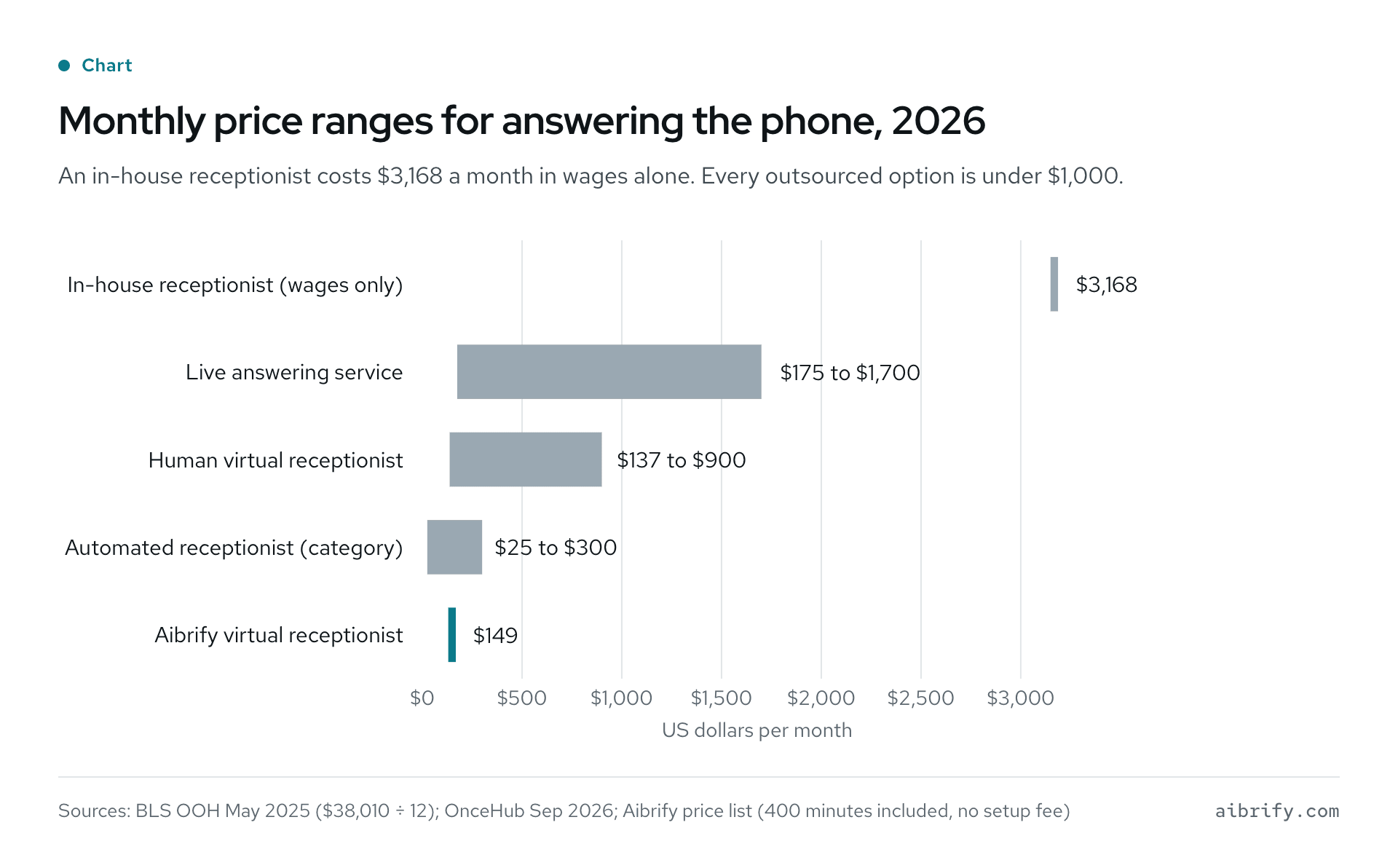
The chart shows the published monthly ranges side by side. The table adds the sources and the overage terms.
| Option | Monthly price | Overage | Source |
|---|---|---|---|
| In-house receptionist | ~$3,168 in wages (median $38,010 a year) | Overtime | BLS, May 2025 |
| Live answering service | $175–$1,700 by call volume | $1.75–$5.40 a minute | OnceHub, Sep 2026 |
| Human virtual receptionist | $137–$325 entry; $400–$900 realistic | $1.75–$5.40 a minute | OnceHub, Sep 2026 |
| AI receptionist (category) | $25–$300; most $50–$200 | Varies | OnceHub, Sep 2026 |
| Aibrify AI receptionist | $149 with 400 minutes; setup included | $0.30 a minute | Aibrify price list |
What Does a Typical Month of Calls Cost on Each Plan?
Take 640 minutes a month, the sample volume in Nextiva's guide. A live service costs $480 to $960 on per-minute pricing, a mid-tier human plan $325 to $700, and the Aibrify AI receptionist $221.
Nextiva builds its example from eight calls a day, four minutes each, five days a week: about 640 minutes a month. Multiplying those minutes by Nextiva's $0.75 to $1.50 a minute gives the $480 to $960 above.
OnceHub's moderate-volume human tier, $325 to $700 a month, covers a similar load, with $1.75 to $5.40 a minute beyond the plan. AI receptionist plans in the $50 to $200 range usually cap minutes too; the fine print decides the real bill.
The Aibrify plan includes 400 minutes at $149. The remaining 240 minutes cost $0.30 each, or $72, for a total of $221. There is no setup fee to add.
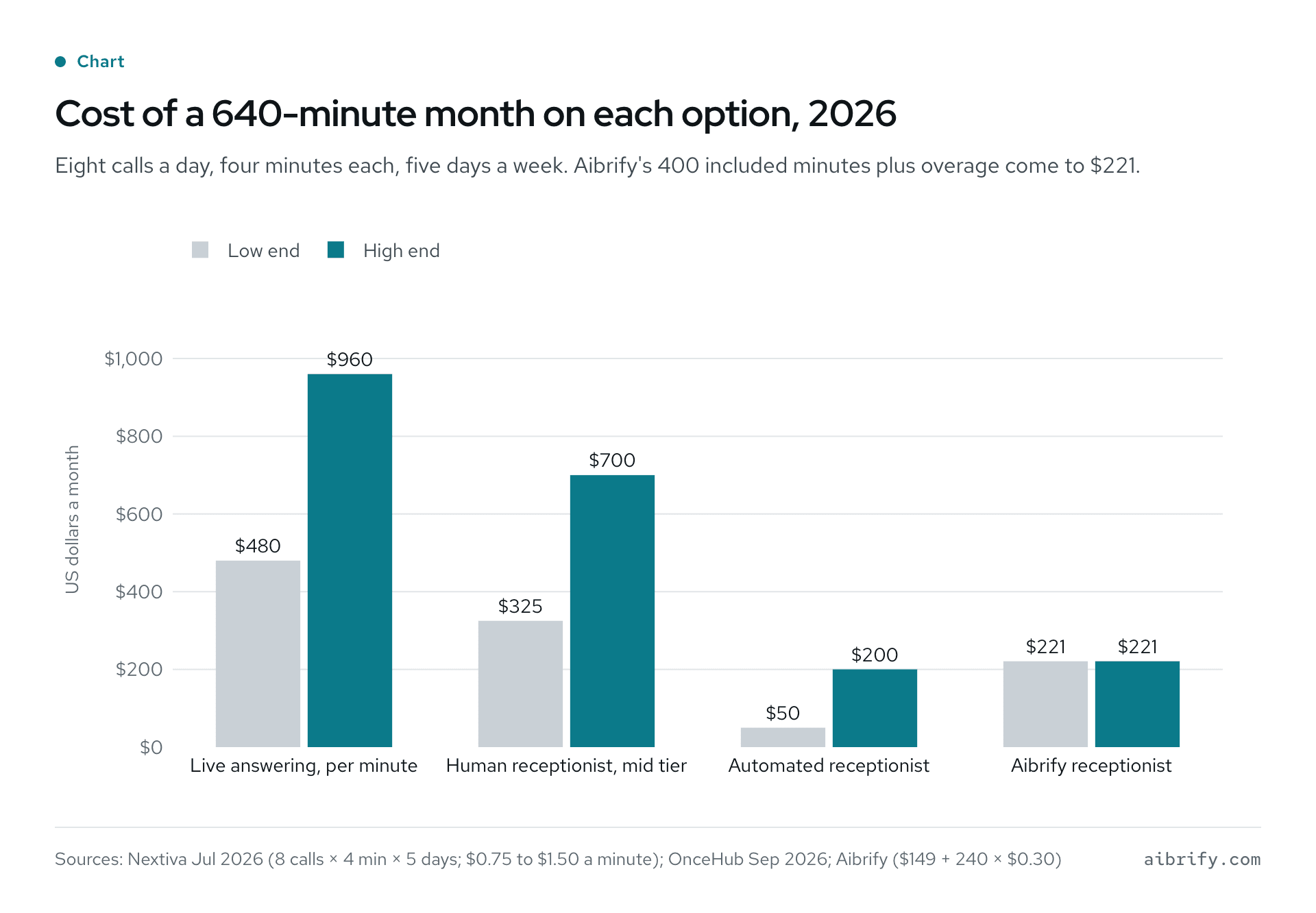
The chart prices the same 640-minute month on each option. The table shows the arithmetic.
| Option | Monthly cost at 640 minutes | Arithmetic |
|---|---|---|
| Live answering, per-minute pricing | $480–$960 | 640 × $0.75 to $1.50 (Nextiva) |
| Human virtual receptionist, moderate tier | $325–$700 | OnceHub tier for 50–200 calls |
| AI receptionist, category | $50–$200 | Typical full-featured plans (OnceHub); minute caps vary |
| Aibrify AI receptionist | $221 | $149 + 240 extra minutes × $0.30 |
What Happens to a Call Each Option Cannot Handle?
Every option has calls it cannot finish, and the difference is what happens next: a message, an on-call transfer, or a rule-based hand-off. The cost of that path is where the monthly bill actually moves.
Live answering service. The operator takes a message, and the business returns the call later. Some services route urgent calls to an on-call number. Either way the minutes bill at the plan rate, or at OnceHub's overage of $1.75 to $5.40 a minute or $10.50 to $11.50 a call.
Human virtual receptionist. A dedicated receptionist can handle scheduling, screening, and routine questions in the call itself. A question only the owner can answer becomes a message or a transfer, depending on the plan, and after-hours coverage also depends on the plan. Overage past the tier runs $1.75 to $5.40 a minute in OnceHub's survey.
AI receptionist. The call is transferred to a person by rule, and the Aibrify AI receptionist texts the owner a summary either way. The failure mode is different: a weak product invents an answer instead of transferring, so the checklist below starts with a question outside the script. On the Aibrify plan, transferred minutes count against the 400 included and then bill $0.30 a minute.
| Option | Where the call goes | What that path costs |
|---|---|---|
| Live answering service | A message, or an on-call number for urgent calls | Plan minutes; overage $1.75–$5.40 a minute or $10.50–$11.50 a call (OnceHub) |
| Human virtual receptionist | Handled in the call, or a message or transfer by plan | Plan tier; overage $1.75–$5.40 a minute (OnceHub) |
| AI receptionist | Transfer to a person by rule | Plan minutes; Aibrify bills $0.30 a minute past 400 |
A business whose callers often need the owner should price the transfer path, not only the plan.
Which One Fits Your Business?
Choose an answering service for overflow and after-hours messages. Choose a human virtual receptionist for high-touch scheduling and screening, and an AI receptionist for order and booking volume at any hour. The deciding question is what the caller needs to walk away with.
Choose a live answering service when callers mainly need to leave a message that a person will return. Law firms taking intake after hours and property managers logging maintenance requests fit here. The cost stays low as long as call volume does.
Choose a human virtual receptionist when calls require judgment: qualifying a lead, explaining a service, or handling an upset customer with care. OnceHub prices a dedicated receptionist who knows the business at $400 to $900 a month at realistic volume.
Choose an AI receptionist when calls are repetitive and time-sensitive: orders, reservations, appointment bookings, hours and directions. Restaurants, clinics, salons, and real estate offices field calls of exactly this kind. The Aibrify AI receptionist answers them at any hour, in English or Mandarin, and transfers the exceptions.
Do nothing only if the missed calls are worth nothing. Quick-service restaurants miss 40.1 percent of calls, per Revmo's 2026 report. Aibrify's guide to missed calls collects the published estimates of $27,000 to $73,000 a year per location.
The Bureau of Labor Statistics projects receptionist employment to fall 2 percent between 2025 and 2035, a loss of about 16,000 jobs. The reason it gives is routine phone work moving to software.
What Should You Ask Before Choosing a Provider?
Five questions separate a receptionist from a voicemail, and each has an answer to look for. Ask them on a real call rather than in a sales email.
- What happens to a call you cannot handle? The answer should name a path: transfer, on-call number, or a message with a callback time. Test it by asking something outside the script.
- Do you book or order into my system? Ruby draws the line here: messages and routing, or scheduling, orders, and lead capture. A service that only takes a message is an answering service, whatever it is called.
- What is the overage rate? Published rates run from $0.30 a minute on the Aibrify plan to $1.75 to $5.40 a minute in OnceHub's survey. The fine print on what counts as a minute matters more than the headline price.
- Which languages, on every shift? A second language that depends on who is on duty turns into transfers or messages when it matters.
- What does the monthly report contain? Minutes used says nothing about outcomes. Look for calls answered, after-hours calls caught, and bookings or orders taken.
How Does the Aibrify AI Receptionist Handle Calls?
The Aibrify AI receptionist follows five rules on every call.
- It opens with a notice. The caller hears that the call is recorded and answered by an automated assistant. That satisfies California's all-party consent rule for recording under Penal Code section 632. It also goes beyond the state's bot-disclosure law, which is written for websites and apps rather than phone calls.
- It works from what the owner sends. Menu, prices, hours, services, and booking rules come from the owner's brief; anything outside them is transferred.
- It answers in the caller's language. English or Mandarin on the same line, decided by the caller, not by a menu option.
- It transfers when unsure. Anything outside the rules goes to the number the owner chose, and the owner gets a text summary.
- It reports monthly. The owner gets a monthly report of the calls it answered. That report, not the technology, is how an owner knows the line is paying for itself.
The business keeps its own number, and calls forward to the AI receptionist when the line is busy or after hours. The receptionist texts the owner a summary of each call, or the order, in Chinese or English.
Setup is included and takes about a week: the owner sends the source material, Aibrify builds the flow, and the owner test-calls until satisfied. The monthly plan is $149 with 400 minutes, then $0.30 a minute. Details are on the AI receptionist page, with prices on the price list.
Frequently Asked Questions (FAQ)
Is a virtual receptionist the same as an answering service?
No. An answering service takes messages and routes calls, while a virtual receptionist also schedules appointments, takes orders, answers customer questions, and screens leads. Ruby describes the virtual receptionist as everything an answering service does plus the tasks an in-house receptionist handles.
How much does a virtual receptionist cost per month?
Human virtual receptionists cost $137 to $325 a month at entry level and $400 to $900 at realistic volume, per OnceHub's 2026 survey. The AI receptionist category is $25 to $300 in the same survey. The Aibrify AI receptionist costs $149 a month with 400 minutes, with setup included.
How much does an answering service cost?
Live answering services cost $175 to $325 a month at entry level, according to OnceHub. Plans run $325 to $700 for 50 to 200 calls and $700 to $1,700 for 200 to 500 calls. Ruby cites $50 to $450 a month, and overage minutes run $1.75 to $5.40.
Is a virtual receptionist cheaper than hiring a receptionist?
Yes, by a wide margin. The median in-house receptionist earns $38,010 a year in wages, about $3,168 a month before taxes and benefits, and covers one shift. A human virtual receptionist runs $137 to $900 a month and an AI receptionist $25 to $300, with coverage at any hour.
Can an AI receptionist transfer calls to a real person?
Yes, when it is built to. The Aibrify AI receptionist transfers any call outside its rules to the number the owner chose and texts the owner a summary. The first thing to test is whether it transfers or invents an answer, so ask something outside the script on a test call.
Which option works best for a restaurant?
An AI receptionist, because restaurant calls are repetitive and time-sensitive. Quick-service restaurants miss 40.1 percent of calls, per Revmo's 2026 report. An AI receptionist takes the orders and transfers the exceptions to a person.
What questions should I ask before choosing a provider?
Ask what happens to a call the service cannot handle, and whether it books or orders into your system or only takes a message. Ask the overage rate, the languages it answers in, and what the monthly report contains. A provider that reports only minutes used cannot show whether calls were converted.
Does an AI receptionist need to disclose that it is automated?
Disclosure is not required by a phone-specific California statute: Business and Professions Code section 17941 covers automated accounts on websites and apps used to mislead. Penal Code section 632 does require all-party consent to record a confidential call, and other states set their own rules. The Aibrify AI receptionist opens each call by saying it is automated and recorded, so the recording rule is met and nobody is misled.
What Should You Do Next?
List the five calls the business gets most often. If four of them are bookings, orders, hours, or directions, the Aibrify AI receptionist will answer them at any hour for $149 a month. That is about 8 hours of pay at the $18.27 median receptionist wage.
Text or email Aibrify the list; Aibrify replies within one business hour, and a written scope and fixed price come before any work starts. The plan is $149 a month with setup included. See the AI receptionist or start a project.


