


Why have platform update cycles sped up in 2026?
Because every major social platform is competing on recommendation quality, creator monetization, and advertiser measurement at the same time. Feature shipping cadence has roughly doubled since 2023 as a result.
Per Meta's Graph API changelog, Meta now ships a new Graph API version every 90 days and deprecates the oldest supported version in the same cycle. Per YouTube API release notes, YouTube ships meaningful API changes every 6–8 weeks.
The cumulative effect on marketing operations is real. A social strategy running on assumptions older than 6 months is almost certainly outdated on at least one platform.
Tooling that does not track API versions breaks multiple times per year. The teams handling this well treat platform evolution as a quarterly operating review, not as breaking news.
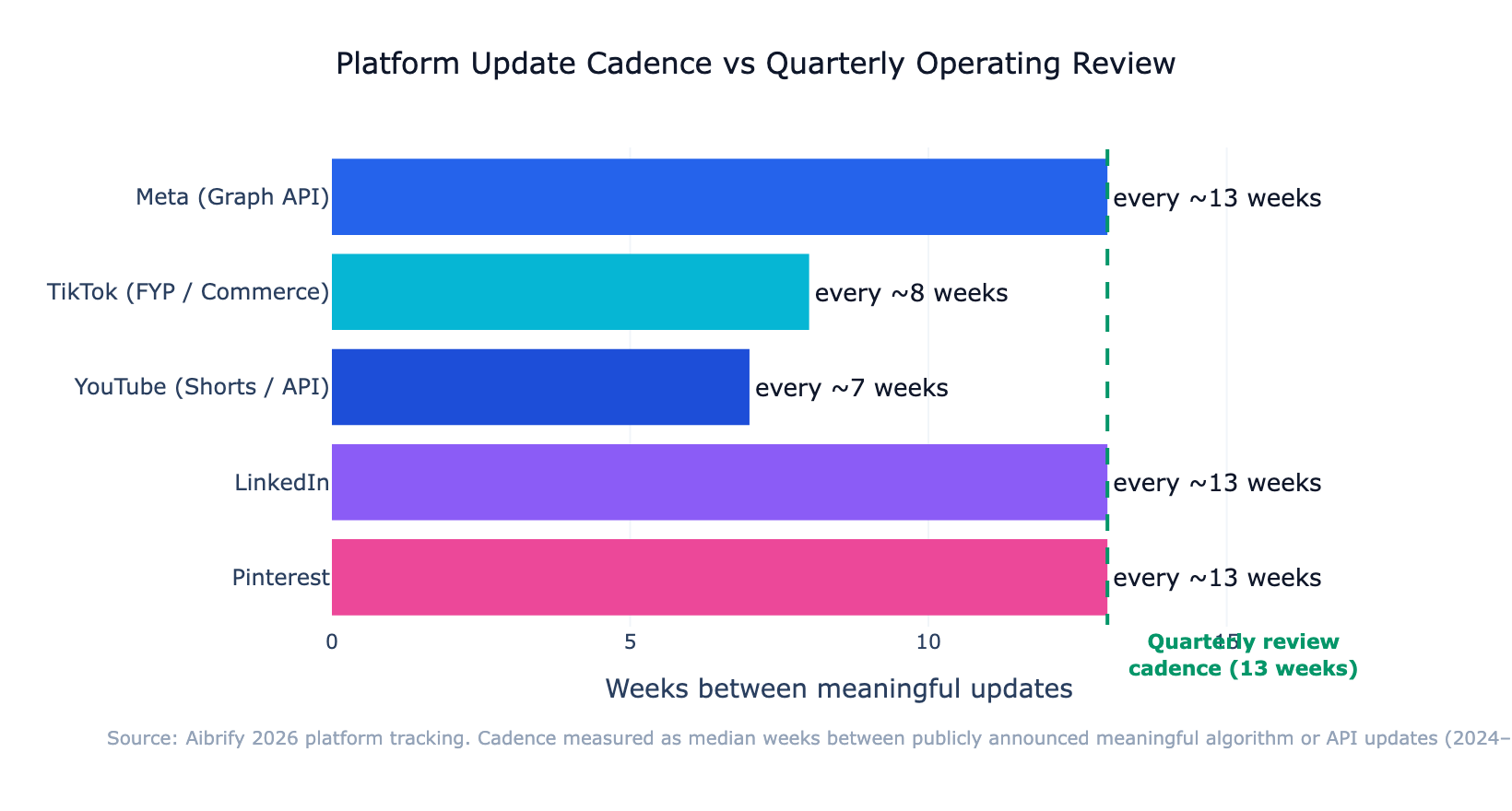
This roadmap walks through what has shifted across the major platforms in 2025–early 2026, what is shipping next, and the marketing workflows that need to adapt before each change lands.
Meta: iOS modeling, Reels incentives, and Graph API migration
Three concurrent changes are reshaping Meta's platform for marketers.
iOS conversion modeling tightening (SKAN 4.0 and beyond). Per Apple's SKAdNetwork 4.0 specification, multi-conversion-window reporting now supports 24/48/72-hour windows with hierarchical conversion values. Meta has integrated this and expanded the coarse and fine postback handling across 2025. Teams running Meta ads with iOS-heavy audiences recover meaningful attribution clarity — but only if they configure the conversion schemas. Default settings leave signal on the table.
Reels monetization incentives. Meta has expanded the Reels performance bonus program and pushed algorithmic distribution toward Reels at the expense of static posts. Industry observation across 2025 shows Reels earning 3–5x the organic reach of equivalent-quality static posts on the same account — a shift that has made video-first production the operational default for Instagram and Facebook, not a nice-to-have.
Graph API v18 deprecation. v18 moved to unsupported status in mid-2025. Tooling that had not migrated to v20 or v21 started returning errors. Scheduled posts failed, analytics pulls broke, OAuth reconnects produced 400 responses. The operational cost was concentrated on agencies and publishing tools, and the pattern will repeat — Meta publishes a 2-year deprecation schedule for each Graph API version. Tracking the schedule and migrating 8+ weeks ahead of the deprecation date is the only way to avoid multi-day publishing outages.
TikTok: Commerce API stabilization and Creator Marketplace access
Commerce API stabilization for U.S. market. TikTok Shop's U.S. rollout has stabilized the Commerce API for product catalog sync, order management, and attribution. Per TikTok Shop developer documentation, the API now supports the same fundamental operations as Meta Shops and Amazon Marketplace, which removes a historical barrier to running TikTok as a primary commerce channel rather than a discovery channel.
Creator Marketplace API access. TikTok has opened Creator Marketplace API access to verified agency partners. The API exposes creator discovery, campaign briefing, and performance reporting endpoints. The operational effect is that agencies running influencer programs can integrate TikTok discovery directly into their workflows rather than through the web-only interface.
FYP algorithm volatility. Creator-reported observations across 2025 suggest the FYP algorithm is shipping meaningful ranking signal updates roughly every 8 weeks. The specific patterns that rotate: retention curve weight, rewatch spike weight, share-rate weight, and completion rate for different content categories. No reliable public documentation of these shifts exists — the practical response is to run A/B tests on hook patterns every 6–8 weeks and trust short-horizon data over quarter-old benchmarks.
LinkedIn: newsletter algorithm integration and thought-leadership signals
Newsletter recommendations in the main feed. LinkedIn has expanded newsletter content into feed ranking, with weight on follower overlap and topic affinity. For B2B marketers who publish LinkedIn newsletters, this has materially increased newsletter discoverability — accounts with 5,000+ subscribers have seen 2–4x more new subscribers in 2025 compared to the same cadence in 2023.
Thought-leadership signal expansion. Per LinkedIn's engineering blog, the platform is weighting "original thought-leadership" signals more heavily in the feed algorithm. Signal markers include post uniqueness (versus widely syndicated content), engagement from verified professionals in the author's industry, and long-form native posts (1,200+ words). The operational implication: LinkedIn rewards B2B content investment more in 2026 than it did in previous years.
API limitations remain. LinkedIn's Marketing Developer API still lacks the flexibility of Meta's Graph API — programmatic posting to personal accounts is restricted, and company page automation requires specific partner tier access. Teams building LinkedIn tooling need to factor this constraint into architecture decisions; workflows that assume parity with Meta break.
YouTube: Shorts integration and caption quality checks
Shorts-to-long-form cross-promotion. YouTube has expanded the prompts that appear on long-form videos inviting viewers into the creator's Shorts feed, and vice versa. For channels running both formats, this drives measurable cross-format subscriber conversion. The operational change: the long-form hook now needs to explicitly reference Shorts content when relevant, and Shorts end-cards need to point to the long-form library.
Auto-caption quality checks. YouTube has started deprioritizing videos with auto-generated captions that contain material errors — the error detection is particularly aggressive on technical or medical content. The fix is the same as for short-form: generate auto-captions, then manually correct. Videos that fail the check do not get a direct penalty notice; their reach simply stalls.
Shorts monetization eligibility changes. Per YouTube's partner program updates, Shorts ad-share eligibility now requires 1,000 subscribers plus 10 million Shorts views in the last 90 days. The threshold is achievable but sets a floor that smaller channels need to clear before monetization becomes a consideration.
Pinterest: unified ranking signal and commerce integration
Static and Idea Pin ranking unification. Pinterest has consolidated static pin and Idea Pin ranking into a unified signal system. Previously, the two formats had separate distribution algorithms; now they compete in the same ranking pool with adjusted weights per query type. The operational effect: Idea Pins now appear more often in search results (where static pins previously dominated), and static pins appear more often in the home feed (where Idea Pins dominated).
Shop API expansion. Pinterest's Shop API has expanded product catalog sync, dynamic ad integration, and conversion tracking. For ecommerce brands, this brings Pinterest closer to parity with Meta Shops as a commerce channel — not a replacement, but a credible additional channel with the evergreen traffic advantage Pinterest has always offered.
Trends API access for partners. Pinterest has opened Trends API access to verified partners, which exposes the underlying search-query trend data that previously only appeared in the web dashboard. Teams integrating this into content calendars see measurable lift because pin designs are produced against actual demand curves rather than against assumptions.
How to operationalize the roadmap without burning out
The failure mode for teams trying to track all of this is constant reaction — every platform announcement triggers a ops review, and the team never settles into execution.
The workflow that scales:
Quarterly operating review, not real-time monitoring. One 60–90 minute meeting per quarter that reviews the tracked documents for all platforms. Assigns an impact score (1–5) and a workflow owner to each change. Schedules the adaptation work into the next 1–2 production cycles.
One watcher per platform, rotated every 6 months. Prevents platform-specific knowledge from becoming a single-person liability. Rotation also forces documentation quality because the next watcher needs the docs to do the job.
Three subscribed changelogs: Meta Graph API, YouTube API, TikTok Developer. These cover the majority of operationally relevant API changes. Algorithm changes come through creator communities, platform blogs, and third-party coverage (Search Engine Journal, Social Media Today) — harder to subscribe to, monitor weekly instead.
Separate API-level from algorithm-level changes in tracking. API changes have longer lead times (8–12 weeks) and different owners (engineering). Algorithm changes have shorter lead times (4 weeks) and different owners (content). Mixing them produces incomplete response to both.
Which 2026 changes to prepare for now
Three changes are shipping or expanding in the next 2 quarters that marketing teams should be preparing for.
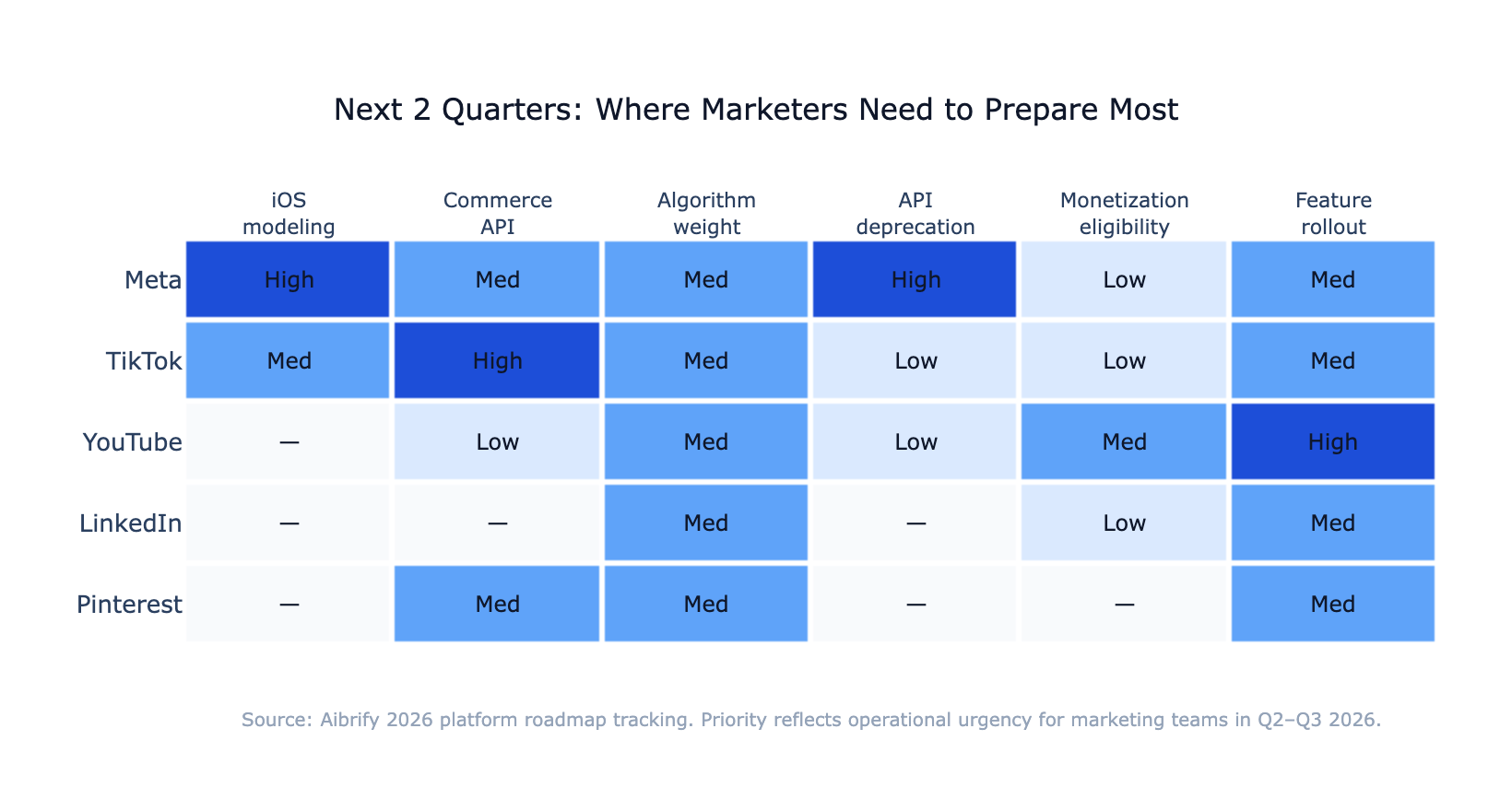
Meta Graph API v21 deprecation. The schedule indicates v21 will move to deprecated status in mid-2026. Teams should be on v23+ by Q3 2026 to avoid a repeat of the v18 outage pattern.
TikTok Commerce API expansion. Additional international markets are coming online in Q2–Q3 2026. Brands with non-U.S. audiences who have deprioritized TikTok commerce should re-evaluate the channel as the API stabilizes globally.
YouTube auto-caption enforcement expansion. The quality-check system that currently affects technical and medical content is expanding to broader categories through 2026. Production workflows that rely on auto-captions without review will start to see reach impact on more content types.
Each of these has a concrete adaptation pattern, a lead time, and an owner. The teams that pre-adapt do not experience these as disruptions; the teams that wait for the impact to be measurable experience them as emergencies.
The bottom line
Major social platforms in 2026 ship meaningful changes every 6–12 weeks. The cumulative cost of ignoring this cadence is real — broken tooling, stalled reach, missed opportunity on new features.
The cost of tracking it is small. A single document per platform, a quarterly review meeting, one watcher per platform with rotation, three subscribed changelogs. Six hours per quarter of marketing operations time covers the entire workflow.
Teams that treat platform evolution as ambient noise bear the operational cost invisibly — in the 6-week stretches where a publishing tool is silently breaking, in the reach loss after an algorithm update, in the missed monetization eligibility because nobody saw the threshold change. Teams that treat it as a quarterly operating review bear the cost visibly and in controlled timing.
The next quarterly review is the beginning of the discipline. The platforms will keep shipping; the only question is whether the marketing team is shipping changes alongside them or catching up three months later.
Aibrify is a done-for-you social media management platform that tracks and adapts to Graph API, TikTok Commerce, and platform algorithm changes on behalf of managed clients. The operational overhead of tracking platform evolution is exactly what a managed service layer removes from the marketing team's desk.


![120+ TikTok Captions That Go Viral [Copy & Paste 2026]](/_next/image?url=%2Fimages%2Fblog%2Fcaption-writing.jpg&w=1920&q=75)
