


Why do most B2B case studies convert below 0.5%?
Because they read like sales sheets pretending to be stories. A logo at the top, three metrics that look good, a quote that sounds like marketing wrote it and sent to the customer for a rubber-stamp approval — and prospects can tell.
Industry research compiled by the Content Marketing Institute consistently ranks case studies among the most trusted B2B content types — but only when they read as authentic. DemandGen Report's B2B buyer surveys similarly show case studies in the top three content types buyers consume before making purchase decisions.
A case study that converts 3–7% of its readers into pipeline inquiries is doing something structurally different. It spends 40% of the word count on the problem before mentioning the solution.
It presents what the customer did, not what the product has. It leads the results section with the metric that invited skepticism. And its quotes came from a recorded 45-minute interview where the customer was asked what had failed before.
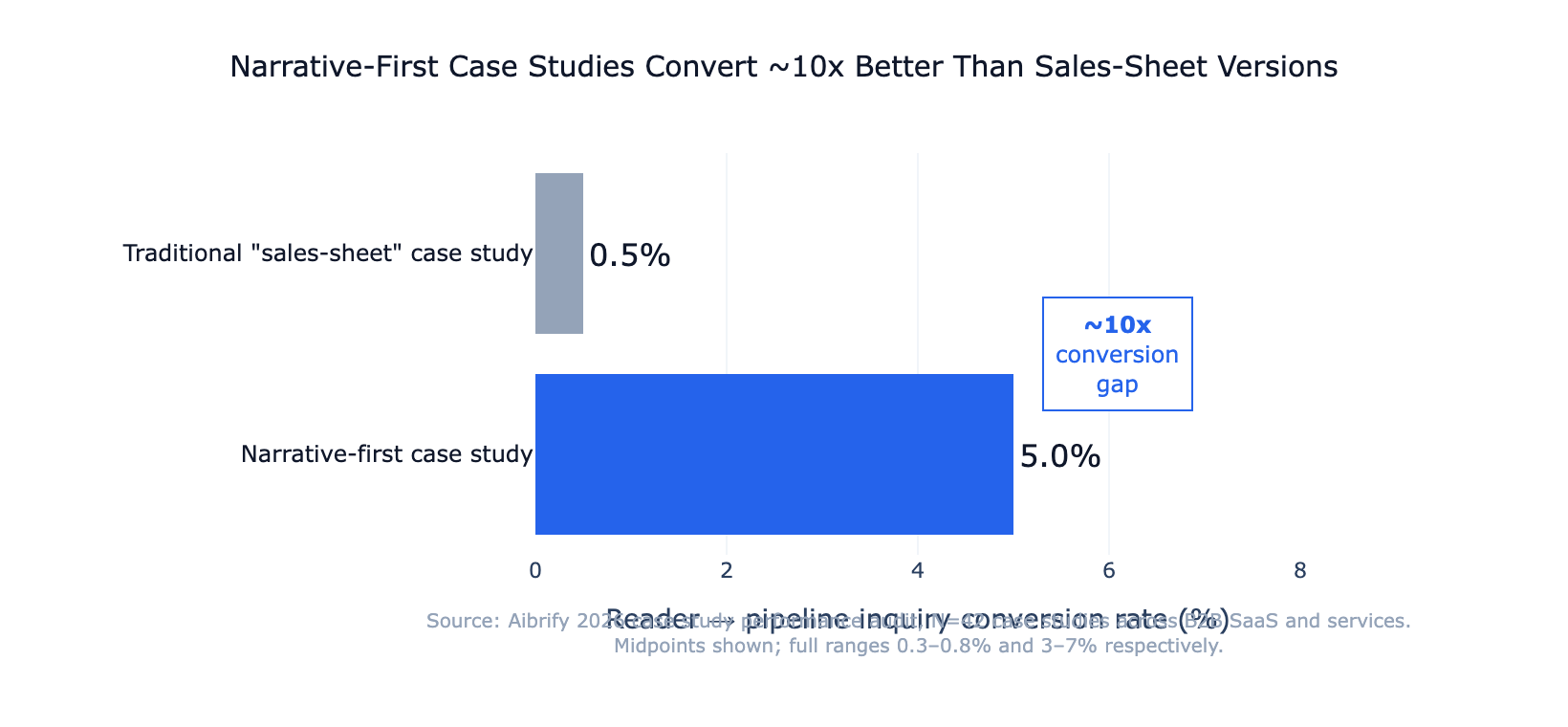
This framework walks through the four structural choices that separate case studies prospects finish from case studies they skim in 20 seconds. It is specific enough to follow on the next case study and generic enough to apply across industries.
Structure: 40% problem, 30% solution, 20% results, 10% implications
Most failed case studies invert this ratio — 10% problem, 60% solution, 30% results. The reader never sees themselves in the story.
Problem section (600 words for a 1,500-word case). Name the specific pain in the customer's language. Describe what they tried before that did not work. Quantify the stakes of not solving it. Do not mention the product.
Solution section (450 words). Frame as 4–6 decisions the customer made, not features of the product. Product mentions happen inside the decisions, incidentally.
Results section (300 words). Lead with the most contested metric. Include one metric that did not improve. Explain the causal chain in one paragraph.
Implications section (150 words). What does the story suggest for readers in similar situations? What is the transferable lesson? This is where the prospect connects the dots to their own context.
The discipline — do not mention the product until word 500 — is what makes this structure work. It forces the writer to treat the problem as load-bearing narrative rather than a 30-second setup for the product pitch.
The interview protocol that produces authentic quotes
Quotes are where case studies most often break. Generic language ("improved our workflow," "saved us time") reads as scripted. Specific, slightly rough language ("we were three weeks into the migration and it was falling apart") reads as real.
The difference is not in the editing. It is in how the quote was produced.
Record a 45-minute interview, not a 10-minute approval call. The shorter the interview, the more polished the quotes. 45 minutes gives the customer time to talk about what failed, what worried them, and what the first month looked like internally. These are the quotes that convert.
Do not send questions in advance. Scripted answers are polite; unscripted answers are specific. The customer who is told "I'll ask about your onboarding experience" on the phone produces better material than the customer who prepared a response.
Ask four specific questions. What did you try before us that did not work? What were you afraid would happen if you did not solve this? What did month one look like internally? What specific moment convinced you this was working? These questions produce quotes no marketing team can invent.
Let a professional writer run the interview, not a product manager. Product managers ask leading questions about their product. Writers ask about the customer's situation. The difference in output quality is substantial.
The goal of the interview is raw material. A good writer extracts 6–10 usable quotes from a 45-minute recording. Of those, 3–5 end up in the final case study — in their original, slightly rough form.
Leading the results with the contested metric
The metric that invited skepticism is the metric that convinces. "Reduced onboarding time by 25%" reads as ad copy because the percentage hides the baseline. "Cut onboarding time from 8 weeks to 6 weeks" reads as real because the numbers are specific.
Research from Forrester's B2B buyer behavior reports points to this tension directly: prospects discount content that reads as uniformly positive. The 2026 results section follows a three-part structure:
Start with the contested metric. The one an internal reviewer pushed back on. The one that seemed too good to be true until the baseline was specified.
Include one metric that did not improve. A retention rate that stayed flat. A support ticket volume that was unchanged. A cost per acquisition that did not move. This single detail does more for credibility than any testimonial — because case studies without tradeoffs read as sanitized.
Close with the causal chain. One paragraph that names what changed, why that change mattered, and what the customer did differently because of it. Numbers without causality read as sales sheets; causality without numbers reads as a story; both together is a case study.
A results section that leads with "3x faster," includes only upside metrics, and has no causality is indistinguishable from product marketing copy. A results section that leads with a specific baseline, acknowledges an unchanged metric, and explains the causal chain reads as evidence.
How to present a case study for different decision stages
Different readers at different decision stages need different formats of the same story.
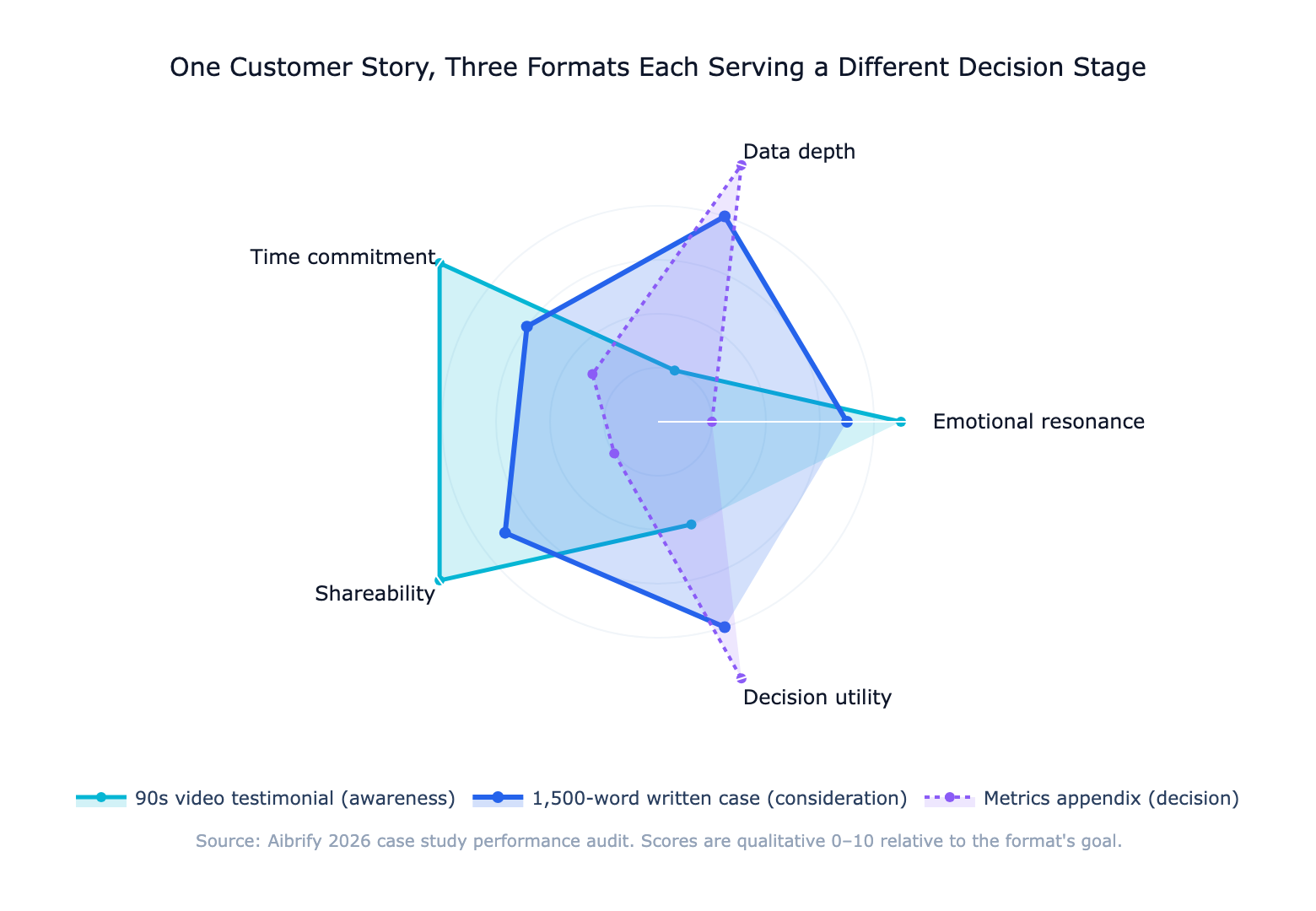
Awareness stage: a 90-second video testimonial. The customer on camera, named and visible, saying one sentence each about the problem, the solution, and the result. Per HubSpot's research on video testimonials, short video testimonials convert highest when deployed at the awareness stage, not the decision stage. Use on social and the homepage. Not a full case study — a door-opener.
Consideration stage: the 1,500-word written case. The full story with the 40/30/20/10 structure. This is what prospects read when they are comparing options and want evidence.
Decision stage: the metrics appendix. The raw numbers, the timeline, the exact configuration the customer used, the customer's contact for reference calls. This is what a buyer forwards to their finance team or their CEO.
One customer story, three formats, each serving a different decision stage. Teams that only produce the middle format leave awareness and decision-stage opportunity untapped.
The customer review that turns them into a second case study
The final step — sending the full draft to the customer for approval before publishing — is the step most teams compress or skip. It is also the step that determines whether the customer agrees to a second case study in the future.
Send the full draft, not just quotes. Customers catch internal-facing details, confidential numbers, and tone issues that no internal reviewer sees. Their feedback improves the piece; the review itself is also a trust signal for future collaboration.
Give them two business days and an explicit prompt. "What would you change?" gets better feedback than "let me know if this is OK." Make it easy to push back.
Accept the veto, even if it hurts. A customer who asks for a specific metric to be removed or a quote softened is almost always right. Pushing back turns the customer from advocate to hostage. Removing the metric costs one case study worth of conversion; pushing back costs the next three.
Close the loop after publish. Send the customer the published URL, the traffic numbers after two weeks, and an explicit thank-you. Customers who see the case study performed well are the customers who say yes to round two — and round two is cheaper to produce than round one because the relationship already exists.
What this looks like in practice
A case study produced under this framework takes 6–10 hours of work: 1 hour to schedule and prepare, 45 minutes to interview, 1 hour to transcribe and select quotes, 3–4 hours to draft, 1 hour for customer review cycle, 1 hour for final polish. The output is a 1,500-word written piece, a 90-second cut for social, and a metrics appendix.
At a production rate of two case studies per month and conversion rates of 3–7% on the resulting content, a year of disciplined case study production typically produces more qualified pipeline than a year of paid social at equivalent cost — with the advantage that each case study keeps working for 2–3 years. G2's buyer intent research similarly shows case studies and customer stories as the highest-weighted decision-stage content across B2B software categories.
The economics are not the argument for this framework. The argument is that case studies are the single piece of content prospects trust most, and the industry default of "sales sheet dressed up as a story" is converting below the floor of what is achievable. Fixing the structure, the quotes, and the results section is a tractable, repeatable editorial change.
The bottom line
A case study that converts 3–7% of readers is not harder to produce than one that converts 0.3%. It is produced under a different framework — 40% problem, decisions-not-features, contested metric first, quotes from an unscripted interview.
The time cost is 6–10 hours per case. The conversion lift is 10–20x. The compounding effect is that a library of 12 well-written case studies outperforms a library of 40 sales-sheet versions at every stage of the buyer journey.
The next case study is the one where the framework produces the first measurable lift. After that, the difference in conversion makes the 6–10 hours look small.
Start the interview before you start the draft. Write the problem first.
Lead the results with the metric you doubted. Let the customer approve the whole thing. Ship.
Aibrify is a done-for-you social media management service. The case studies we publish with clients follow this framework — problem-first, decisions-over-features, contested metric leading the results — because the readers they are written for are the same readers who will judge any case study in their feed the same way.


